Homeschool Daily Grade 5 / Grade 5
Grade 5 Complete Homeschool
A complete grade-level pack across four core subjects, with a clear lesson-by-lesson learning path.
WHAT’S INSIDE
Know what you’ll learn.
Explore the lessons in this pack.
Open a topic for a closer look.
01 Language Arts Evidence That Answers the Claim
Locate a quotation supporting an explicit claim. Explain how the quotation supports that claim.
Topic reference: HD.G5.LA.001
02 Math Tenfold Steps Across Places
Compare a digit's value in adjacent places. Explain a tenfold relationship using a place-value model.
Topic reference: HD.G5.MATH.001
03 Science Properties We Can Measure
Distinguish a material observation from an inference. Select a tool for measuring a relevant property.
Topic reference: HD.G5.SCI.001
04 Language Arts Reading Between Stated Details
Infer a character's concern from textual clues. Identify the details supporting the inference.
Topic reference: HD.G5.LA.002
05 Math One Tenth of a Place Value
Identify a digit value one place to the right. Express the relationship as one tenth of the original value.
Topic reference: HD.G5.MATH.002
06 Social Studies Questions Guide a Social Inquiry
Identify a focused question about a community or past event. Select the kinds of sources needed to investigate it.
Topic reference: HD.G5.SS.001
07 Language Arts Quoting Without Changing Meaning
Select a quotation that preserves the speaker's meaning. Distinguish an accurate quotation from a misleading excerpt.
Topic reference: HD.G5.LA.003
08 Math Whole and Decimal Places Connect
Locate ones, tenths, and hundredths on a chart. Explain the relationship between consecutive places.
Topic reference: HD.G5.MATH.003
09 Science Comparisons Need Consistent Units
Record material measurements in consistent units. Compare observations collected with the same procedure.
Topic reference: HD.G5.SCI.002
10 Language Arts When Evidence Does Not Fit
Identify a detail that challenges an inference. Revise an inference to account for that detail.
Topic reference: HD.G5.LA.004
11 Math Tracing a Digit Through Several Places
Determine a digit's value after a place shift. Justify the change using repeated tenfold relationships.
Topic reference: HD.G5.MATH.004
12 Social Studies Gathering Relevant Evidence
Gather information relevant to an inquiry question. Distinguish useful evidence from an unrelated fact.
Topic reference: HD.G5.SS.002
13 Language Arts Choices Reveal Character
Infer a character trait from an action. Distinguish a lasting trait from a temporary emotion.
Topic reference: HD.G5.LA.005
14 Math Powers Written With Exponents
Express repeated multiplication by ten using an exponent. Interpret a whole-number power of ten.
Topic reference: HD.G5.MATH.005
15 Science Several Clues Identify a Material
Use multiple properties to distinguish materials. Explain why a single shared property is insufficient.
Topic reference: HD.G5.SCI.003
16 Language Arts Two Responses to One Challenge
Compare two characters' responses to a shared problem. Support the comparison with details about their actions.
Topic reference: HD.G5.LA.006
17 Math Whole Numbers Times Powers of Ten
Multiply a whole number by a power of ten. Explain the product using place value.
Topic reference: HD.G5.MATH.006
18 Social Studies Maps Represent Places Selectively
Construct a map with an appropriate legend. Explain what its symbols represent.
Topic reference: HD.G5.SS.003
19 Language Arts Setting Changes the Possibilities
Compare two settings within a story. Explain how each setting affects a character's choices.
Topic reference: HD.G5.LA.007
20 Math Decimals Times Powers of Ten
Multiply a decimal by a power of ten. Explain the resulting digit positions.
Topic reference: HD.G5.MATH.007
21 Science Solubility as Evidence
Compare materials using observations of dissolving. Identify which observation supports a material identification.
Topic reference: HD.G5.SCI.004
22 Language Arts Interactions Change Events
Identify an interaction that redirects a plot. Explain the resulting change using textual evidence.
Topic reference: HD.G5.LA.008
23 Math Dividing by Powers of Ten
Divide a number by a power of ten. Check the quotient using a place-value relationship.
Topic reference: HD.G5.MATH.008
24 Social Studies Scale Changes What a Map Shows
Compare maps of the same place at different scales. Explain a difference in visible geographic detail.
Topic reference: HD.G5.SS.004
25 Language Arts From Topic to Theme
Distinguish a topic from a thematic statement. Connect a thematic statement to a character's response.
Topic reference: HD.G5.LA.009
26 Math Naming Thousandths
Read a decimal through thousandths. Identify the value represented by each digit.
Topic reference: HD.G5.MATH.009
27 Science Testing a Material's Responses
Compare materials using conductivity or magnetic response. Organize the results in a property table.
Topic reference: HD.G5.SCI.005
28 Language Arts A Theme Across the Story
Trace evidence for a theme across separate events. Reject a theme contradicted by the ending.
Topic reference: HD.G5.LA.010
29 Math Decimal Forms Tell the Same Value
Write a decimal in expanded form. Match expanded and standard forms of the same number.
Topic reference: HD.G5.MATH.010
30 Social Studies Land and Water Shape North America
Locate major physical features using a map. Explain a relationship between a feature and a nearby region.
Topic reference: HD.G5.SS.005
31 Language Arts Summaries Keep the Essential
Identify events essential to a story summary. Produce a brief summary without personal judgments.
Topic reference: HD.G5.LA.011
32 Math Comparing Decimals by Place
Compare decimals through thousandths with a symbol. Justify the comparison at the first differing place.
Topic reference: HD.G5.MATH.011
33 Science Identifying an Unknown From Data
Identify an unknown material from measured properties. Justify the identification with converging evidence.
Topic reference: HD.G5.SCI.006
34 Language Arts More Than One Supported Message
Identify two themes supported by a story. Assign separate textual evidence to each theme.
Topic reference: HD.G5.LA.012
35 Math Ordering Values on a Number Line
Order a set of decimals. Locate the ordered values on a scaled number line.
Topic reference: HD.G5.MATH.012
36 Social Studies Environment and Regional Patterns
Compare environmental characteristics of two regions. Support the comparison with geographic representations.
Topic reference: HD.G5.SS.006
37 Language Arts Whose Knowledge Shapes the Story
Identify what a narrator knows about an event. Distinguish narrator knowledge from reader inference.
Topic reference: HD.G5.LA.013
38 Math Rounding to a Whole
Locate a decimal between consecutive whole numbers. Round it using the midpoint as evidence.
Topic reference: HD.G5.MATH.013
39 Science Evidence for Unseen Matter
Identify observations showing that air occupies space. Represent unseen matter with a particle model.
Topic reference: HD.G5.SCI.007
40 Language Arts Words Reveal a Narrator's Stance
Locate wording that signals a narrator's attitude. Explain its effect on the description of an event.
Topic reference: HD.G5.LA.014
41 Math Rounding to Tenths
Identify the adjacent tenths surrounding a decimal. Select the nearest tenth using a number line.
Topic reference: HD.G5.MATH.014
42 Social Studies Resources and Ways of Living
Explain how cultural practices influence regional use of the environment. Identify evidence of different human responses to similar conditions.
Topic reference: HD.G5.SS.007
43 Language Arts One Event Through Two Voices
Compare accounts of an event by different narrators. Explain how perspective changes the emphasized details.
Topic reference: HD.G5.LA.015
44 Math Rounding to Hundredths
Round a decimal to the nearest hundredth. Explain the decision using thousandths.
Topic reference: HD.G5.MATH.015
45 Science Models Have Useful Limits
Explain what a particle model represents. Identify a feature that should not be taken literally.
Topic reference: HD.G5.SCI.008
46 Language Arts A Speaker's View in Poetry
Infer a poem speaker's attitude toward a topic. Support that inference with the speaker's language.
Topic reference: HD.G5.LA.016
47 Math Choosing Useful Precision
Select an appropriate rounding place for a context. Explain how rounding affects an estimate.
Topic reference: HD.G5.MATH.016
48 Social Studies People Change Their Surroundings
Describe a human modification of an environment over time. Explain how the place's characteristics changed after that modification.
Topic reference: HD.G5.SS.008
49 Language Arts Comparisons Beneath the Words
Interpret a simile within its sentence. Explain the shared quality in the comparison.
Topic reference: HD.G5.LA.017
50 Math Products Built From Parts
Decompose a multi-digit factor by place value. Combine partial products into a complete product.
Topic reference: HD.G5.MATH.017
51 Science Matter After Dissolving
Use a model to account for dissolved material. Connect the model to observable recovery evidence.
Topic reference: HD.G5.SCI.009
52 Language Arts Metaphors Shape an Impression
Interpret a metaphor in a literary passage. Explain how it affects the reader's impression.
Topic reference: HD.G5.LA.018
53 Math The Algorithm Matches the Model
Connect a standard-algorithm row to an area-model region. Explain the place value of that row.
Topic reference: HD.G5.MATH.018
54 Social Studies States Within a National Map
Locate states within United States regions. Explain how state boundaries differ from regional groupings.
Topic reference: HD.G5.SS.009
55 Language Arts Context Changes a Word
Determine a word's meaning in a story. Identify context that rules out another meaning.
Topic reference: HD.G5.LA.019
56 Math Multiplying With Regrouping
Multiply multi-digit whole numbers with regrouping. Track each regrouped value to its destination place.
Topic reference: HD.G5.MATH.019
57 Science Compression Without Losing Matter
Model air before and after compression. Explain a changed volume without removing particles.
Topic reference: HD.G5.SCI.010
58 Language Arts Figurative Language and Mood
Identify figurative wording that builds a mood. Explain the connection between wording and mood.
Topic reference: HD.G5.LA.020
59 Math Zero Inside a Factor
Multiply a whole number containing an internal zero. Explain why a zero-valued partial product occupies a place.
Topic reference: HD.G5.MATH.020
60 Social Studies Capitals, Cities, and Insets
Distinguish a state capital from another major city. Interpret the location information provided by an inset map.
Topic reference: HD.G5.SS.010
61 Language Arts Why a Chapter Belongs Here
Identify a chapter's role in a story's development. Explain its connection to the preceding chapter.
Topic reference: HD.G5.LA.021
62 Math Estimating a Large Product
Estimate a multi-digit product using rounded factors. Use the estimate to assess a calculated product.
Topic reference: HD.G5.MATH.021
63 Science Measuring Before and After a Change
Compare total weights before and after a closed-system change. Represent the comparison in a graph.
Topic reference: HD.G5.SCI.011
64 Language Arts Scenes Build a Drama
Identify a scene that introduces a conflict. Explain how a later scene develops that conflict.
Topic reference: HD.G5.LA.022
65 Math Finding a Shifted Partial Product
Identify a place-value error in multiplication. Correct the product with a labeled algorithm.
Topic reference: HD.G5.MATH.022
66 Social Studies Why Communities Grow in Particular Places
Explain a settlement pattern using environmental and cultural factors. Support the explanation with map evidence.
Topic reference: HD.G5.SS.011
67 Language Arts Stanzas Build a Poem
Describe the focus of individual stanzas. Explain how their order develops the poem's idea.
Topic reference: HD.G5.LA.023
68 Math Multiplication in Equal-Group Contexts
Represent an equal-group situation with multiplication. Compute the total using the standard algorithm.
Topic reference: HD.G5.MATH.023
69 Science Changes of Form and Conserved Matter
Explain conservation during a change of state. Support the explanation with measured evidence.
Topic reference: HD.G5.SCI.012
70 Language Arts An Ending Connects the Parts
Explain how an ending resolves earlier developments. Identify an earlier detail that prepares the resolution.
Topic reference: HD.G5.LA.024
71 Math Selecting an Efficient Product Check
Check a multi-digit product by decomposition. Explain agreement between two computation methods.
Topic reference: HD.G5.MATH.024
72 Social Studies Routes Connect Communities
Trace movement of people or goods along a route. Explain how a route connects settlements with needed natural resources.
Topic reference: HD.G5.SS.012
73 Language Arts Pictures Add Information
Identify information supplied by an illustration. Explain its contribution to a literary text's meaning.
Topic reference: HD.G5.LA.025
74 Math Two-Digit Divisors as Equal Groups
Represent division by a two-digit divisor. Interpret the quotient in an equal-group context.
Topic reference: HD.G5.MATH.025
75 Science Mixing Within a Closed System
Determine the total weight of a closed mixing system. Explain why all components must be included.
Topic reference: HD.G5.SCI.013
76 Language Arts Visual Choices Set a Tone
Describe how color or composition affects tone. Connect that effect to evidence in the accompanying text.
Topic reference: HD.G5.LA.026
77 Math Estimating the Number of Groups
Estimate a quotient using compatible numbers. Use the estimate to choose a reasonable first partial quotient.
Topic reference: HD.G5.MATH.026
78 Social Studies Many Indigenous Nations
Distinguish specific Indigenous communities using reliable sources. Compare a documented past practice with contemporary continuity.
Topic reference: HD.G5.SS.013
79 Language Arts Two Adventures and a Shared Theme
Compare treatments of a theme in adventure stories. Identify a difference in how characters respond to danger.
Topic reference: HD.G5.LA.027
80 Math Building a Quotient in Chunks
Divide a whole number using partial quotients. Explain why the partial quotients can be combined.
Topic reference: HD.G5.MATH.027
81 Science When a Measurement Seems to Lose Matter
Identify how an open system affects a weight comparison. Propose a measurement change that accounts for escaping matter.
Topic reference: HD.G5.SCI.014
82 Language Arts Mysteries With Different Messages
Compare approaches to a shared topic in mysteries. Support a thematic contrast with details from both stories.
Topic reference: HD.G5.LA.028
83 Math An Area Model for Division
Find a missing rectangle dimension using division. Relate the area model to a partial-quotient calculation.
Topic reference: HD.G5.MATH.028
84 Social Studies Homelands and Adaptation
Explain how a nation's cultural practices shaped adaptation to its homeland. Identify evidence without treating environment as the sole cultural cause.
Topic reference: HD.G5.SS.014
85 Language Arts Two Main Ideas in One Article
Identify two main ideas in an article. Assign relevant details to each main idea.
Topic reference: HD.G5.LA.029
86 Math Four-Digit Dividends
Divide a four-digit dividend by a two-digit divisor. Check the quotient with multiplication.
Topic reference: HD.G5.MATH.029
87 Science Evidence of a New Substance
Compare properties before and after mixing. Identify evidence consistent with new-substance formation.
Topic reference: HD.G5.SCI.015
88 Language Arts Details Carry Different Weight
Distinguish central evidence from interesting minor details. Explain which main idea a selected detail supports.
Topic reference: HD.G5.LA.030
89 Math Zeros Within a Quotient
Determine a quotient containing a zero place. Explain the zero using the dividend's place values.
Topic reference: HD.G5.MATH.030
90 Social Studies Sources for Indigenous Histories
Explain how oral histories and material sources inform history. Identify the contribution of a source from an Indigenous perspective.
Topic reference: HD.G5.SS.015
91 Language Arts Evidence for an Informational Inference
Infer an unstated connection in an article. Support the inference with an accurate quotation.
Topic reference: HD.G5.LA.031
92 Math Remainders Have Meanings
Interpret a remainder in a practical situation. Decide whether the situation requires rounding up or retaining leftovers.
Topic reference: HD.G5.MATH.031
93 Science A Fair Investigation of Mixing
Plan a controlled investigation of mixed materials. Specify observations needed to evaluate the result.
Topic reference: HD.G5.SCI.016
94 Language Arts Summarizing Several Main Ideas
State the main ideas of an informational text. Compose a concise summary preserving their relationship.
Topic reference: HD.G5.LA.032
95 Math Repairing a Division Argument
Identify an incorrect partial quotient. Correct it using multiplication and subtraction evidence.
Topic reference: HD.G5.MATH.032
96 Social Studies Comparing Accounts of Community Life
Compare information from two historical sources. Identify agreement and a question requiring further evidence.
Topic reference: HD.G5.SS.016
97 Language Arts Connections Among Historical Events
Explain a relationship between two historical events. Identify text evidence establishing that relationship.
Topic reference: HD.G5.LA.033
98 Math Combining Decimal Units
Add decimals to hundredths using a model. Explain why equal place-value units must align.
Topic reference: HD.G5.MATH.033
99 Science Repeated Observations Strengthen a Claim
Compare observations across repeated mixing trials. Distinguish consistent evidence from an isolated result.
Topic reference: HD.G5.SCI.017
100 Language Arts People and Ideas Influence Each Other
Describe how a person's action advances an idea. Support the explanation with informational text details.
Topic reference: HD.G5.LA.034
101 Math Decimal Sums With Regrouping
Compute a decimal sum requiring regrouping. Explain a regrouped unit with base-ten relationships.
Topic reference: HD.G5.MATH.034
102 Social Studies Motives Behind Atlantic Voyages
Explain multiple reasons for European Atlantic exploration. Connect a voyage route to a stated historical objective.
Topic reference: HD.G5.SS.017
103 Language Arts Steps in a Scientific Process
Explain the relationship between stages of a process. Identify what would be missing if a stage were omitted.
Topic reference: HD.G5.LA.035
104 Math Subtracting Decimal Quantities
Subtract decimals to hundredths using a number line. Check the difference by addition.
Topic reference: HD.G5.MATH.035
105 Science Explaining a Mixing Investigation
State a claim about whether new substances formed. Support the claim with measured or observed properties.
Topic reference: HD.G5.SCI.018
106 Language Arts Cause Needs Evidence
Distinguish a causal explanation from a sequence. Identify details supporting a proposed cause.
Topic reference: HD.G5.LA.036
107 Math Regrouping Across Decimal Places
Subtract decimals requiring regrouping. Explain how equivalent decimal notation supports the subtraction.
Topic reference: HD.G5.MATH.036
108 Social Studies Exchange With Unequal Consequences
Trace how a geographic feature affected movement of people or goods after contact. Explain differing consequences for affected communities.
Topic reference: HD.G5.SS.018
109 Language Arts Two Ways to Organize Information
Identify the structures of two texts on one topic. Explain how each structure organizes the details.
Topic reference: HD.G5.LA.037
110 Math A Decimal Repeated Several Times
Multiply a decimal by a whole number. Connect the product to equal groups.
Topic reference: HD.G5.MATH.037
111 Science Where Growing Plants Get Material
Identify air and water as principal material sources for plant growth. Distinguish those sources from soil's supporting role.
Topic reference: HD.G5.SCI.019
112 Language Arts Comparisons Versus Causes
Distinguish comparison structure from cause and effect. Cite relationships supporting the structural classification.
Topic reference: HD.G5.LA.038
113 Math Tenths Times Tenths
Model the product of two tenths-based decimals. Explain why the product is measured in hundredths.
Topic reference: HD.G5.MATH.038
114 Social Studies Contact Through Different Perspectives
Compare accounts of contact from distinct perspectives. Explain how experience shaped what each account emphasized.
Topic reference: HD.G5.SS.019
115 Language Arts Problems and Sequences
Compare a problem-solution text with a sequential account. Explain how structure changes the reader's focus.
Topic reference: HD.G5.LA.039
116 Math Decimal Products by Place Value
Compute a decimal product to hundredths. Justify the decimal placement using a model.
Topic reference: HD.G5.MATH.039
117 Science Evidence About Plant Growth
Compare plant-growth evidence with changes in supplied materials. Use the evidence to evaluate a soil-only explanation.
Topic reference: HD.G5.SCI.020
118 Language Arts Choosing an Organization for a Purpose
Compare the usefulness of two text structures. Support a choice using the information being communicated.
Topic reference: HD.G5.LA.040
119 Math Checking a Decimal Product
Estimate the size of a decimal product. Correct a product with an unreasonable place value.
Topic reference: HD.G5.MATH.040
120 Social Studies Cooperation, Conflict, and Evidence
Identify evidence of cooperation or conflict in early contact. Distinguish a supported claim from a broad stereotype.
Topic reference: HD.G5.SS.020
121 Language Arts An Account Has a Viewpoint
Identify an account's point of view. Connect selected details to the writer's perspective.
Topic reference: HD.G5.LA.041
122 Math Sharing a Decimal Amount
Divide a decimal by a whole number. Interpret the quotient as an equal share.
Topic reference: HD.G5.MATH.041
123 Science Separating Materials From Energy
Distinguish material inputs from a plant's energy input. Explain why light is not counted as plant-building matter.
Topic reference: HD.G5.SCI.021
124 Language Arts Accounts Agree and Diverge
Compare two accounts of one event. Identify evidence explaining a difference in focus.
Topic reference: HD.G5.LA.042
125 Math Counting Decimal-Sized Groups
Divide by a decimal through a measurement model. Explain what the quotient counts.
Topic reference: HD.G5.MATH.042
126 Social Studies Jamestown's Challenges
Explain a challenge faced by early Jamestown settlers. Connect an attempted response to geographic or historical evidence.
Topic reference: HD.G5.SS.021
127 Language Arts Reasons Support Particular Claims
Match a reason to the claim it supports. Explain the relationship between that reason and claim.
Topic reference: HD.G5.LA.043
128 Math Equivalent Division Expressions
Scale dividend and divisor by the same power of ten. Explain why the quotient stays unchanged.
Topic reference: HD.G5.MATH.043
129 Science An Argument About Plant Materials
Construct an evidence-based claim about plant material sources. Identify evidence that challenges an alternative explanation.
Topic reference: HD.G5.SCI.022
130 Language Arts Testing an Author's Evidence
Identify evidence relevant to an author's point. Explain why an unrelated detail fails to support it.
Topic reference: HD.G5.LA.044
131 Math Decimal Division With a Check
Compute a decimal quotient to hundredths. Verify it through multiplication.
Topic reference: HD.G5.MATH.044
132 Social Studies New England Settlement Purposes
Identify purposes behind early New England settlements. Compare them with purposes of another English settlement.
Topic reference: HD.G5.SS.022
133 Language Arts Technical Words in Context
Infer a domain-specific word's meaning from context. Confirm the meaning with a relevant reference entry.
Topic reference: HD.G5.LA.045
134 Math Decimal Operations in a Budget
Select operations for a fixed-price budget situation. Compute the remaining or required amount.
Topic reference: HD.G5.MATH.045
135 Science Tracing Food Energy to Sunlight
Trace energy from sunlight through plants to animal food. Interpret the direction of arrows in an energy model.
Topic reference: HD.G5.SCI.023
136 Language Arts Answering With a Diagram
Locate information in a labeled diagram. Combine it with text to answer a focused question.
Topic reference: HD.G5.LA.046
137 Math Comparing Decimal Strategies
Compare two valid decimal computation strategies. Explain the place-value reasoning shared by them.
Topic reference: HD.G5.MATH.046
138 Social Studies Regional Economies in the Colonies
Compare production in two colonial regions. Explain how cultural practices and resources shaped regional production.
Topic reference: HD.G5.SS.023
139 Language Arts Finding Evidence Efficiently
Select a source feature suited to a research question. Locate relevant information without reading unrelated sections.
Topic reference: HD.G5.LA.047
140 Math Two Steps With Decimal Measures
Represent a two-step measurement situation. Solve it with decimal operations and labeled units.
Topic reference: HD.G5.MATH.047
141 Science Food Energy Supports Animal Functions
Identify animal functions supported by food energy. Connect one function to the model's original energy source.
Topic reference: HD.G5.SCI.024
142 Language Arts Several Sources, One Explanation
Identify complementary information in two sources. Integrate that information into a coherent explanation.
Topic reference: HD.G5.LA.048
143 Math Finding an Implausible Decimal Result
Identify an unreasonable decimal answer. Repair the computation using an estimate and model.
Topic reference: HD.G5.MATH.048
144 Social Studies Labor Behind Colonial Goods
Identify forms of labor supporting colonial production. Distinguish paid work, indentured labor, and enslaved labor.
Topic reference: HD.G5.SS.024
145 Language Arts A Situation Worth Following
Establish a clear opening situation for a narrative. Introduce a narrator appropriate to that situation.
Topic reference: HD.G5.LA.049
146 Math Equivalent Units Before Combining
Represent equivalent fractions using equal wholes. Rename two fractions with a shared denominator.
Topic reference: HD.G5.MATH.049
147 Science Different Foods, a Shared Energy Origin
Compare energy pathways for animals with different diets. Identify the sunlight connection in each pathway.
Topic reference: HD.G5.SCI.025
148 Language Arts Events With a Logical Path
Arrange narrative events in a coherent sequence. Identify a missing connection between events.
Topic reference: HD.G5.LA.050
149 Math Adding Unlike Fraction Units
Add fractions with unlike denominators. Explain why the renamed units can be combined.
Topic reference: HD.G5.MATH.050
150 Social Studies Lives Under Enslavement
Use historical evidence to describe constraints imposed by slavery. Identify documented examples of resistance or community building.
Topic reference: HD.G5.SS.025
151 Language Arts Dialogue Moves a Scene
Use dialogue to reveal a character's response. Explain how the dialogue advances a scene.
Topic reference: HD.G5.LA.051
152 Math Subtracting Unlike Fraction Units
Subtract fractions with unlike denominators. Check the difference with a fraction model.
Topic reference: HD.G5.MATH.051
153 Science Repairing an Energy Model
Identify a missing or reversed energy-flow arrow. Revise the model using evidence about feeding relationships.
Topic reference: HD.G5.SCI.026
154 Language Arts Pacing a Turning Point
Identify an event that deserves elaboration. Revise its pacing through selected descriptive detail.
Topic reference: HD.G5.LA.052
155 Math Choosing a Helpful Common Unit
Select a common denominator for two fractions. Explain why different valid common denominators give equivalent results.
Topic reference: HD.G5.MATH.052
156 Social Studies Voices Often Left Out
Identify perspectives missing from a colonial account. Select a source that could broaden the account.
Topic reference: HD.G5.SS.026
157 Language Arts Sensory Detail With a Purpose
Select sensory details supporting a narrative moment. Remove details that distract from its focus.
Topic reference: HD.G5.LA.053
158 Math Adding Mixed Amounts
Add mixed numbers with unlike denominators. Express the result in an equivalent mixed-number form.
Topic reference: HD.G5.MATH.053
159 Science Living Roles in a Matter System
Distinguish producers, consumers, and decomposers in a system. Identify the matter transfers connecting those roles.
Topic reference: HD.G5.SCI.027
160 Language Arts Transitions Keep Time Clear
Use transitions to clarify a narrative sequence. Correct an ambiguous shift in time.
Topic reference: HD.G5.LA.054
161 Math Subtracting Mixed Amounts
Subtract mixed numbers with unlike denominators. Check the difference using addition.
Topic reference: HD.G5.MATH.054
162 Social Studies Colonial Rules and Representation
Explain a dispute over colonial authority or representation. Identify the competing claims involved.
Topic reference: HD.G5.SS.027
163 Language Arts An Ending That Follows
Draft an ending connected to the preceding events. Explain how it resolves the central situation.
Topic reference: HD.G5.LA.055
164 Math Trading a Whole for Fraction Units
Rename a mixed number to enable subtraction. Explain the trade with a fraction model.
Topic reference: HD.G5.MATH.055
165 Science Decomposers Return Materials
Model matter moving through decomposition. Explain how decomposed materials reenter the environment.
Topic reference: HD.G5.SCI.028
166 Language Arts Revising the Whole Narrative
Identify a coherence problem in a narrative draft. Revise the draft to resolve that problem.
Topic reference: HD.G5.LA.056
167 Math Repairing Mixed-Number Arithmetic
Locate an error in mixed-number addition or subtraction. Correct it while preserving equivalent quantities.
Topic reference: HD.G5.MATH.056
168 Social Studies From New Taxes to Protest
Explain a connection between a British policy and colonial protest. Support the explanation with historical evidence.
Topic reference: HD.G5.SS.028
169 Language Arts An Opinion With a Clear Focus
State an opinion suited to a specified audience. Distinguish it from a factual topic statement.
Topic reference: HD.G5.LA.057
170 Math Benchmarks Before Fraction Calculation
Estimate a fraction sum using benchmark values. Judge whether an exact result is reasonable.
Topic reference: HD.G5.MATH.057
171 Science Matter Moves Beyond Food Links
Add air, water, and soil to an ecosystem model. Trace a matter pathway between living and nonliving components.
Topic reference: HD.G5.SCI.029
172 Language Arts Reasons That Advance the Opinion
Select reasons that support an opinion. Explain why an unrelated reason weakens the argument.
Topic reference: HD.G5.LA.058
173 Math Combining Measures of One Whole
Represent a fraction-addition situation with a model. Solve it using equivalent fractions.
Topic reference: HD.G5.MATH.058
174 Social Studies Different Choices About Independence
Compare reasons for Patriot and Loyalist positions. Explain why some people avoided either position.
Topic reference: HD.G5.SS.029
175 Language Arts Facts Behind the Reasons
Match evidence to a supporting reason. Distinguish relevant evidence from an unsupported assertion.
Topic reference: HD.G5.LA.059
176 Math How Much More of the Same Unit
Represent a fraction-comparison situation. Solve for the difference using subtraction.
Topic reference: HD.G5.MATH.059
177 Science Comparing Two Ecosystem Models
Compare matter movement in terrestrial and aquatic systems. Identify a relationship common to both models.
Topic reference: HD.G5.SCI.030
178 Language Arts Grouping Related Reasons
Organize reasons into logical groups. Explain how the grouping clarifies an opinion piece.
Topic reference: HD.G5.LA.060
179 Math Two Fraction Steps in Context
Write equations for a two-step fraction situation. Interpret the result using the original measurement unit.
Topic reference: HD.G5.MATH.060
180 Social Studies Conflict Becomes Revolution
Sequence developments leading to armed conflict. Explain more than one contributing cause.
Topic reference: HD.G5.SS.030
181 Language Arts Linking Reasons and Evidence
Use linking language to connect reasons with evidence. Clarify a weak connection in an opinion paragraph.
Topic reference: HD.G5.LA.061
182 Math Fractions Express Division
Interpret a fraction as a division expression. Match the expression to an equal-sharing model.
Topic reference: HD.G5.MATH.061
183 Science Changing One Part of an Ecosystem
Predict a matter-transfer effect of changing one system component. Support the prediction with a model pathway.
Topic reference: HD.G5.SCI.031
184 Language Arts Concluding Without Wandering
Write a conclusion related to the stated opinion. Remove an unsupported new argument from an ending.
Topic reference: HD.G5.LA.062
185 Math Sharing Fewer Wholes Than People
Divide whole objects into equal fractional shares. Verify that the shares recombine to the original amount.
Topic reference: HD.G5.MATH.062
186 Social Studies Ideas in the Declaration
Identify a central principle in the Declaration of Independence. Explain its purpose within the argument for independence.
Topic reference: HD.G5.SS.031
187 Language Arts Checking Support Across a Draft
Identify a reason that lacks supporting evidence. Specify the kind of evidence needed to strengthen it.
Topic reference: HD.G5.LA.063
188 Math Sharing More Wholes Than People
Express a whole-number quotient as a mixed number. Interpret the mixed number as an equal share.
Topic reference: HD.G5.MATH.063
189 Science Building a Complete Matter Model
Construct a model connecting organisms and environmental matter. Explain how the model accounts for recycled materials.
Topic reference: HD.G5.SCI.032
190 Language Arts An Opinion Ready for Readers
Revise an opinion draft for logical organization. Explain a revision that improves audience understanding.
Topic reference: HD.G5.LA.064
191 Math Locating a Fractional Quotient
Place a division result between consecutive whole numbers. Check that placement with multiplication.
Topic reference: HD.G5.MATH.064
192 Social Studies Promises and Exclusions
Compare a founding ideal with a documented historical exclusion. Identify evidence showing the gap between principle and practice.
Topic reference: HD.G5.SS.032
193 Language Arts An Explanation With Boundaries
State a focused topic for an informative piece. Distinguish relevant subtopics from unrelated ones.
Topic reference: HD.G5.LA.065
194 Math A Fraction of a Whole-Number Amount
Find a fractional part of a whole-number quantity. Explain the result using equal partitions.
Topic reference: HD.G5.MATH.065
195 Science Four Systems in One Place
Identify Earth's major systems in a landscape. Describe an interaction between two identified systems.
Topic reference: HD.G5.SCI.033
196 Language Arts Grouping Information for Readers
Organize information under useful headings. Explain how the headings support the topic's focus.
Topic reference: HD.G5.LA.066
197 Math Several Copies of a Fraction
Multiply a fraction by a whole number. Relate the computation to repeated equal groups.
Topic reference: HD.G5.MATH.066
198 Social Studies Turning Points in the War
Locate major Revolutionary developments on a timeline. Explain the significance of one turning point.
Topic reference: HD.G5.SS.033
199 Language Arts Definitions That Clarify
Define a technical term for a Grade 5 audience. Connect the definition to the explanation's topic.
Topic reference: HD.G5.LA.067
200 Math Two Orders, One Product
Compare a fraction-times-whole product with its reversed factors. Explain why the products are equal.
Topic reference: HD.G5.MATH.067
201 Science Water Changes Land
Model an interaction between water and land materials. Explain an observed landscape change using that interaction.
Topic reference: HD.G5.SCI.034
202 Language Arts Details That Develop a Topic
Select facts that elaborate an explanatory point. Identify where additional explanation is needed.
Topic reference: HD.G5.LA.068
203 Math Products Beyond One Whole
Compute a fraction product greater than one. Represent the result as a mixed quantity.
Topic reference: HD.G5.MATH.068
204 Social Studies Allies and Contributions
Identify contributions of different groups to the Revolution. Explain how an alliance influenced the war's outcome.
Topic reference: HD.G5.SS.034
205 Language Arts Precise Words for an Explanation
Replace vague wording with precise topic vocabulary. Check that the replacement preserves factual meaning.
Topic reference: HD.G5.LA.069
206 Math A Fraction of a Fraction
Represent one fractional part of another. Compute the product from the overlapping region.
Topic reference: HD.G5.MATH.069
207 Science Plants Connect Earth's Systems
Describe how vegetation interacts with land and water. Represent the interaction with labeled model connections.
Topic reference: HD.G5.SCI.035
208 Language Arts Linking Categories of Information
Use transitions between related subtopics. Explain the relationship signaled by a transition.
Topic reference: HD.G5.LA.070
209 Math Explaining Fraction Products
Multiply two fractions symbolically. Connect numerator and denominator products to a partitioned model.
Topic reference: HD.G5.MATH.070
210 Social Studies Governing After Independence
Describe a limitation of the Articles of Confederation. Explain a resulting challenge for the new nation.
Topic reference: HD.G5.SS.035
211 Language Arts An Image That Explains
Select a visual that clarifies an explanatory point. Specify labels connecting that visual to the text.
Topic reference: HD.G5.LA.071
212 Math Fractional Sides and Area
Find the area of a rectangle with fractional sides. Explain the area using unit-fraction tiles.
Topic reference: HD.G5.MATH.071
213 Science Air and Water at a Coast
Model interactions between atmosphere and hydrosphere. Explain an observable coastal effect of those interactions.
Topic reference: HD.G5.SCI.036
214 Language Arts Finishing an Informative Draft
Write a conclusion consistent with the explanation. Revise a passage that disrupts its logical organization.
Topic reference: HD.G5.LA.072
215 Math Checking Equivalent Area Models
Compare two partitions representing one fraction product. Explain why their shaded areas agree.
Topic reference: HD.G5.MATH.072
216 Social Studies Debating a New Constitution
Identify a problem considered at the Constitutional Convention. Explain how a proposed arrangement addressed that problem.
Topic reference: HD.G5.SS.036
217 Language Arts A Research Question Small Enough to Answer
Formulate a focused research question. Identify separate aspects requiring investigation.
Topic reference: HD.G5.LA.073
218 Math Scaling Down
Predict a product's size when a factor is less than one. Justify the prediction without computing the product.
Topic reference: HD.G5.MATH.073
219 Science Following Water Through a Watershed
Trace water movement through a watershed model. Identify the interacting Earth systems along the route.
Topic reference: HD.G5.SCI.037
220 Language Arts Sources for Different Parts of an Inquiry
Select sources relevant to different research aspects. Explain what information each source could contribute.
Topic reference: HD.G5.LA.074
221 Math Scaling Up
Predict a product's size when a factor exceeds one. Explain the comparison with a scaling model.
Topic reference: HD.G5.MATH.074
222 Social Studies Three Branches, Different Responsibilities
Distinguish legislative, executive, and judicial responsibilities. Match a governmental action to the responsible branch.
Topic reference: HD.G5.SS.037
223 Language Arts Notes in Your Own Words
Paraphrase a source idea without changing its meaning. Distinguish a paraphrase from copied wording.
Topic reference: HD.G5.LA.075
224 Math Multiplying by One in Disguise
Recognize a fraction equivalent to one. Explain why multiplying by it preserves a quantity.
Topic reference: HD.G5.MATH.075
225 Science Comparing Landscape Models
Compare interactions shown in two landscape models. Explain how a model change improves an observed relationship.
Topic reference: HD.G5.SCI.038
226 Language Arts Keeping Track of Sources
Record identifying information for a consulted source. Link research notes to the correct source record.
Topic reference: HD.G5.LA.076
227 Math Ordering Products Without Computing
Order products sharing one factor. Justify the order using the other factors' sizes.
Topic reference: HD.G5.MATH.076
228 Social Studies Powers Across Levels of Government
Compare responsibilities at national and state levels. Explain an example of shared or distinct authority.
Topic reference: HD.G5.SS.038
229 Language Arts Quotations Inside Research Writing
Incorporate a short quotation for a specific purpose. Identify its source in accompanying notes.
Topic reference: HD.G5.LA.077
230 Math Mixed Numbers as Factors
Convert a mixed number to an equivalent fraction. Use it to compute a fraction product.
Topic reference: HD.G5.MATH.077
231 Science Saltwater and Freshwater Reservoirs
Classify major water reservoirs by water type. Compare their relative amounts using supplied data.
Topic reference: HD.G5.SCI.039
232 Language Arts Reconciling Different Source Details
Identify an apparent disagreement between sources. Specify additional evidence needed to resolve it.
Topic reference: HD.G5.LA.078
233 Math Fractional Measures in Recipes
Represent a recipe-scaling situation with multiplication. Interpret the product in the stated units.
Topic reference: HD.G5.MATH.078
234 Social Studies Rights Protected in the Bill of Rights
Identify a protected freedom in an age-appropriate situation. Connect that freedom to a constitutional purpose.
Topic reference: HD.G5.SS.039
235 Language Arts Evidence From Literature
Support a literary analysis with textual evidence. Explain how each selected detail advances the analysis.
Topic reference: HD.G5.LA.079
236 Math Area With Mixed Dimensions
Compute a rectangular area with mixed-number sides. Check the result using decomposed areas.
Topic reference: HD.G5.MATH.079
237 Science Graphing Earth's Water
Construct a graph of water-reservoir quantities. Explain the distribution shown by the graph.
Topic reference: HD.G5.SCI.040
238 Language Arts Evidence From Informational Reading
Support an explanatory statement using source details. Distinguish source information from the writer's inference.
Topic reference: HD.G5.LA.080
239 Math Explaining a Fraction Product in Context
Select a model for a fraction-multiplication situation. Explain the meaning of the computed product.
Topic reference: HD.G5.MATH.080
240 Social Studies Rules, Freedoms, and Responsibilities
Explain how a rule protects a freedom or responsibility. Compare the effects of two possible rules.
Topic reference: HD.G5.SS.040
241 Language Arts Syllables Inside Unfamiliar Words
Divide an unfamiliar word into pronounceable syllables. Read the complete word using those syllables.
Topic reference: HD.G5.LA.081
242 Math Sharing One Fractional Unit
Divide a unit fraction by a nonzero whole number. Describe the size of each equal share.
Topic reference: HD.G5.MATH.081
243 Science Where Freshwater Is Stored
Compare freshwater stored in ice, groundwater, and surface reservoirs. Support the comparison with a labeled graph.
Topic reference: HD.G5.SCI.041
244 Language Arts Word Parts Work Together
Identify a root and affixes in a word. Use those parts to propose its meaning.
Topic reference: HD.G5.LA.082
245 Math More Shares, Smaller Pieces
Compare quotients for a fixed unit fraction. Explain how the number of shares affects their size.
Topic reference: HD.G5.MATH.082
246 Social Studies Participation Beyond Election Day
Identify ways people participate responsibly in civic life. Explain how a participation choice can address a community need.
Topic reference: HD.G5.SS.041
247 Language Arts Greek Roots in Science Words
Infer a word's meaning from a Greek root. Check the inference against the sentence context.
Topic reference: HD.G5.LA.083
248 Math Checking Fractional Shares
Verify a unit-fraction division using multiplication. Relate the check to the original whole.
Topic reference: HD.G5.MATH.083
249 Science Water Data and Availability
Distinguish water abundance from ready availability. Explain a claim using reservoir-distribution evidence.
Topic reference: HD.G5.SCI.042
250 Language Arts Latin Roots Across Subjects
Identify a shared Latin root across related words. Explain how the root contributes to each meaning.
Topic reference: HD.G5.LA.084
251 Math Unit-Fraction Sharing in Context
Represent a fractional-sharing situation. Solve it with a unit-fraction division equation.
Topic reference: HD.G5.MATH.084
252 Social Studies Deliberating About a Shared Problem
Compare proposals using agreed civic criteria. Support a position while accurately acknowledging another view.
Topic reference: HD.G5.SS.042
253 Language Arts Context Offers Several Clues
Infer a word meaning from surrounding statements. Identify the strongest contextual clue.
Topic reference: HD.G5.LA.085
254 Math How Many Fractional Units Fit
Divide a whole number by a unit fraction. Interpret the quotient as a count of groups.
Topic reference: HD.G5.MATH.085
255 Science Science Behind Community Conservation
Identify a science idea used in a conservation action. Explain how the action protects a local resource.
Topic reference: HD.G5.SCI.043
256 Language Arts Choosing the Right Reference Meaning
Select the dictionary sense appropriate to a sentence. Use an entry to confirm pronunciation or meaning.
Topic reference: HD.G5.LA.086
257 Math Counting Groups on a Number Line
Represent whole-number division by a unit fraction. Explain the count using equal number-line intervals.
Topic reference: HD.G5.MATH.086
258 Social Studies Territory and Changing Boundaries
Interpret changes in United States territory over time. Distinguish a territorial claim from control or consent.
Topic reference: HD.G5.SS.043
259 Language Arts Word Relationships Refine Meaning
Use a synonym to clarify a word's meaning. Explain a meaningful difference between related words.
Topic reference: HD.G5.LA.087
260 Math Two Meanings of Fraction Division
Distinguish sharing from measuring fractional groups. Select the equation matching each interpretation.
Topic reference: HD.G5.MATH.087
261 Science Comparing Resource-Protection Sources
Gather relevant information from two conservation sources. Combine their findings into a supported explanation.
Topic reference: HD.G5.SCI.044
262 Language Arts Idioms and Familiar Sayings
Interpret an idiom in context. Explain the message of an adage or proverb.
Topic reference: HD.G5.LA.088
263 Math Choosing and Checking a Fraction Quotient
Solve a unit-fraction division context. Verify the result against the original quantity.
Topic reference: HD.G5.MATH.088
264 Social Studies Movement West and Its Consequences
Explain reasons for westward migration. Identify consequences for different communities using sources.
Topic reference: HD.G5.SS.044
265 Language Arts Joining Ideas With Conjunctions
Explain a conjunction's function in a sentence. Select a conjunction expressing an intended relationship.
Topic reference: HD.G5.LA.089
266 Math Metric Lengths in Equivalent Units
Convert lengths within the metric system. Explain how unit size affects the numerical measure.
Topic reference: HD.G5.MATH.089
267 Science Reducing Harmful Runoff
Explain how a community action can reduce runoff impacts. Identify source evidence for the proposed effect.
Topic reference: HD.G5.SCI.045
268 Language Arts Prepositions Show Relationships
Identify the relationship expressed by a prepositional phrase. Revise a phrase to clarify location or time.
Topic reference: HD.G5.LA.090
269 Math Metric Mass Conversions
Convert masses between grams and kilograms. Compare quantities expressed in different metric mass units.
Topic reference: HD.G5.MATH.090
270 Social Studies Forced Removal and Indigenous Resistance
Distinguish forced removal from voluntary movement. Use evidence to describe Indigenous responses to removal.
Topic reference: HD.G5.SS.045
271 Language Arts Interjections Express Reactions
Explain an interjection's function in context. Punctuate an interjection to match the intended emphasis.
Topic reference: HD.G5.LA.091
272 Math Metric Liquid Measures
Convert between liters and milliliters. Interpret decimal values in either unit.
Topic reference: HD.G5.MATH.091
273 Science Comparing Environmental Actions
Compare two resource-protection approaches. Support a recommendation with information from several sources.
Topic reference: HD.G5.SCI.046
274 Language Arts Pairs of Conjunctions
Use a correlative conjunction pair correctly. Repair an incomplete or mismatched pair.
Topic reference: HD.G5.LA.092
275 Math Several Metric Steps
Solve a multi-step situation requiring metric conversion. Check that the final unit matches the requested quantity.
Topic reference: HD.G5.MATH.092
276 Social Studies Transport and Industrial Change
Explain how a transportation or production change affected daily life. Identify groups that experienced different consequences.
Topic reference: HD.G5.SS.046
277 Language Arts Past Actions Connected to Now
Form a present-perfect verb phrase. Explain its time relationship in a sentence.
Topic reference: HD.G5.LA.093
278 Math Customary Lengths
Convert among inches, feet, and yards. Explain the conversion using an equivalence table.
Topic reference: HD.G5.MATH.093
279 Science Down Means Toward Earth
Describe the direction of Earth's gravitational pull. Represent that direction at different surface locations.
Topic reference: HD.G5.SCI.047
280 Language Arts One Past Action Before Another
Form a past-perfect verb phrase. Identify the earlier action in a two-event account.
Topic reference: HD.G5.LA.094
281 Math Customary Weights
Convert between pounds and ounces. Compare weights expressed in different customary units.
Topic reference: HD.G5.MATH.094
282 Social Studies People Working to End Slavery
Identify an abolitionist action from historical evidence. Explain how that action sought to produce change.
Topic reference: HD.G5.SS.047
283 Language Arts Completion Before a Future Point
Form a future-perfect verb phrase. Identify the future reference point for completion.
Topic reference: HD.G5.LA.095
284 Math Customary Liquid Capacity
Convert among customary liquid-capacity units. Check the result using a known unit relationship.
Topic reference: HD.G5.MATH.095
285 Science Evidence for a Gravitational Argument
Use observations to support a claim about downward force. Reject a diagram with gravity arrows pointing away from Earth.
Topic reference: HD.G5.SCI.048
286 Language Arts Keeping Verb Time Consistent
Identify an inappropriate tense shift. Revise the shift while preserving the intended sequence.
Topic reference: HD.G5.LA.096
287 Math Time and Mixed Measures
Convert time quantities within a measurement problem. Solve a multi-step comparison using consistent units.
Topic reference: HD.G5.MATH.096
288 Social Studies Expanding Rights Through Reform
Formulate a question about a nineteenth-century reform movement. Use sources to support a claim about its goals.
Topic reference: HD.G5.SS.048
289 Language Arts Commas in a Series
Punctuate a series of words or phrases. Explain how punctuation separates the listed elements.
Topic reference: HD.G5.LA.097
290 Math Building a Fraction Line Plot
Display fractional measurements on a line plot. Label its scale with consistent unit intervals.
Topic reference: HD.G5.MATH.097
291 Science Apparent Brightness and Distance
Compare apparent brightness for similar lights at different distances. Explain how distance influences the observation.
Topic reference: HD.G5.SCI.049
292 Language Arts Opening Words and Direct Address
Place a comma after an introductory element. Punctuate a name used in direct address.
Topic reference: HD.G5.LA.098
293 Math Reading Frequencies and Measures
Determine the frequency of a fractional measurement. Distinguish that count from the measured quantity.
Topic reference: HD.G5.MATH.098
294 Social Studies Slavery, Secession, and War
Explain slavery's central role in sectional conflict and secession. Distinguish a documented cause from an unsupported simplification.
Topic reference: HD.G5.SS.049
295 Language Arts Yes, No, and Tag Questions
Punctuate an introductory yes or no. Separate a tag question from its statement.
Topic reference: HD.G5.LA.099
296 Math Adding Measurements From a Plot
Compute a total from a fraction line plot. Explain how repeated marks contribute to the total.
Topic reference: HD.G5.MATH.099
297 Science Why the Sun Appears So Bright
Support a distance-based explanation of the Sun's apparent brightness. Distinguish apparent brightness from an object's size.
Topic reference: HD.G5.SCI.050
298 Language Arts Titles and Spelling References
Format a work's title appropriately. Correct a spelling error using a reference source.
Topic reference: HD.G5.LA.100
299 Math Redistributing Measured Amounts
Determine an equal share of a plotted total. Check the share against the original observations.
Topic reference: HD.G5.MATH.100
300 Social Studies Emancipation During the Civil War
Place emancipation developments in chronological order. Explain the scope and limits of a wartime emancipation measure.
Topic reference: HD.G5.SS.050
301 Language Arts Combining for a Clear Relationship
Combine sentences to clarify an idea. Explain the relationship expressed by the new sentence.
Topic reference: HD.G5.LA.101
302 Math Volume Counts Space-Filling Units
Identify a cubic unit as a volume measure. Explain why gaps or overlaps invalidate a cube count.
Topic reference: HD.G5.MATH.101
303 Science Recording a Day of Shadows
Organize shadow length and direction observations by time. Identify a recurring pattern in the data.
Topic reference: HD.G5.SCI.051
304 Language Arts Expanding Without Losing Focus
Expand a sentence with a useful detail. Remove an addition that obscures the main idea.
Topic reference: HD.G5.LA.102
305 Math Counting Cubes in Layers
Determine volume by counting cubes in layers. Account for cubes hidden behind visible faces.
Topic reference: HD.G5.MATH.102
306 Social Studies Reconstruction and Constitutional Change
Identify the purposes of the Reconstruction amendments. Compare their promises with conditions after the war.
Topic reference: HD.G5.SS.051
307 Language Arts Different Englishes in Stories
Compare varieties of English used in literature. Explain how a language choice suits a speaker or context.
Topic reference: HD.G5.LA.103
308 Math Different Stacks, Equal Volume
Compare volumes of differently arranged cube structures. Explain equality using unit-cube counts.
Topic reference: HD.G5.MATH.103
309 Science Representing Shadow Patterns
Graph a day's shadow measurements. Use the graph to support a claim about change over time.
Topic reference: HD.G5.SCI.052
310 Language Arts Words Fit the Task
Select academic vocabulary for an explanation. Revise informal wording for an appropriate formal context.
Topic reference: HD.G5.LA.104
311 Math Units for Measuring Volume
Select an appropriate cubic unit for a solid. State a measured volume with its unit.
Topic reference: HD.G5.MATH.104
312 Social Studies Rights on Paper and in Practice
Identify evidence of barriers to newly recognized rights. Explain a continuity or change between Reconstruction and later civic life.
Topic reference: HD.G5.SS.052
313 Language Arts Preparing a Contribution
Select evidence relevant to a discussion topic. Prepare a contribution grounded in that evidence.
Topic reference: HD.G5.LA.105
314 Math From Layers to a Volume Formula
Relate prism layers to base area and height. Compute volume from whole-number dimensions.
Topic reference: HD.G5.MATH.105
315 Science Daylight Across the Year
Compare daylight-duration data across seasons. Describe the repeating pattern supported by the data.
Topic reference: HD.G5.SCI.053
316 Language Arts Building on Another Idea
Restate a partner's idea accurately. Add a relevant elaboration to that idea.
Topic reference: HD.G5.LA.106
317 Math Three Factors Describe a Prism
Compute rectangular-prism volume using three edge lengths. Explain why regrouping the factors preserves the volume.
Topic reference: HD.G5.MATH.106
318 Social Studies Scarcity Makes Choices Necessary
Compare benefits and costs of a limited-resource decision. Identify the opportunity forgone by that choice.
Topic reference: HD.G5.SS.053
319 Language Arts Questions That Advance Discussion
Pose a specific question about a speaker's point. Respond to a question with relevant evidence.
Topic reference: HD.G5.LA.107
320 Math Missing Dimensions of a Prism
Determine a missing whole-number prism dimension. Check it against the stated volume.
Topic reference: HD.G5.MATH.107
321 Science Seasonal Views of the Night Sky
Compare dated observations of visible stars. Use the observations to identify a seasonal pattern.
Topic reference: HD.G5.SCI.054
322 Language Arts Drawing a Shared Conclusion
Summarize key ideas from a discussion. State a conclusion supported by those ideas.
Topic reference: HD.G5.LA.108
323 Math Volume in a Packing Situation
Represent a packing context with a rectangular prism. Interpret its volume in cubic units.
Topic reference: HD.G5.MATH.108
324 Social Studies Incentives Influence Decisions
Identify a positive or negative incentive. Explain how it could change a person's choice.
Topic reference: HD.G5.SS.054
325 Language Arts Listening for Main Ideas
Identify main ideas in information read aloud. Summarize the information without unrelated details.
Topic reference: HD.G5.LA.109
326 Math Breaking a Solid Into Prisms
Decompose a composite solid into nonoverlapping prisms. Compute each component's volume.
Topic reference: HD.G5.MATH.109
327 Science Defining a Solvable Design Need
Describe a problem that can be addressed by a design. Identify measurable criteria for a successful solution.
Topic reference: HD.G5.SCI.055
328 Language Arts Listening Across Media
Identify information conveyed by an oral source and a graphic. Integrate the information into a short summary.
Topic reference: HD.G5.LA.110
329 Math Adding Component Volumes
Determine a composite solid's total volume. Explain why addition applies to the chosen decomposition.
Topic reference: HD.G5.MATH.110
330 Social Studies Resources Behind Goods and Services
Classify natural, human, and capital resources in production. Explain the role of one resource in a production process.
Topic reference: HD.G5.SS.055
331 Language Arts A Speaker's Reasons
Identify a speaker's principal claims. Match the speaker's reasons to those claims.
Topic reference: HD.G5.LA.111
332 Math Two Decompositions Agree
Compare two valid prism decompositions. Verify that both produce the same total volume.
Topic reference: HD.G5.MATH.111
333 Science Working Within Limits
Identify material, time, and cost constraints. Revise a problem statement to include those limits.
Topic reference: HD.G5.SCI.056
334 Language Arts Checking Oral Evidence
Summarize evidence offered for an oral claim. Explain how the evidence supports the claim.
Topic reference: HD.G5.LA.112
335 Math Repairing a Volume Model
Identify a gap or overlap in a decomposition. Revise the model to match the described solid.
Topic reference: HD.G5.MATH.112
336 Social Studies Specialization and Exchange
Explain why people or businesses specialize. Identify how a voluntary trade can benefit both participants.
Topic reference: HD.G5.SS.056
337 Language Arts An Organized Spoken Report
Sequence a report's main ideas logically. Support an idea with a relevant descriptive detail.
Topic reference: HD.G5.LA.113
338 Math The Origin and Two Axes
Identify the origin and coordinate axes. Describe how an ordered pair specifies movement.
Topic reference: HD.G5.MATH.113
339 Science Generating More Than One Solution
Propose different solutions to one defined problem. Explain how each could meet the success criteria.
Topic reference: HD.G5.SCI.057
340 Language Arts Pace and Clarity for Listeners
Deliver a short report at an understandable pace. Revise delivery based on a listener's feedback.
Topic reference: HD.G5.LA.114
341 Math Plotting Ordered Pairs
Plot ordered pairs in the first quadrant. Read coordinates of plotted points.
Topic reference: HD.G5.MATH.114
342 Social Studies Money Makes Exchange Easier
Explain how money facilitates exchange. Compare a money transaction with direct barter.
Topic reference: HD.G5.SS.057
343 Language Arts Visuals That Help a Listener
Select a display that develops a main idea. Explain its connection to the spoken report.
Topic reference: HD.G5.LA.115
344 Math Coordinates Represent Real Quantities
Interpret a point using labeled axes. Match an ordered pair to a contextual statement.
Topic reference: HD.G5.MATH.115
345 Science Comparing Designs Against Requirements
Compare proposed solutions against shared criteria. Identify a tradeoff imposed by a constraint.
Topic reference: HD.G5.SCI.058
346 Language Arts Adapting Speech to the Audience
Identify language appropriate to a speaking context. Adapt a presentation for a different audience.
Topic reference: HD.G5.LA.116
347 Math Solving With a Coordinate Graph
Use plotted data to answer a contextual question. Explain the meaning of the resulting coordinates.
Topic reference: HD.G5.MATH.116
348 Social Studies Costs, Revenue, and Seller Choices
Distinguish revenue from profit in a simple market. Explain how expected profit can influence a seller's decision.
Topic reference: HD.G5.SS.058
349 Language Arts Reading With Purpose
Identify a purpose for reading a grade-level text. State its central meaning after independent reading.
Topic reference: HD.G5.LA.117
350 Math Grouping Changes a Calculation
Evaluate an expression containing parentheses. Explain how the grouping affects operation order.
Topic reference: HD.G5.MATH.117
351 Science Planning a Fair Design Test
Identify variables that must remain controlled. Plan repeated trials for comparing prototype performance.
Topic reference: HD.G5.SCI.059
352 Language Arts Phrasing Supports Meaning
Read prose in meaningful phrases. Adjust phrasing to clarify a sentence's meaning.
Topic reference: HD.G5.LA.118
353 Math Brackets and Braces Organize Steps
Evaluate an expression with nested grouping symbols. Identify the innermost operation to perform first.
Topic reference: HD.G5.MATH.118
354 Social Studies Financial Institutions Serve Different Needs
Describe a role of a financial institution beyond a bank. Compare services offered for saving or borrowing.
Topic reference: HD.G5.SS.059
355 Language Arts Poetry With Accurate Expression
Read a grade-level poem accurately. Adjust expression using punctuation and meaning.
Topic reference: HD.G5.LA.119
356 Math Recording a Calculation in Symbols
Write a numerical expression for described operations. Explain the role of each grouping symbol.
Topic reference: HD.G5.MATH.119
357 Science Reading Design Test Data
Organize results from repeated prototype trials. Identify a failure point supported by the data.
Topic reference: HD.G5.SCI.060
358 Language Arts Rereading to Repair Meaning
Identify a reading error that disrupts meaning. Correct a reading error by checking context and rereading.
Topic reference: HD.G5.LA.120
359 Math Comparing Expressions Without Full Calculation
Interpret the relationship between two numerical expressions. Justify the comparison using their structure.
Topic reference: HD.G5.MATH.120
360 Social Studies Interest and Financial Choices
Explain interest as a cost of borrowing or return on saving. Compare simple financial choices using stated terms.
Topic reference: HD.G5.SS.060
361 Language Arts Writing for a Real Audience
Choose an organization suited to a writing task. Explain how the organization serves the audience.
Topic reference: HD.G5.LA.121
362 Math Properties Pass to Subcategories
Identify properties shared by a shape category. Explain why its subcategories inherit those properties.
Topic reference: HD.G5.MATH.121
363 Science Improving a Weak Design Feature
Select a design feature to improve using test evidence. Explain how the revision addresses an observed failure.
Topic reference: HD.G5.SCI.061
364 Language Arts Using Feedback to Revise
Identify a useful peer or adult suggestion. Revise a draft in response to that suggestion.
Topic reference: HD.G5.LA.122
365 Math Quadrilaterals Within Quadrilaterals
Classify quadrilaterals using defining properties. Place a square within a valid category hierarchy.
Topic reference: HD.G5.MATH.122
366 Social Studies Prices and Employment Can Change
Distinguish inflation, deflation, and unemployment. Interpret a simple indicator without overgeneralizing from one item.
Topic reference: HD.G5.SS.061
367 Language Arts Producing a Digital Draft
Type a sustained draft using appropriate keyboarding habits. Format the draft so readers can follow its structure.
Topic reference: HD.G5.LA.123
368 Math Triangles by Shared Properties
Classify triangles by geometric attributes. Organize triangle subcategories in a hierarchy.
Topic reference: HD.G5.MATH.123
369 Science Retesting an Improved Design
Compare original and revised prototype results. Decide whether the evidence demonstrates improvement.
Topic reference: HD.G5.SCI.062
370 Language Arts Collaborating Before Publication
Respond constructively to a collaborator's writing. Prepare a revised piece for an agreed publication format.
Topic reference: HD.G5.LA.124
371 Math Testing a Shape Classification
Evaluate a proposed two-dimensional shape hierarchy. Use a counterexample to correct an invalid inclusion.
Topic reference: HD.G5.MATH.124
372 Social Studies Paying for Shared Services
Explain how government funds public goods and services. Connect a funding source to a community service.
Topic reference: HD.G5.SS.062
373 Language Arts Comparing Literary Approaches
Compare two same-genre texts on a shared theme. Support the comparison with evidence from both texts.
Topic reference: HD.G5.LA.125
374 Math Two Rules From One Starting Point
Generate two numerical patterns from given rules. Pair corresponding terms in order.
Topic reference: HD.G5.MATH.125
375 Science A Resource Problem Worth Solving
Combine information about a community resource problem. Specify a design response supported by that information.
Topic reference: HD.G5.SCI.063
376 Language Arts Synthesizing an Information Set
Integrate complementary facts from several texts. Identify a remaining question those texts do not answer.
Topic reference: HD.G5.LA.126
377 Math Relationships Between Pattern Terms
Identify a relationship between paired pattern terms. Explain the relationship using the generating rules.
Topic reference: HD.G5.MATH.126
378 Social Studies Checking Sources Before a Conclusion
Distinguish factual statements from opinions when evaluating source credibility. Select evidence supporting a bounded inquiry claim.
Topic reference: HD.G5.SS.063
379 Language Arts An Evidence-Based Reflection
State a conclusion about a reading inquiry. Support the conclusion with selected textual evidence.
Topic reference: HD.G5.LA.127
380 Math Graphing Paired Patterns
Plot ordered pairs from two numerical patterns. Describe the pattern visible in the first quadrant.
Topic reference: HD.G5.MATH.127
381 Science Defending a Design With Evidence
Compare a resource-protection design with an alternative. Communicate a recommendation using criteria and source evidence.
Topic reference: HD.G5.SCI.064
382 Language Arts Choosing Work That Shows Growth
Select writing that demonstrates a specific improvement. Explain that improvement using features of the selected work.
Topic reference: HD.G5.LA.128
383 Math Using a Pattern Relationship
Predict a paired term from an established relationship. Verify the prediction with the original rules.
Topic reference: HD.G5.MATH.128
384 Social Studies Communicating an Informed Civic Choice
Construct a claim supported by gathered evidence. Use a democratic procedure to decide on a classroom civic action.
Topic reference: HD.G5.SS.064
No lessons match that search.
A LOOK INSIDE
See learning in action.
Real app screens. Explore a preview, then find the pack that fits.
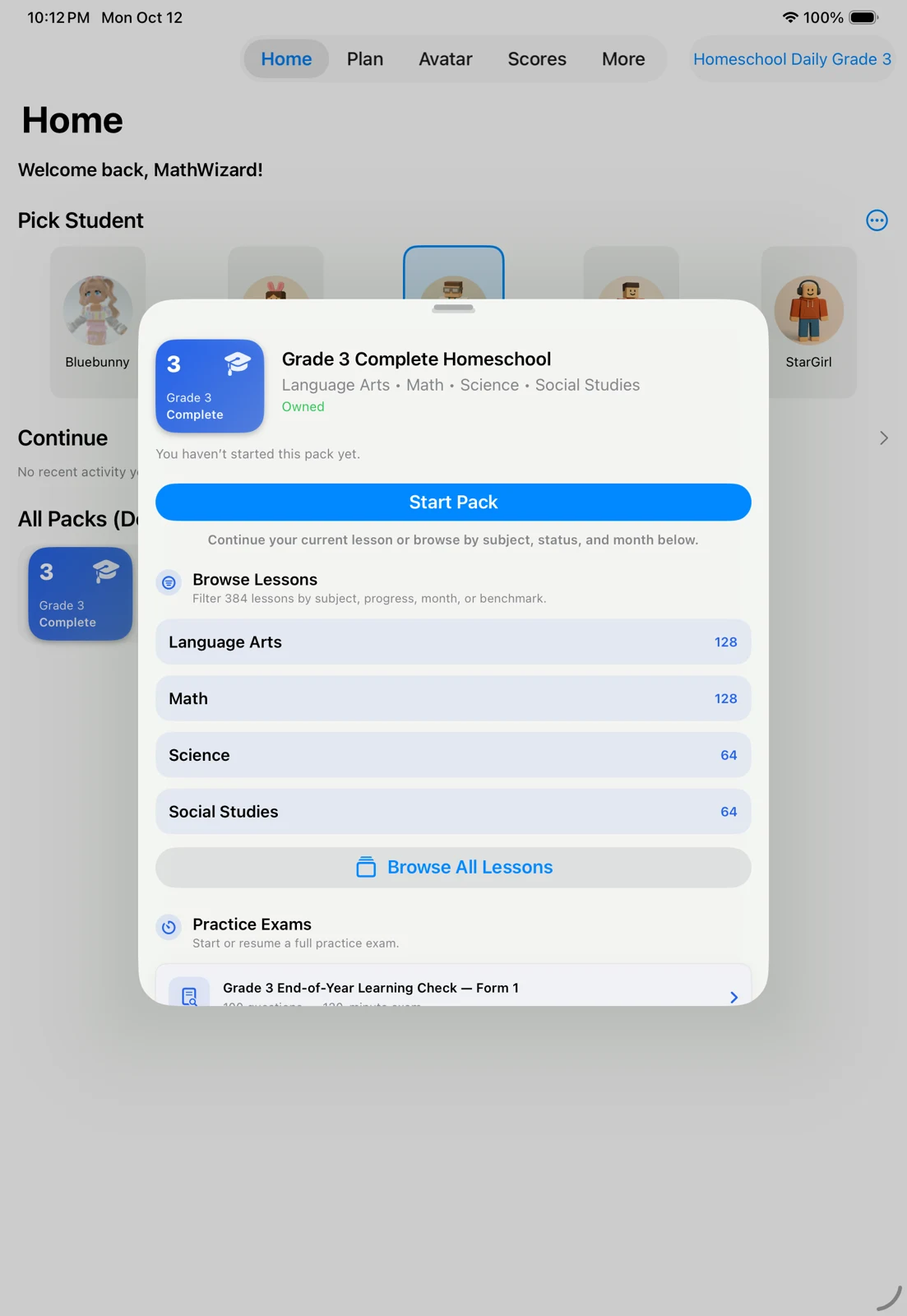
See the learning path
Grade 3 app example: organized subjects and lessons.
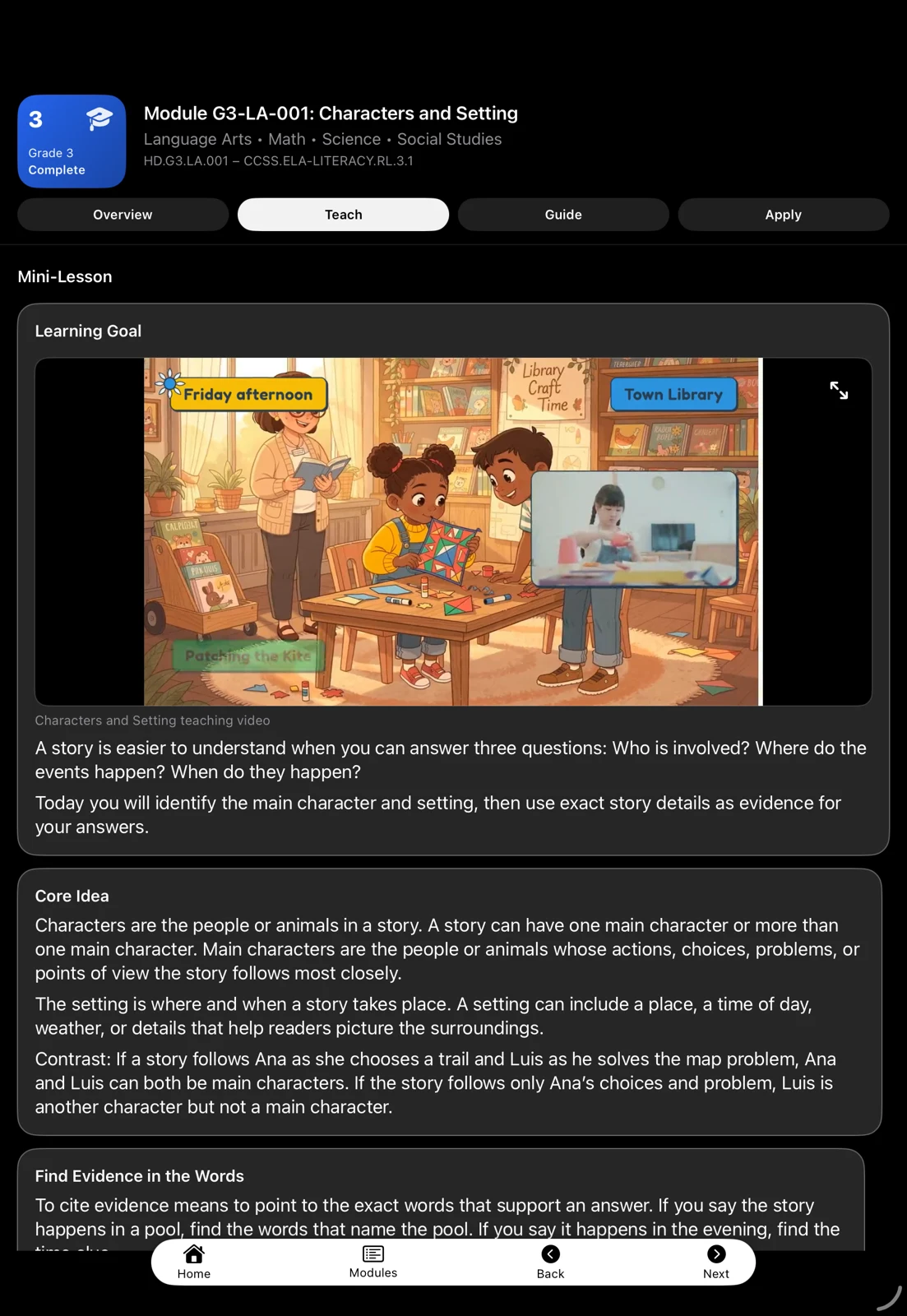
Learn one idea at a time
Grade 3 app example: a lesson on characters and setting.
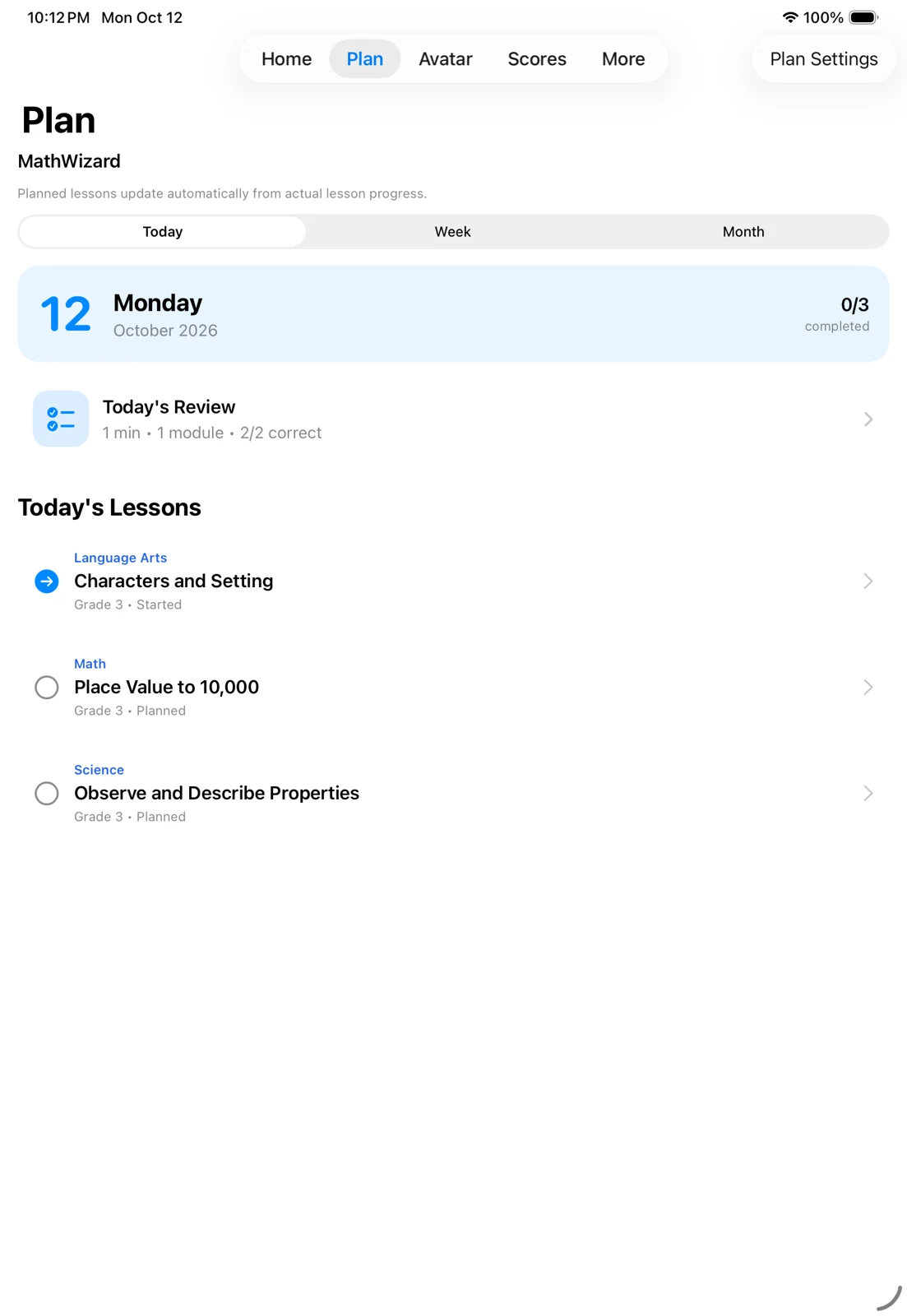
Make room for a daily routine
Grade 3 app example: the daily learning plan.

Keep a record of progress
Grade 3 app example: learning portfolio tools.
FROM CART TO CONFIDENCE
Your next steps are simple.
-
01
Get the app
Install the app for your chosen pack. Available store links are on its product page.
-
02
Choose your packs
Mix packs from different apps in one cart and pay once.
-
03
Unlock and learn
We email an itemized receipt and a license key for each pack. Enter each key in its app under More → Activation Keys.
Each license supports up to two devices at once. Website purchases unlock content in the named app; they are not a separate browser-based course.