Homeschool Daily Grade 6 / Grade 6
Grade 6 Complete Homeschool
A complete grade-level pack across four core subjects, with a clear lesson-by-lesson learning path.
WHAT’S INSIDE
Know what you’ll learn.
Explore the lessons in this pack.
Open a topic for a closer look.
01 Language Arts A Detail That Proves It
Locate a sentence that supports a stated factual claim. Explain why a nearby detail does not support that claim.
Topic reference: HD.G6.LA.001
02 Math Dividing by a Two-Digit Number
Compute a whole-number quotient using the standard algorithm. Verify the quotient by multiplication.
Topic reference: HD.G6.MATH.001
03 Science A Problem We Can Design For
Define a design problem using a stated need. Distinguish a measurable success criterion from a constraint.
Topic reference: HD.G6.SCI.001
04 Language Arts Reading Between the Facts
Infer an unstated conclusion from two informational details. Cite the details that make the inference reasonable.
Topic reference: HD.G6.LA.002
05 Math Choosing a Quotient Digit
Estimate a quotient digit using place value. Correct an overestimate during long division.
Topic reference: HD.G6.MATH.002
06 Social Studies A Question About the Past
Formulate a historical inquiry question. Identify the kinds of sources needed to investigate it.
Topic reference: HD.G6.SS.001
07 Language Arts The Idea Holding a Paragraph Together
State the central idea of an informational paragraph. Separate a central idea from a narrow supporting example.
Topic reference: HD.G6.LA.003
08 Math Zero Inside a Quotient
Place zero correctly in a multi-digit quotient. Explain the place-value consequence of omitting that zero.
Topic reference: HD.G6.MATH.003
09 Science A Fair Comparison of Designs
Identify variables to hold constant in a design comparison. Explain how a repeated measurement improves the comparison.
Topic reference: HD.G6.SCI.002
10 Language Arts Following an Idea Across Sections
Trace a central idea through two sections. Explain how a later detail develops the central idea.
Topic reference: HD.G6.LA.004
11 Math What to Do With a Remainder
Interpret a remainder in a real situation. Choose a context-appropriate form of the quotient.
Topic reference: HD.G6.MATH.004
12 Social Studies What This Source Can Tell Us
Identify a source's creator, date, and purpose. Explain a question the source can help answer.
Topic reference: HD.G6.SS.002
13 Language Arts A Summary Without My Opinion
Select essential information for an objective summary. Remove personal judgments from a draft summary.
Topic reference: HD.G6.LA.005
14 Math Decimals Lined Up by Value
Add multi-digit decimals with the standard algorithm. Explain why equal place values must align.
Topic reference: HD.G6.MATH.005
15 Science Measurements That Support a Choice
Interpret a table of design-test measurements. Identify which criterion each measurement addresses.
Topic reference: HD.G6.SCI.003
16 Language Arts When Evidence Is Too Weak
Distinguish relevant evidence from merely related information. Revise an unsupported claim to match available evidence.
Topic reference: HD.G6.LA.006
17 Math Subtracting Across Decimal Places
Subtract multi-digit decimals with regrouping. Check the difference with addition.
Topic reference: HD.G6.MATH.006
18 Social Studies A Source With Limits
Evaluate a source's usefulness for a specific inquiry. Identify a limitation caused by its context or perspective.
Topic reference: HD.G6.SS.003
19 Language Arts Two Details Working Together
Explain how two facts jointly support an inference. Distinguish an inference from an explicitly stated fact.
Topic reference: HD.G6.LA.007
20 Math Estimating Before Calculating
Estimate a decimal sum or difference. Use the estimate to reject an unreasonable result.
Topic reference: HD.G6.MATH.007
21 Science Choosing With Evidence
Evaluate two designs against common criteria. Justify a choice while acknowledging a constraint.
Topic reference: HD.G6.SCI.004
22 Language Arts A Clear Account of What I Read
Write a brief objective summary of an original article. Support its central idea with accurately paraphrased details.
Topic reference: HD.G6.LA.008
23 Math A Decimal Calculation With Meaning
Solve a context requiring decimal addition or subtraction. Label the answer with the appropriate unit.
Topic reference: HD.G6.MATH.008
24 Social Studies Two Sources, One Investigation
Gather relevant evidence from two source types. Explain how the second source changes confidence in a claim.
Topic reference: HD.G6.SS.004
25 Language Arts An Action Reveals a Character
Infer a character trait from an action. Support the inference with a precise narrative detail.
Topic reference: HD.G6.LA.009
26 Math Multiplying Tenths and Hundredths
Compute a decimal product using the standard algorithm. Relate decimal placement to place value.
Topic reference: HD.G6.MATH.009
27 Science A Model Too Small to See
Distinguish a particle model from a life-size picture. Explain one limitation of the representation.
Topic reference: HD.G6.SCI.005
28 Language Arts What the Character Wants
Identify a character's goal from dialogue and action. Explain how an obstacle shapes the character's response.
Topic reference: HD.G6.LA.010
29 Math A Product Smaller Than a Factor
Predict the effect of multiplying by a number below one. Verify the prediction with a decimal calculation.
Topic reference: HD.G6.MATH.010
30 Social Studies Finding Places With Coordinates
Locate a place using latitude and longitude. Distinguish absolute location from a relative description.
Topic reference: HD.G6.SS.005
31 Language Arts Episodes That Change the Problem
Order the major episodes in a story. Explain how one episode intensifies the central conflict.
Topic reference: HD.G6.LA.011
32 Math Locating a Misplaced Decimal
Identify a decimal-placement error in a product. Correct the error using a magnitude estimate.
Topic reference: HD.G6.MATH.011
33 Science Atoms as Building Units
Identify atom types in a simple molecular model. Count each atom type using the model key.
Topic reference: HD.G6.SCI.006
34 Language Arts A Different Choice at the End
Describe a character's change across a narrative. Cite contrasting actions that demonstrate the change.
Topic reference: HD.G6.LA.012
35 Math Decimal Products in Measurements
Calculate a measurement product with decimal factors. Explain the resulting unit in its context.
Topic reference: HD.G6.MATH.012
36 Social Studies A Map Made for a Question
Select a map suited to a geographic question. Explain a relevant limitation of its scale or projection.
Topic reference: HD.G6.SS.006
37 Language Arts From Topic to Theme
Express a story's theme as a complete statement. Distinguish a theme from a plot summary.
Topic reference: HD.G6.LA.013
38 Math A Decimal Divided Into Equal Groups
Divide a decimal by a whole number. Check the result by multiplication.
Topic reference: HD.G6.MATH.013
39 Science Molecules With Different Arrangements
Compare compositions of two simple molecular models. Explain how symbols represent different atom types.
Topic reference: HD.G6.SCI.007
40 Language Arts Details That Build a Theme
Connect a recurring detail to a proposed theme. Reject a theme unsupported by the ending.
Topic reference: HD.G6.LA.014
41 Math Making the Divisor a Whole Number
Generate an equivalent division with a whole-number divisor. Explain why both quantities scale together.
Topic reference: HD.G6.MATH.014
42 Social Studies Drawing a Spatial Pattern
Construct a map showing a cultural or environmental pattern. Use a legend that communicates the pattern clearly.
Topic reference: HD.G6.SS.007
43 Language Arts Retelling Only What Matters
Summarize a story without personal judgment. Explain why a minor episode can be omitted.
Topic reference: HD.G6.LA.015
44 Math Dividing by a Decimal
Compute a quotient with a decimal divisor. Check whether its size is reasonable.
Topic reference: HD.G6.MATH.015
45 Science Beyond Separate Molecules
Distinguish a simple molecule model from an extended structure. Describe a repeating arrangement using model evidence.
Topic reference: HD.G6.SCI.008
46 Language Arts A Resolution With Evidence
Explain how a resolution follows earlier character choices. Support a thematic interpretation with evidence from two episodes.
Topic reference: HD.G6.LA.016
47 Math Repairing a Division Method
Identify an invalid decimal shift in division. Replace it with an equivalent-quotient method.
Topic reference: HD.G6.MATH.016
48 Social Studies Comparing a Region Over Time
Use two maps to describe environmental change. Support a spatial explanation with mapped evidence.
Topic reference: HD.G6.SS.008
49 Language Arts A Word Explained Nearby
Infer word meaning from a definition clue. Verify the inferred meaning by rereading the sentence.
Topic reference: HD.G6.LA.017
50 Math The Greatest Shared Factor
Find the greatest common factor of two numbers at most 100. Interpret the factor as the size of equal groups.
Topic reference: HD.G6.MATH.017
51 Science Particles in Three States
Compare particle arrangement across states of a pure substance. Explain which features are model conventions.
Topic reference: HD.G6.SCI.009
52 Language Arts Examples Unlock a New Word
Infer word meaning from examples in a paragraph. Explain which example rules out an alternative meaning.
Topic reference: HD.G6.LA.018
53 Math The First Shared Multiple
Find the least common multiple of two numbers at most 12. Explain why an earlier multiple is not shared.
Topic reference: HD.G6.MATH.018
54 Social Studies Evidence Before Written Records
Explain how material evidence supports claims about early people. Identify a limit of an archaeological interpretation.
Topic reference: HD.G6.SS.009
55 Language Arts Reading a Contrast Clue
Infer word meaning from a contrast in context. Identify the signal that makes the contrast useful.
Topic reference: HD.G6.LA.019
56 Math Choosing Factors or Multiples
Choose GCF or LCM for a grouping or repetition problem. Justify the choice using the context.
Topic reference: HD.G6.MATH.019
57 Science Heating Changes Particle Motion
Predict a change in particle motion when energy is added. Connect the prediction to a temperature observation.
Topic reference: HD.G6.SCI.010
58 Language Arts Roots Carry Meaning
Infer a word's meaning using a Greek or Latin root. Check the inference against the sentence context.
Topic reference: HD.G6.LA.020
59 Math Factoring a Sum
Rewrite a sum using a common factor and distribution. Verify the equivalence by expanding the expression.
Topic reference: HD.G6.MATH.020
60 Social Studies Different Ways to Obtain Food
Compare foraging and farming in historical contexts. Explain why communities could combine both practices.
Topic reference: HD.G6.SS.010
61 Language Arts How an Affix Changes a Word
Explain how an affix changes a base word's meaning. Select an affixed word that fits an original sentence.
Topic reference: HD.G6.LA.021
62 Math How Many Fractional Groups?
Model fraction division as counting groups of a given size. Interpret the quotient in the model.
Topic reference: HD.G6.MATH.021
63 Science Cooling and Changes of State
Model particle motion as a pure substance cools. Relate a state change to energy transfer.
Topic reference: HD.G6.SCI.011
64 Language Arts Almost the Same Meaning
Distinguish connotations of words with similar definitions. Choose a word whose connotation fits an intended tone.
Topic reference: HD.G6.LA.022
65 Math Groups That Do Not Fill Exactly
Represent a fractional remainder as part of one divisor-sized group. Express the quotient as a mixed number.
Topic reference: HD.G6.MATH.022
66 Social Studies Why Some Settlements Grew
Explain multiple factors contributing to permanent settlements. Distinguish a contributing factor from an inevitable outcome.
Topic reference: HD.G6.SS.011
67 Language Arts Checking a Reference Entry
Use a reference entry to select the relevant meaning. Verify a word's pronunciation using the entry's key.
Topic reference: HD.G6.LA.023
68 Math Dividing a Whole by a Fraction
Compute a whole number divided by a fraction. Explain the quotient using equal fractional groups.
Topic reference: HD.G6.MATH.023
69 Science Checking a State-Change Model
Identify an incorrect particle-count change in a model. Revise the model while preserving the sample's particles.
Topic reference: HD.G6.SCI.012
70 Language Arts Precise Words for a Topic
Use a domain-specific word accurately in an explanation. Replace a vague word with a context-appropriate term.
Topic reference: HD.G6.LA.024
71 Math A Fraction Shared Equally
Model a fraction divided by a whole number. Connect the model to the resulting fraction.
Topic reference: HD.G6.MATH.024
72 Social Studies Change Without a Single Path
Classify early-community developments as change or continuity. Support the classification with contextual evidence.
Topic reference: HD.G6.SS.012
73 Language Arts Pronouns Doing the Action
Select a subject pronoun for a sentence. Explain its role as the subject of the clause.
Topic reference: HD.G6.LA.025
74 Math Why the Reciprocal Works
Explain fraction division using equivalent unit fractions. Connect the model to multiplication by the reciprocal.
Topic reference: HD.G6.MATH.025
75 Science Temperature Is One Measurement
Distinguish temperature from total energy transferred. Identify evidence needed beyond a single temperature reading.
Topic reference: HD.G6.SCI.013
76 Language Arts Pronouns Receiving the Action
Select an object pronoun after a verb or preposition. Correct a pronoun case error in a compound object.
Topic reference: HD.G6.LA.026
77 Math Fraction Divided by Fraction
Compute a quotient of two fractions. Verify it by multiplying the quotient and divisor.
Topic reference: HD.G6.MATH.026
78 Social Studies Living Between Rivers
Explain how river conditions shaped Mesopotamian settlement. Identify a geographic opportunity and a constraint.
Topic reference: HD.G6.SS.013
79 Language Arts Showing Ownership Clearly
Distinguish possessive pronouns from contractions. Revise an ownership statement using correct pronoun case.
Topic reference: HD.G6.LA.027
80 Math Mixed Numbers in Division
Convert mixed numbers before fraction division. Simplify the resulting quotient accurately.
Topic reference: HD.G6.MATH.027
81 Science Comparing Equal Masses
Plan a comparison using equal masses of different materials. Identify the measured temperature change.
Topic reference: HD.G6.SCI.014
82 Language Arts Adding Emphasis With Myself
Identify an intensive pronoun used for emphasis. Distinguish an intensive use from a reflexive use.
Topic reference: HD.G6.LA.028
83 Math Checking a Fraction Quotient
Estimate the size of a fraction quotient. Diagnose an incorrect reciprocal step.
Topic reference: HD.G6.MATH.028
84 Social Studies Water and Collective Work
Explain how irrigation created coordination needs. Support the explanation using supplied evidence.
Topic reference: HD.G6.SS.014
85 Language Arts Keeping Pronoun Number Steady
Detect an inappropriate pronoun-number shift. Revise the sentence to agree with its antecedent.
Topic reference: HD.G6.LA.029
86 Math Measuring With a Fractional Unit
Write a division expression for a measurement situation. Interpret a nonwhole quotient in that situation.
Topic reference: HD.G6.MATH.029
87 Science Changing the Amount of Material
Predict how mass affects temperature change for equal energy input to the same material without a phase change. Support the prediction using supplied data.
Topic reference: HD.G6.SCI.015
88 Language Arts Keeping the Same Person
Detect an unintended shift in pronoun person. Revise a paragraph to maintain its intended perspective.
Topic reference: HD.G6.LA.030
89 Math Finding One Share
Represent a fractional sharing situation with division. Explain what one unit of the quotient means.
Topic reference: HD.G6.MATH.030
90 Social Studies Cities With Specialized Work
Explain relationships among surplus, specialization, and exchange. Identify more than one factor in urban growth.
Topic reference: HD.G6.SS.015
91 Language Arts Who Does This Pronoun Mean?
Identify a pronoun with two possible antecedents. Replace the ambiguous pronoun with a precise noun phrase.
Topic reference: HD.G6.LA.031
92 Math A Missing Side From Area
Find a fractional side length from rectangle area. Check the solution by reconstructing the area.
Topic reference: HD.G6.MATH.031
93 Science An Investigation With Limits
Interpret a controlled thermal investigation's results. State a limitation that prevents an overbroad conclusion.
Topic reference: HD.G6.SCI.016
94 Language Arts Language Choices Across Settings
Compare a conversational form with conventional formal usage. Revise usage to suit a stated speaking or writing context.
Topic reference: HD.G6.LA.032
95 Math Writing a Fraction Division Story
Create a situation matching a given fraction division. Explain the roles of dividend, divisor, and quotient.
Topic reference: HD.G6.MATH.032
96 Social Studies Rules in Their Historical Setting
Explain possible purposes of an ancient law collection. Distinguish historical explanation from present-day endorsement.
Topic reference: HD.G6.SS.016
97 Language Arts How an Article Introduces an Idea
Identify how an opening introduces its central subject. Explain what an introductory example contributes.
Topic reference: HD.G6.LA.033
98 Math Two Quantities in a Comparison
Describe a ratio with its quantities in order. Write a ratio matching an original collection.
Topic reference: HD.G6.MATH.033
99 Science Where Thermal Energy Moves
Identify the direction of thermal transfer between objects. Explain how a temperature difference supports the direction.
Topic reference: HD.G6.SCI.017
100 Language Arts An Example That Develops the Idea
Trace how an example elaborates an earlier statement. Distinguish elaboration from unrelated detail.
Topic reference: HD.G6.LA.034
101 Math Part Compared With Part
Identify a part-to-part ratio in a collection. Distinguish it from a part-to-whole ratio.
Topic reference: HD.G6.MATH.034
102 Social Studies The Nile as a Geographic Connection
Explain how Nile geography influenced settlement and travel. Use map evidence to support the explanation.
Topic reference: HD.G6.SS.017
103 Language Arts The Job of a Paragraph
Explain a paragraph's role in an article. Predict what information is lost if it is removed.
Topic reference: HD.G6.LA.035
104 Math The Order of a Ratio Matters
Interpret a ratio in a stated order. Explain how reversing the order changes its meaning.
Topic reference: HD.G6.MATH.035
105 Science A Barrier to Thermal Transfer
Explain how a design feature reduces thermal transfer. Connect the feature to a measurable design criterion.
Topic reference: HD.G6.SCI.018
106 Language Arts Comparing to Explain
Identify the basis of a comparison in an article. Explain how the comparison develops the main idea.
Topic reference: HD.G6.LA.036
107 Math Ratio Language in a Situation
Write a ratio statement with named quantities. Reject a statement that compares the wrong quantities.
Topic reference: HD.G6.MATH.036
108 Social Studies Work and Authority in Egypt
Explain how coordinated work related to political authority. Distinguish evidence about daily life from an unsupported generalization.
Topic reference: HD.G6.SS.018
109 Language Arts Causes in an Explanation
Distinguish a cause from an effect in a text. Explain how their arrangement supports the explanation.
Topic reference: HD.G6.LA.037
110 Math Building Equivalent Ratios
Generate equivalent ratios by scaling both quantities. Verify equivalence with a diagram.
Topic reference: HD.G6.MATH.037
111 Science Testing a Container Design
Design a controlled test of thermal-container performance. Identify data needed to compare two prototypes.
Topic reference: HD.G6.SCI.019
112 Language Arts A Problem and a Response
Identify a problem and its proposed response. Explain how a section develops the response.
Topic reference: HD.G6.LA.038
113 Math Filling a Ratio Table
Complete missing entries in a ratio table. Explain the scale factor between two rows.
Topic reference: HD.G6.MATH.038
114 Social Studies Kush in Its Regional Setting
Explain Kush's connections to neighboring regions. Cite evidence of exchange or political interaction.
Topic reference: HD.G6.SS.019
115 Language Arts An Author's Purpose in the Details
Infer an author's purpose from selection of details. Cite wording that conveys the author's perspective.
Topic reference: HD.G6.LA.039
116 Math Finding a Missing Quantity
Use an equivalent ratio to find an unknown quantity. Check that the resulting pair preserves the relationship.
Topic reference: HD.G6.MATH.039
117 Science Improving With Test Results
Revise a thermal design based on test evidence. Explain the tradeoff introduced by the revision.
Topic reference: HD.G6.SCI.020
118 Language Arts One Topic, Different Emphasis
Explain how an article's organization advances its purpose. Support the explanation with evidence from two sections.
Topic reference: HD.G6.LA.040
119 Math An Additive Trap
Identify a false equivalent ratio formed by addition. Correct it using multiplicative reasoning.
Topic reference: HD.G6.MATH.040
120 Social Studies Exchange in More Than One Direction
Compare cultural or economic exchanges along the Nile. Explain why influence need not travel in only one direction.
Topic reference: HD.G6.SS.020
121 Language Arts Narrowing an Explanation
Narrow a broad topic to a manageable focus. Select facts that directly develop that focus.
Topic reference: HD.G6.LA.041
122 Math A Rate for One Unit
Calculate a unit rate from a whole-number ratio. State its meaning with both units.
Topic reference: HD.G6.MATH.041
123 Science Evidence of Cells
Identify cell evidence in magnified observations. Distinguish observation from an inference about living things.
Topic reference: HD.G6.SCI.021
124 Language Arts Organizing What I Know
Group related facts into explanatory sections. Choose headings that express each section's role.
Topic reference: HD.G6.LA.042
125 Math Which Unit Comes First?
Distinguish two reciprocal rates for a situation. Choose the rate that answers a stated question.
Topic reference: HD.G6.MATH.042
126 Social Studies Cities of the Indus Region
Describe urban features supported by archaeological evidence. Explain how a city plan supports one interpretation.
Topic reference: HD.G6.SS.021
127 Language Arts An Opening That Orients Readers
Draft an opening that introduces a precise topic. Revise the opening to match a stated audience.
Topic reference: HD.G6.LA.043
128 Math Comparing Cost Per Item
Use unit prices to compare packages. Explain the comparison without relying on package price alone.
Topic reference: HD.G6.MATH.043
129 Science One Cell or Many
Compare single-celled and multicellular organisms. Cite evidence that both are made of cells.
Topic reference: HD.G6.SCI.022
130 Language Arts Developing With Facts and Examples
Expand an explanation using a relevant example. Distinguish a supporting fact from unsupported opinion.
Topic reference: HD.G6.LA.044
131 Math Distance in One Unit of Time
Find a unit rate for constant travel. Interpret the rate using distance and time units.
Topic reference: HD.G6.MATH.044
132 Social Studies Water, Land, and Settlement in South Asia
Explain how regional geography shaped settlement choices. Identify a limitation of a geographic explanation alone.
Topic reference: HD.G6.SS.022
133 Language Arts Connections Between Ideas
Select transitions that express actual relationships. Repair a transition that misstates the relationship.
Topic reference: HD.G6.LA.045
134 Math A Ratio on Two Number Lines
Represent equivalent ratios on aligned number lines. Use alignment to find an unknown value.
Topic reference: HD.G6.MATH.045
135 Science A Boundary With a Job
Explain the cell membrane's role in a cell model. Predict a consequence of disrupted boundary function.
Topic reference: HD.G6.SCI.023
136 Language Arts A Clear Formal Explanation
Revise vague language into precise explanatory wording. Maintain a consistent formal style in a paragraph.
Topic reference: HD.G6.LA.046
137 Math Plotting Equivalent Ratio Pairs
Plot ratio-table pairs in the coordinate plane. Interpret a plotted point in context.
Topic reference: HD.G6.MATH.046
138 Social Studies Evidence and Unanswered Questions
Distinguish a supported Indus claim from an unresolved question. Explain what additional evidence would help.
Topic reference: HD.G6.SS.023
139 Language Arts An Ending That Follows
Draft a conclusion supported by the explanation. Remove an unrelated new claim from a conclusion.
Topic reference: HD.G6.LA.047
140 Math Choosing a Helpful Representation
Select a table or diagram for a ratio problem. Explain how the representation exposes the unknown.
Topic reference: HD.G6.MATH.047
141 Science Parts Support the Whole Cell
Relate selected cell parts to the cell's overall function. Explain a limitation of a simplified cell model.
Topic reference: HD.G6.SCI.024
142 Language Arts Revising My Explanation
Reorganize an explanatory draft for clarity. Explain how a revision improves development for its audience.
Topic reference: HD.G6.LA.048
143 Math Comparing Two Mixtures
Compare mixtures using equivalent ratios. Support the comparison with a common quantity.
Topic reference: HD.G6.MATH.048
144 Social Studies South Asia Across Changing Periods
Connect selected South Asian developments to their historical contexts. Identify continuity without treating the region as uniform.
Topic reference: HD.G6.SS.024
145 Language Arts The Narrator's Limited View
Identify what a narrator knows about an event. Explain how limited knowledge shapes the reader's understanding.
Topic reference: HD.G6.LA.049
146 Math Percent Means Per Hundred
Interpret a percent as a rate per hundred. Represent the same proportion with a fraction.
Topic reference: HD.G6.MATH.049
147 Science From Cells to Tissues
Describe how specialized cells form tissues. Use an example to distinguish tissue from an organ.
Topic reference: HD.G6.SCI.025
148 Language Arts A Speaker's Attitude
Infer a poem speaker's attitude from wording. Cite language that establishes the attitude.
Topic reference: HD.G6.LA.050
149 Math Fractions, Decimals, and Percents
Convert a familiar fraction to a percent. Verify the conversion using a hundred-based representation.
Topic reference: HD.G6.MATH.050
150 Social Studies River Landscapes of Early China
Explain a connection between geography and an early settlement. Support the connection with mapped evidence.
Topic reference: HD.G6.SS.025
151 Language Arts Word Choices Set the Tone
Describe the tone created by specific narrative words. Explain how changing one word alters that tone.
Topic reference: HD.G6.LA.051
152 Math Finding a Percent of a Quantity
Calculate a percent of a whole quantity. Explain the part-to-whole relationship used.
Topic reference: HD.G6.MATH.051
153 Science An Organ Within a System
Locate an organ within a body-system model. Explain its contribution to the larger system.
Topic reference: HD.G6.SCI.026
154 Language Arts A Comparison Beyond the Literal
Interpret a figurative comparison in context. Explain its effect on the passage's meaning.
Topic reference: HD.G6.LA.052
155 Math Finding the Whole
Find a whole from a known part and percent. Check the result by calculating the stated percent.
Topic reference: HD.G6.MATH.052
156 Social Studies Evidence of Early Chinese Societies
Interpret an artifact account in its historical context. Distinguish evidence about elites from claims about all people.
Topic reference: HD.G6.SS.026
157 Language Arts An Allusion With a Clue
Use a supplied source note to interpret an allusion. Explain what the allusion adds to a character description.
Topic reference: HD.G6.LA.053
158 Math Converting With a Ratio
Convert measurements using a stated conversion ratio. Verify that the resulting unit matches the question.
Topic reference: HD.G6.MATH.053
159 Science Two Systems Working Together
Explain an interaction between two body systems. Support the explanation with supplied physiological evidence.
Topic reference: HD.G6.SCI.027
160 Language Arts Why This Stanza Belongs Here
Explain a stanza's contribution to a poem's development. Relate its imagery to the poem's larger meaning.
Topic reference: HD.G6.LA.054
161 Math Following Units Through a Conversion
Track units through a two-step conversion. Identify an inverted conversion ratio.
Topic reference: HD.G6.MATH.054
162 Social Studies Ideas About Order and Responsibility
Compare contextualized ideas about social or political order. Identify evidence for a similarity and a difference.
Topic reference: HD.G6.SS.027
163 Language Arts The Turning Scene
Explain how a scene changes a drama's direction. Connect the scene's placement to a developing conflict.
Topic reference: HD.G6.LA.055
164 Math A Budget as Parts of a Whole
Calculate category amounts from a simple percent budget. Check whether the allocated parts match the whole.
Topic reference: HD.G6.MATH.055
165 Science When One Part Changes
Predict an effect of a subsystem disruption. Explain the reasoning through a system interaction.
Topic reference: HD.G6.SCI.028
166 Language Arts How a Viewpoint Takes Shape
Trace a narrator's perspective through selected details. Explain how a structural choice reinforces that perspective.
Topic reference: HD.G6.LA.056
167 Math A Ratio Decision With Constraints
Solve a practical ratio problem with a stated constraint. Explain why the chosen result satisfies the constraint.
Topic reference: HD.G6.MATH.056
168 Social Studies Change and Continuity Across Dynasties
Classify selected developments as change or continuity. Explain the classification using a timeline and source evidence.
Topic reference: HD.G6.SS.028
169 Language Arts Introducing My Narrator
Establish a narrative situation and narrator. Choose opening details that orient a reader.
Topic reference: HD.G6.LA.057
170 Math Numbers Below a Reference Point
Interpret positive and negative quantities in context. Explain the meaning of zero in that context.
Topic reference: HD.G6.MATH.057
171 Science Resources a Population Needs
Identify a limiting resource in an ecosystem account. Support the identification with population data.
Topic reference: HD.G6.SCI.029
172 Language Arts A Character With a Problem
Develop a character's goal through action. Introduce a conflict that follows from the situation.
Topic reference: HD.G6.LA.058
173 Math Opposites Across Zero
Locate opposite numbers on a number line. Explain why opposite quantities are equally far from zero.
Topic reference: HD.G6.MATH.058
174 Social Studies Studying Beliefs Respectfully
Distinguish historical description from a statement of personal faith. Use respectful language when comparing traditions.
Topic reference: HD.G6.SS.029
175 Language Arts Events That Belong Together
Organize events into a causal narrative sequence. Remove an event that interrupts that sequence.
Topic reference: HD.G6.LA.059
176 Math Negative Fractions Have Places
Locate negative fractions on a number line. Identify a rational number between two marked values.
Topic reference: HD.G6.MATH.059
177 Science A Resource Changes Over Time
Analyze how population data vary with resource availability. Distinguish a data pattern from proof of a single cause.
Topic reference: HD.G6.SCI.030
178 Language Arts Dialogue That Moves a Story
Write dialogue that advances a conflict. Explain what the dialogue reveals about a character.
Topic reference: HD.G6.LA.060
179 Math An Opposite of an Opposite
Determine the opposite of a negative number. Explain why taking an opposite twice returns the original number.
Topic reference: HD.G6.MATH.060
180 Social Studies Traditions in Their Places and Times
Connect selected traditions to historical regions and periods. Identify limits of a simplified origin map.
Topic reference: HD.G6.SS.030
181 Language Arts Slowing an Important Moment
Revise a key moment with deliberate pacing. Distinguish useful description from distracting detail.
Topic reference: HD.G6.LA.061
182 Math Ordering Negative Values
Compare two negative rational numbers. Justify their order using number-line positions.
Topic reference: HD.G6.MATH.061
183 Science Competition Across Ecosystems
Explain competition when organisms share a limited resource. Predict a comparable interaction in a different ecosystem.
Topic reference: HD.G6.SCI.031
184 Language Arts Moving Through Time and Place
Use transitions to signal a narrative shift. Revise a confusing shift to orient the reader.
Topic reference: HD.G6.LA.062
185 Math Inequalities Tell an Order
Write an inequality comparing rational quantities. Interpret the inequality in its context.
Topic reference: HD.G6.MATH.062
186 Social Studies Different Perspectives Within a Tradition
Compare two contextualized perspectives within one tradition. Reject a claim that treats all adherents as identical.
Topic reference: HD.G6.SS.031
187 Language Arts A Sensory Detail With Purpose
Select sensory details that develop a setting. Replace a vague description with precise language.
Topic reference: HD.G6.LA.063
188 Math Distance From Zero
Find a rational number's absolute value. Explain absolute value as a distance.
Topic reference: HD.G6.MATH.063
189 Science Different Ways Organisms Interact
Distinguish predation, competition, and mutually beneficial interactions. Support an interaction classification with observed evidence.
Topic reference: HD.G6.SCI.032
190 Language Arts A Narrative Ending That Fits
Write a conclusion that follows from the events. Revise the narrative to resolve a continuity problem.
Topic reference: HD.G6.LA.064
191 Math Order Is Different From Distance
Distinguish comparing signed values from comparing absolute values. Select the comparison that answers a contextual question.
Topic reference: HD.G6.MATH.064
192 Social Studies Belief, Community, and Historical Evidence
Explain a documented connection between belief and community life. Support the explanation without making a theological truth claim.
Topic reference: HD.G6.SS.032
193 Language Arts Finding the Main Claim
Identify the central claim of an argument. Distinguish that claim from a supporting reason.
Topic reference: HD.G6.LA.065
194 Math Four Regions of the Plane
Plot an ordered pair with signed coordinates. Identify its quadrant from the coordinate signs.
Topic reference: HD.G6.MATH.065
195 Science Tracing Energy Through a Food Web
Trace energy flow from a producer through consumers. Explain the direction of a food-web arrow.
Topic reference: HD.G6.SCI.033
196 Language Arts Following a Reason to Evidence
Trace the evidence offered for one reason. Explain how the evidence supports the reason.
Topic reference: HD.G6.LA.066
197 Math Reading a Point's Coordinates
Read coordinates from a four-quadrant graph. Explain the order of horizontal and vertical coordinates.
Topic reference: HD.G6.MATH.066
198 Social Studies City-States in a Mountainous Region
Explain geographic connections among Greek city-states. Distinguish shared culture from a single unified government.
Topic reference: HD.G6.SS.033
199 Language Arts A Claim Without Support
Identify a claim lacking relevant evidence. Explain what evidence would be needed to assess it.
Topic reference: HD.G6.LA.067
200 Math Reflections Across an Axis
Predict coordinates after reflection across one axis. Verify the prediction on a coordinate grid.
Topic reference: HD.G6.MATH.067
201 Science Matter Returns Through Decomposition
Model matter moving between organisms and the environment. Distinguish matter cycling from energy flow.
Topic reference: HD.G6.SCI.034
202 Language Arts Choosing Credible Support
Select credible evidence for a written claim. Reject support that is irrelevant to the reason.
Topic reference: HD.G6.LA.068
203 Math Distance Along a Grid Line
Find distance between points sharing one coordinate. Explain the distance using absolute values.
Topic reference: HD.G6.MATH.068
204 Social Studies Who Could Participate in Athens?
Describe eligibility for participation in ancient Athens. Support a claim about exclusion using evidence.
Topic reference: HD.G6.SS.034
205 Language Arts Planning My Argument
Organize a claim with distinct supporting reasons. Assign relevant evidence to each reason.
Topic reference: HD.G6.LA.069
206 Math Repeated Factors, Shorter Notation
Write repeated multiplication using an exponent. Identify the base and exponent in the notation.
Topic reference: HD.G6.MATH.069
207 Science A Change Spreads Through a System
Predict effects of a changed ecosystem component. Support the prediction using a model and data.
Topic reference: HD.G6.SCI.035
208 Language Arts Links That Make Reasoning Clear
Use transitions to connect reasons and claims. Repair a gap between evidence and a written reason.
Topic reference: HD.G6.LA.070
209 Math Evaluating Whole-Number Powers
Evaluate a numerical expression with a whole-number exponent. Distinguish a power from base-times-exponent multiplication.
Topic reference: HD.G6.MATH.070
210 Social Studies Comparing Civic Life in Two Poleis
Compare civic arrangements in two Greek city-states. Explain a difference within its historical context.
Topic reference: HD.G6.SS.035
211 Language Arts A Formal Argument and Conclusion
Maintain formal style in an argument paragraph. Draft a conclusion that follows from its reasons.
Topic reference: HD.G6.LA.071
212 Math Order With Powers and Grouping
Evaluate an expression with exponents and parentheses. Explain the required order of operations.
Topic reference: HD.G6.MATH.071
213 Science An Ecosystem Claim With Limits
Construct a claim about an ecosystem change using evidence. Explain uncertainty caused by an unmeasured factor.
Topic reference: HD.G6.SCI.036
214 Language Arts Checking the Whole Argument
Evaluate whether each claim has sufficient relevant support. Revise a weak reasoning link without overstating evidence.
Topic reference: HD.G6.LA.072
215 Math Finding an Evaluation Error
Identify the first invalid step in an expression calculation. Repair the calculation using the correct order.
Topic reference: HD.G6.MATH.072
216 Social Studies Greek Ideas Across a Wider Region
Connect selected Greek cultural developments to exchange. Distinguish documented influence from an unsupported origin claim.
Topic reference: HD.G6.SS.036
217 Language Arts A Question Worth Investigating
Formulate a focused research question. Identify the kinds of sources needed to answer it.
Topic reference: HD.G6.LA.073
218 Math A Letter for a Quantity
Write an expression using a variable for a quantity. Explain what the variable represents.
Topic reference: HD.G6.MATH.073
219 Science Clues in Rock Materials
Classify rock observations by formation evidence. Distinguish an observed feature from a formation inference.
Topic reference: HD.G6.SCI.037
220 Language Arts Finding Relevant Sources
Select sources relevant to a research question. Reject a source that addresses a different question.
Topic reference: HD.G6.LA.074
221 Math Reading Parts of an Expression
Identify terms, factors, and coefficients. Describe a compound expression as a single entity.
Topic reference: HD.G6.MATH.074
222 Social Studies A Republic in Its Historical Context
Explain a feature of Roman republican government. Distinguish formal institutions from equal political participation.
Topic reference: HD.G6.SS.037
223 Language Arts Who Is Behind the Information?
Assess a source using authorship and evidence. Identify a credibility limitation in a source record.
Topic reference: HD.G6.LA.075
224 Math From Words to an Expression
Translate a verbal relationship into an expression. Explain the role of grouping in the expression.
Topic reference: HD.G6.MATH.075
225 Science Melting and Cooling in a Cycle
Model a pathway involving melting and solidification. Identify the energy transfer associated with the pathway.
Topic reference: HD.G6.SCI.038
226 Language Arts Notes in My Own Words
Paraphrase a source idea accurately. Distinguish a paraphrase from copied wording.
Topic reference: HD.G6.LA.076
227 Math Substituting a Given Value
Evaluate an expression at a stated variable value. Check substitution before applying operation order.
Topic reference: HD.G6.MATH.076
228 Social Studies Expansion and Its Consequences
Explain multiple causes of Roman expansion. Identify contrasting consequences for different groups.
Topic reference: HD.G6.SS.038
229 Language Arts When Exact Words Matter
Integrate a brief quotation with attribution. Explain why its exact wording supports an analysis.
Topic reference: HD.G6.LA.077
230 Math Distributing a Factor
Expand an expression using the distributive property. Explain the expansion with an area partition.
Topic reference: HD.G6.MATH.077
231 Science Sediments Become Rock
Explain a pathway from weathered material to sedimentary rock. Distinguish compaction from cementation in a model.
Topic reference: HD.G6.SCI.039
232 Language Arts Keeping a Source Trail
Record basic bibliographic information for a source. Match a note to its originating source.
Topic reference: HD.G6.LA.078
233 Math Collecting Like Terms
Combine like terms using properties of operations. Explain why unlike terms cannot be combined that way.
Topic reference: HD.G6.MATH.078
234 Social Studies Networks Across the Roman World
Explain how infrastructure supported imperial connections. Use map evidence to identify a limit of those connections.
Topic reference: HD.G6.SS.039
235 Language Arts Refocusing With New Evidence
Refine a research question after comparing sources. Explain why the revised focus is more manageable.
Topic reference: HD.G6.LA.079
236 Math Factoring an Expression
Rewrite an expression by extracting a common factor. Verify the rewrite through distribution.
Topic reference: HD.G6.MATH.079
237 Science More Than One Rock Pathway
Model two possible changes from the same starting rock. Explain why rock cycling has no single compulsory route.
Topic reference: HD.G6.SCI.040
238 Language Arts A Short Research Explanation
Organize information from multiple sources into an explanation. Attribute borrowed ideas without plagiarizing wording.
Topic reference: HD.G6.LA.080
239 Math Proving Two Expressions Agree
Justify expression equivalence using operation properties. Use a counterexample to reject a false equivalence claim.
Topic reference: HD.G6.MATH.080
240 Social Studies Political Change in the Roman World
Explain multiple factors in a selected Roman political transition. Reject a single-cause account unsupported by evidence.
Topic reference: HD.G6.SS.040
241 Language Arts Arriving Ready to Discuss
Prepare text-based notes for a discussion. Use a note to support a relevant contribution.
Topic reference: HD.G6.LA.081
242 Math Does This Value Make It True?
Test whether a value satisfies an equation. Distinguish a solution from an arbitrary substitution.
Topic reference: HD.G6.MATH.081
243 Science A Surface Changing Slowly
Explain a gradual landscape change using evidence. Identify the timescale represented by the evidence.
Topic reference: HD.G6.SCI.041
244 Language Arts A Discussion With Shared Roles
Establish discussion goals and participant roles. Apply a shared rule during a collaborative exchange.
Topic reference: HD.G6.LA.082
245 Math An Unknown in a Situation
Define a variable for an unknown quantity. Write an equation representing the situation.
Topic reference: HD.G6.MATH.082
246 Social Studies Routes Across Afro-Eurasia
Describe how transportation changes connected land and sea networks. Explain why the network was more than one road.
Topic reference: HD.G6.SS.041
247 Language Arts Asking a Question That Helps
Pose a specific question about a partner's idea. Answer a question with relevant elaboration.
Topic reference: HD.G6.LA.083
248 Math Equality on Both Sides
Explain equality as a relation between expressions. Identify a step that breaks that relation.
Topic reference: HD.G6.MATH.083
249 Science Moving and Depositing Sediment
Distinguish erosion from deposition in a landform sequence. Explain the observed change in terms of moving material.
Topic reference: HD.G6.SCI.042
250 Language Arts Building on Another Idea
Connect a contribution to an earlier speaker's point. Distinguish agreement from evidence-based extension.
Topic reference: HD.G6.LA.084
251 Math A Set of Possible Solutions
Test given values in an equation or inequality. Report the values that make the statement true.
Topic reference: HD.G6.MATH.084
252 Social Studies Specialization Makes Exchange Useful
Explain how specialization encouraged regional trade. Identify a potential benefit and dependency created by exchange.
Topic reference: HD.G6.SS.042
253 Language Arts Restating a Different View
Paraphrase a partner's position accurately. Identify a point of agreement or disagreement with evidence.
Topic reference: HD.G6.LA.085
254 Math Solving an Addition Equation
Solve an equation of the form x plus p equals q. Verify the solution in the original equation.
Topic reference: HD.G6.MATH.085
255 Science Reading Height From Contours
Interpret elevation patterns on a contour map. Use the map to support a claim about surface shape.
Topic reference: HD.G6.SCI.043
256 Language Arts What the Chart Adds to a Talk
Interpret a visual used in an oral explanation. Explain how it contributes information beyond the words.
Topic reference: HD.G6.LA.086
257 Math Solving a Multiplication Equation
Solve an equation of the form px equals q. Explain the inverse operation used.
Topic reference: HD.G6.MATH.086
258 Social Studies Ideas Travel With People
Trace a documented example of cultural exchange. Distinguish exchange from an unsupported claim of direct copying.
Topic reference: HD.G6.SS.043
259 Language Arts Listening for a Supported Claim
Identify a speaker's claim and supporting reason. Evaluate whether the supplied evidence supports the claim.
Topic reference: HD.G6.LA.087
260 Math An Equation With Fractional Values
Solve a one-step equation using nonnegative fractions. Check the solution by substitution.
Topic reference: HD.G6.MATH.087
261 Science Fast and Slow Changes Together
Compare geoscience processes acting at different rates. Explain how both can contribute to one landscape.
Topic reference: HD.G6.SCI.044
262 Language Arts Reflecting on Our Discussion
Summarize key ideas expressed in a discussion. Revise a conclusion in light of another perspective.
Topic reference: HD.G6.LA.088
263 Math Choosing an Equation for a Problem
Write a one-step equation for a contextual problem. Interpret the solution using the variable's definition.
Topic reference: HD.G6.MATH.088
264 Social Studies Regional Connections After Antiquity
Explain a selected early medieval connection across regions. Relate it to earlier networks without surveying all medieval history.
Topic reference: HD.G6.SS.044
265 Language Arts Setting Off an Extra Detail
Identify a nonrestrictive element in a sentence. Use commas to separate it from the main clause.
Topic reference: HD.G6.LA.089
266 Math A Limit Written as an Inequality
Write x greater than c or x less than c for a constraint. Explain why many values can satisfy it.
Topic reference: HD.G6.MATH.089
267 Science A Pattern Across Continents
Identify matching geological evidence across separated continents. Explain why location patterns support past connection.
Topic reference: HD.G6.SCI.045
268 Language Arts Parentheses With a Purpose
Set off a nonessential element with parentheses. Explain how the punctuation changes emphasis.
Topic reference: HD.G6.LA.090
269 Math Showing Solutions on a Number Line
Graph solutions of a strict one-variable inequality. Explain the open endpoint and direction.
Topic reference: HD.G6.MATH.090
270 Social Studies Many Regions, Many Communities
Compare environmental settings of two Indigenous American societies. Reject a claim that treats the Americas as one culture.
Topic reference: HD.G6.SS.045
271 Language Arts Using Dashes for an Aside
Punctuate a nonrestrictive element using dashes. Distinguish an aside from essential identifying information.
Topic reference: HD.G6.LA.091
272 Math Testing a Boundary Value
Determine whether a boundary value satisfies an inequality. Reject a graph that wrongly includes that boundary.
Topic reference: HD.G6.MATH.091
273 Science Fossils as Geographic Evidence
Interpret a fossil-distribution map. Distinguish distribution evidence from an unsupported migration claim.
Topic reference: HD.G6.SCI.046
274 Language Arts A Reliable Spelling Check
Correct a misspelled word using a reference tool. Apply the checked spelling in an original sentence.
Topic reference: HD.G6.LA.092
275 Math Which Values Fit the Constraint?
Select values satisfying a contextual inequality. Explain a rejected value in terms of the constraint.
Topic reference: HD.G6.MATH.092
276 Social Studies Adapting Agriculture to a Place
Explain a documented agricultural adaptation in the Americas. Support the explanation with environmental evidence.
Topic reference: HD.G6.SS.046
277 Language Arts Varying Sentence Openings
Revise repetitive sentence openings. Explain how the revision changes reader emphasis.
Topic reference: HD.G6.LA.093
278 Math One Quantity Depends on Another
Identify dependent and independent variables. Explain the dependency in a practical situation.
Topic reference: HD.G6.MATH.093
279 Science Clues on the Ocean Floor
Describe a seafloor pattern relevant to plate motion. Explain how the pattern contributes independent evidence.
Topic reference: HD.G6.SCI.047
280 Language Arts Combining Without Losing Meaning
Combine sentences while preserving their relationships. Repair a fragment or run-on introduced during revision.
Topic reference: HD.G6.LA.094
281 Math Writing a Relationship Rule
Write an equation relating two changing quantities. Generate a table using that equation.
Topic reference: HD.G6.MATH.094
282 Social Studies Cities and Networks in the Americas
Explain connections within an American urban or exchange network. Identify the evidence supporting the connection.
Topic reference: HD.G6.SS.047
283 Language Arts Keeping Style Consistent
Identify an unintended shift in writing style. Revise wording to maintain a consistent tone.
Topic reference: HD.G6.LA.095
284 Math From a Table to a Graph
Graph ordered pairs from a relationship table. Interpret one plotted point in the situation.
Topic reference: HD.G6.MATH.095
285 Science Combining Evidence for Moving Plates
Construct an explanation using two geological datasets. Identify a limitation of a simplified plate model.
Topic reference: HD.G6.SCI.048
286 Language Arts An Editor's Final Pass
Correct convention errors in a short draft. Explain one edit in terms of clarity or meaning.
Topic reference: HD.G6.LA.096
287 Math Connecting All Three Forms
Match a table, graph, and equation for one relationship. Explain a mismatch between two representations.
Topic reference: HD.G6.MATH.096
288 Social Studies Continuity and Living Communities
Distinguish an ancient historical account from a claim about present peoples. Explain continuity using a carefully sourced example.
Topic reference: HD.G6.SS.048
289 Language Arts A Story Heard Aloud
Compare reading a story with hearing its performance. Cite a vocal choice that changes the experience.
Topic reference: HD.G6.LA.097
290 Math A Parallelogram Becomes a Rectangle
Derive parallelogram area by rearranging parts. Identify the perpendicular height needed for the calculation.
Topic reference: HD.G6.MATH.097
291 Science Water Stored in Different Places
Identify reservoirs in a water-system model. Describe a transfer between two reservoirs.
Topic reference: HD.G6.SCI.049
292 Language Arts A Scene on the Page and Stage
Compare a drama's text with a simple performance. Explain how staging makes an implied detail visible.
Topic reference: HD.G6.LA.098
293 Math Half of a Related Rectangle
Derive triangle area from a related rectangle. Compute a triangle's area with labeled base and height.
Topic reference: HD.G6.MATH.098
294 Social Studies Who Has Which Civic Role?
Distinguish responsibilities of citizens and public institutions. Identify which role addresses a stated civic situation.
Topic reference: HD.G6.SS.049
295 Language Arts A Poem and a Story on One Theme
Compare approaches to a shared theme across genres. Cite form-specific details supporting the comparison.
Topic reference: HD.G6.LA.099
296 Math Finding a Height Outside the Shape
Identify a valid height for an obtuse triangle. Calculate area using that perpendicular height.
Topic reference: HD.G6.MATH.099
297 Science The Sun Helps Move Water
Explain solar energy's role in evaporation. Model a pathway from surface water to atmospheric water.
Topic reference: HD.G6.SCI.050
298 Language Arts Two Genres, Different Paths
Contrast how two texts develop a similar topic. Explain how a genre choice shapes emphasis.
Topic reference: HD.G6.LA.100
299 Math Comparing Areas Without Guessing
Compare polygon areas using decomposition. Reject a comparison based only on visual appearance.
Topic reference: HD.G6.MATH.100
300 Social Studies Participation Takes Several Forms
Explain a specific role citizens can play. Connect the role to a practical civic responsibility.
Topic reference: HD.G6.SS.050
301 Language Arts An Account and a Recollection
Compare an informational account with a personal recollection. Identify a difference in their presentation of the same event.
Topic reference: HD.G6.LA.101
302 Math Breaking a Polygon Into Parts
Decompose a polygon into familiar shapes. Sum component areas without overlap.
Topic reference: HD.G6.MATH.101
303 Science Gravity Returns Water
Explain gravity's role in runoff or precipitation. Trace water into a surface or underground reservoir.
Topic reference: HD.G6.SCI.051
304 Language Arts Words and Numbers Together
Integrate a chart with an accompanying article. Resolve a question using evidence from both formats.
Topic reference: HD.G6.LA.102
305 Math Removing a Missing Piece
Find an irregular area by subtracting a missing region. Explain why the subtraction matches the diagram.
Topic reference: HD.G6.MATH.102
306 Social Studies Purposes Behind Rules and Laws
Explain a purpose of a rule or law. Distinguish its stated purpose from evidence of its effects.
Topic reference: HD.G6.SS.051
307 Language Arts Two Authors Select Different Details
Compare the details emphasized by two authors. Explain how those choices shape their presentations.
Topic reference: HD.G6.LA.103
308 Math A Trapezoid From Familiar Shapes
Determine a trapezoid's area through decomposition. Verify the result with a second partition.
Topic reference: HD.G6.MATH.103
309 Science One Drop, Several Possible Routes
Construct two plausible water-cycle pathways. Identify the energy or force driving each transfer.
Topic reference: HD.G6.SCI.052
310 Language Arts A Comparison Supported by Both Texts
Organize a comparison using evidence from each source. Revise a claim that is supported by only one source.
Topic reference: HD.G6.LA.104
311 Math An Area Plan With Units
Solve a practical polygon-area problem. Distinguish square units from boundary-length units.
Topic reference: HD.G6.MATH.104
312 Social Studies Comparing Civic Arrangements
Compare civic roles across two governmental contexts. Support the comparison without assuming identical rights or institutions.
Topic reference: HD.G6.SS.052
313 Language Arts A Talk With a Clear Route
Sequence findings into a logical oral presentation. Select details that emphasize its main ideas.
Topic reference: HD.G6.LA.105
314 Math Drawing a Polygon From Coordinates
Plot vertices to form a specified polygon. Check that vertex order matches the intended boundary.
Topic reference: HD.G6.MATH.105
315 Science Air Masses Bring Different Conditions
Compare properties of two air masses. Use observations to infer their likely influence on local weather.
Topic reference: HD.G6.SCI.053
316 Language Arts Speaking So Others Can Follow
Deliver a short explanation with audible volume. Adjust pronunciation and pacing after listener feedback.
Topic reference: HD.G6.LA.106
317 Math A Side Length From Coordinates
Find an axis-aligned polygon side length. Justify the length using coordinate differences or absolute values.
Topic reference: HD.G6.MATH.106
318 Social Studies Choices Under Scarcity
Explain how a scarce-resource choice affects a community. Identify a forgone alternative in that choice.
Topic reference: HD.G6.SS.053
319 Language Arts Looking Up From My Notes
Use brief notes while maintaining audience contact. Revise notes that encourage reading every sentence.
Topic reference: HD.G6.LA.107
320 Math Perimeter on a Coordinate Grid
Calculate perimeter of an axis-aligned polygon. Check that every boundary segment is counted once.
Topic reference: HD.G6.MATH.107
321 Science Where Air Masses Meet
Interpret a front on a weather map. Connect changing conditions to interacting air masses.
Topic reference: HD.G6.SCI.054
322 Language Arts Choosing a Useful Visual
Select a visual that clarifies a presentation claim. Explain how its labels help the audience interpret it.
Topic reference: HD.G6.LA.108
323 Math Planning a Region on the Plane
Solve a coordinate-polygon area problem by decomposition. Explain how the coordinates determine necessary lengths.
Topic reference: HD.G6.MATH.108
324 Social Studies Benefits, Costs, and an Alternative
Evaluate a choice using benefits and costs. Explain why different people may evaluate it differently.
Topic reference: HD.G6.SS.054
325 Language Arts Matching Words to the Setting
Adapt speech to a stated audience and purpose. Use formal English when the context calls for it.
Topic reference: HD.G6.LA.109
326 Math Unfolding a Solid
Match a solid to a valid net. Identify the faces represented in the net.
Topic reference: HD.G6.MATH.109
327 Science Following Weather Across Days
Analyze a sequence of weather observations. Cite data supporting an explanation of a change.
Topic reference: HD.G6.SCI.055
328 Language Arts Rehearsing and Improving
Present a short talk with an integrated visual. Revise the delivery using specific peer feedback.
Topic reference: HD.G6.LA.110
329 Math Counting Every Face Once
Calculate rectangular prism surface area from a net. Check for omitted or duplicated faces.
Topic reference: HD.G6.MATH.110
330 Social Studies When Buyers and Sellers Respond
Describe how competition affects buyers or sellers in a market. Explain a possible price effect using the scenario's evidence.
Topic reference: HD.G6.SS.055
331 Language Arts Publishing a Shared Draft
Use a digital tool to revise a collaborative draft. Explain a responsible choice when publishing writing.
Topic reference: HD.G6.LA.111
332 Math Triangles in a Net
Calculate surface area of a solid with triangular faces. Use perpendicular triangle heights correctly.
Topic reference: HD.G6.MATH.111
333 Science A Forecast With Uncertainty
Use air-mass evidence to propose a near-term forecast. Explain why the prediction is uncertain.
Topic reference: HD.G6.SCI.056
334 Language Arts Keyboarding for a Longer Draft
Type an original draft of at least three pages in a single sitting. Use digital editing tools to improve its readability.
Topic reference: HD.G6.LA.112
335 Math Material Needed to Cover a Solid
Solve a surface-area problem with a stated covering constraint. Explain which faces should be included.
Topic reference: HD.G6.MATH.112
336 Social Studies A Resource Decision With Evidence
Compare two resource-allocation proposals. Justify a decision while acknowledging a cost.
Topic reference: HD.G6.SS.056
337 Language Arts Planning a Longer Reading
Divide a longer literary text into manageable reading sections. Record a purpose for each reading session.
Topic reference: HD.G6.LA.113
338 Math Small Cubes Fill a Prism
Model a prism using cubes with unit-fraction edges. Relate cube count to cubic-unit volume.
Topic reference: HD.G6.MATH.113
339 Science Unequal Heating Around Earth
Describe how solar heating varies with latitude. Explain how the variation contributes to temperature patterns.
Topic reference: HD.G6.SCI.057
340 Language Arts Tracking Meaning Across Chapters
Summarize a chapter's contribution to the whole narrative. Cite a detail that connects it to an earlier chapter.
Topic reference: HD.G6.LA.114
341 Math Multiplying Fractional Edges
Calculate prism volume with fractional dimensions. Explain the product's cubic unit.
Topic reference: HD.G6.MATH.114
342 Social Studies More Than One Cause
Explain two causes of a historical development. Distinguish causation from simple chronological order.
Topic reference: HD.G6.SS.057
343 Language Arts A Difficult Passage, Read Again
Resolve a comprehension difficulty by rereading context. Explain which textual clue clarified the passage.
Topic reference: HD.G6.LA.115
344 Math Base Area Times Height
Compute prism volume using base area and height. Connect that method to length-times-width-times-height.
Topic reference: HD.G6.MATH.115
345 Science Moving Air Redistributes Energy
Model air circulation caused by unequal heating. Explain an energy transfer represented in the model.
Topic reference: HD.G6.SCI.058
346 Language Arts Reading a Longer Explanation
Summarize the development of an idea across an extended article. Identify a section needing additional comprehension support.
Topic reference: HD.G6.LA.116
347 Math Comparing Containers Fairly
Compare volumes of rectangular prisms. Justify the comparison using dimensions rather than appearance.
Topic reference: HD.G6.MATH.116
348 Social Studies Two Historians, Different Arguments
Compare central arguments in two historical accounts. Identify the evidence each account emphasizes.
Topic reference: HD.G6.SS.058
349 Language Arts Writing to Think About Literature
Develop a brief analysis using literary evidence. Revise a claim after checking the full text.
Topic reference: HD.G6.LA.117
350 Math A Question With Variable Answers
Distinguish a statistical question from a nonstatistical question. Explain the anticipated variability.
Topic reference: HD.G6.MATH.117
351 Science Earth's Rotation Changes Patterns
Describe rotation's contribution to circulation patterns. Distinguish a simplified model from a literal path for every air parcel.
Topic reference: HD.G6.SCI.059
352 Language Arts Writing to Think About Information
Develop a reflection using informational evidence. Distinguish the source's conclusion from a personal response.
Topic reference: HD.G6.LA.118
353 Math What a Dataset Measures
Identify the attribute and units in a dataset. Describe why the observations vary.
Topic reference: HD.G6.MATH.118
354 Social Studies Organizing a Historical Claim
Arrange relevant evidence into a coherent historical argument. Exclude a detail that does not support the claim.
Topic reference: HD.G6.SS.059
355 Language Arts A Reading Strategy That Worked
Demonstrate a comprehension strategy on a new passage. Explain when that strategy is useful.
Topic reference: HD.G6.LA.119
356 Math Describing a Distribution's Shape
Describe clusters, gaps, and overall shape in a plot. Support the description with visible data features.
Topic reference: HD.G6.MATH.119
357 Science Oceans and Regional Climate
Use a circulation model to explain a regional climate pattern. Support the explanation using current and temperature evidence.
Topic reference: HD.G6.SCI.060
358 Language Arts A Record of My Reading Growth
Compare earlier and later reading responses for evidentiary support. Set a specific independent reading goal.
Topic reference: HD.G6.LA.120
359 Math Center and Spread Tell Different Stories
Distinguish a measure of center from a measure of variation. Explain why both are useful for a dataset.
Topic reference: HD.G6.MATH.120
360 Social Studies A Comparison Across Early Societies
Compare a defined feature across two early societies. Support the comparison while preserving historical differences.
Topic reference: HD.G6.SS.060
361 Language Arts Choosing the Right Kind of Writing
Match a writing form to a stated purpose. Explain why an alternative form would be less effective.
Topic reference: HD.G6.LA.121
362 Math A Dot for Each Observation
Construct a dot plot from a dataset. Verify the number of plotted observations.
Topic reference: HD.G6.MATH.121
363 Science Measuring a Human Impact
Propose a method to monitor a local environmental impact. Identify a measurable indicator tied to that impact.
Topic reference: HD.G6.SCI.061
364 Language Arts An Argument From New Evidence
Draft a claim supported by newly supplied evidence. Organize its reasons in a defensible sequence.
Topic reference: HD.G6.LA.122
365 Math Grouping Data Into Intervals
Construct a histogram with nonoverlapping intervals. Interpret an interval's frequency.
Topic reference: HD.G6.MATH.122
366 Social Studies Choosing a Community Inquiry
Define an investigable community question. Identify evidence needed to examine a proposed response.
Topic reference: HD.G6.SS.061
367 Language Arts Explaining a Process for New Readers
Draft an explanation for an unfamiliar audience. Define terms that audience needs to follow the process.
Topic reference: HD.G6.LA.123
368 Math Building a Box Plot
Determine a five-number summary using a declared quartile convention. Construct a box plot from that summary.
Topic reference: HD.G6.MATH.123
369 Science Comparing Environmental Solutions
Analyze test data from two impact-reduction designs. Identify useful features that could be combined.
Topic reference: HD.G6.SCI.062
370 Language Arts A Narrative From a New View
Draft a narrative with a consistent narrator. Use details that fit that narrator's knowledge.
Topic reference: HD.G6.LA.124
371 Math Choosing a Data Display
Select an appropriate display for a numerical dataset. Explain what information the display preserves or hides.
Topic reference: HD.G6.MATH.124
372 Social Studies A Claim With Relevant Evidence
Develop a claim from multiple relevant sources. State a limitation or uncertainty in the evidence.
Topic reference: HD.G6.SS.062
373 Language Arts Revising for What Readers Need
Identify a missing explanation in a draft. Add information that addresses a reader's likely question.
Topic reference: HD.G6.LA.125
374 Math A Contextual Summary of Data
Report observation count, measured attribute, and units. Calculate an appropriate measure of center.
Topic reference: HD.G6.MATH.125
375 Science Combining the Strongest Features
Develop a model for an improved environmental design. Explain how combined features meet stated criteria.
Topic reference: HD.G6.SCI.063
376 Language Arts Peer Feedback Into Revision
Give specific feedback tied to a draft's purpose. Apply useful feedback while preserving the writer's meaning.
Topic reference: HD.G6.LA.126
377 Math Measuring Variation With IQR
Calculate interquartile range from a dataset. Interpret the spread of the middle half in context.
Topic reference: HD.G6.MATH.126
378 Social Studies Presenting a Reasoned Conclusion
Construct an argument using claims and evidence. Acknowledge a weakness that qualifies the conclusion.
Topic reference: HD.G6.SS.063
379 Language Arts Finishing a Piece With Care
Revise a selected draft for coherent development. Edit its conventions without changing its intended meaning.
Topic reference: HD.G6.LA.127
380 Math Average Distance From the Mean
Calculate mean absolute deviation for a small dataset. Interpret the result using the dataset's units.
Topic reference: HD.G6.MATH.127
381 Science Testing and Revising a Model
Use test evidence to revise a proposed solution. Explain a remaining limitation and a next test.
Topic reference: HD.G6.SCI.064
382 Language Arts My Next Step as a Writer
Compare two portfolio pieces for a specific improvement. Set a writing goal supported by evidence from the portfolio.
Topic reference: HD.G6.LA.128
383 Math Choosing Summaries That Fit
Select center and variability measures for a distribution. Explain how an unusual value affects that choice.
Topic reference: HD.G6.MATH.128
384 Social Studies Deliberating About a Next Step
Compare possible responses through a reasoned discussion. Assess a group's capacity to carry out a proposed civic action.
Topic reference: HD.G6.SS.064
No lessons match that search.
A LOOK INSIDE
See learning in action.
Real app screens. Explore a preview, then find the pack that fits.
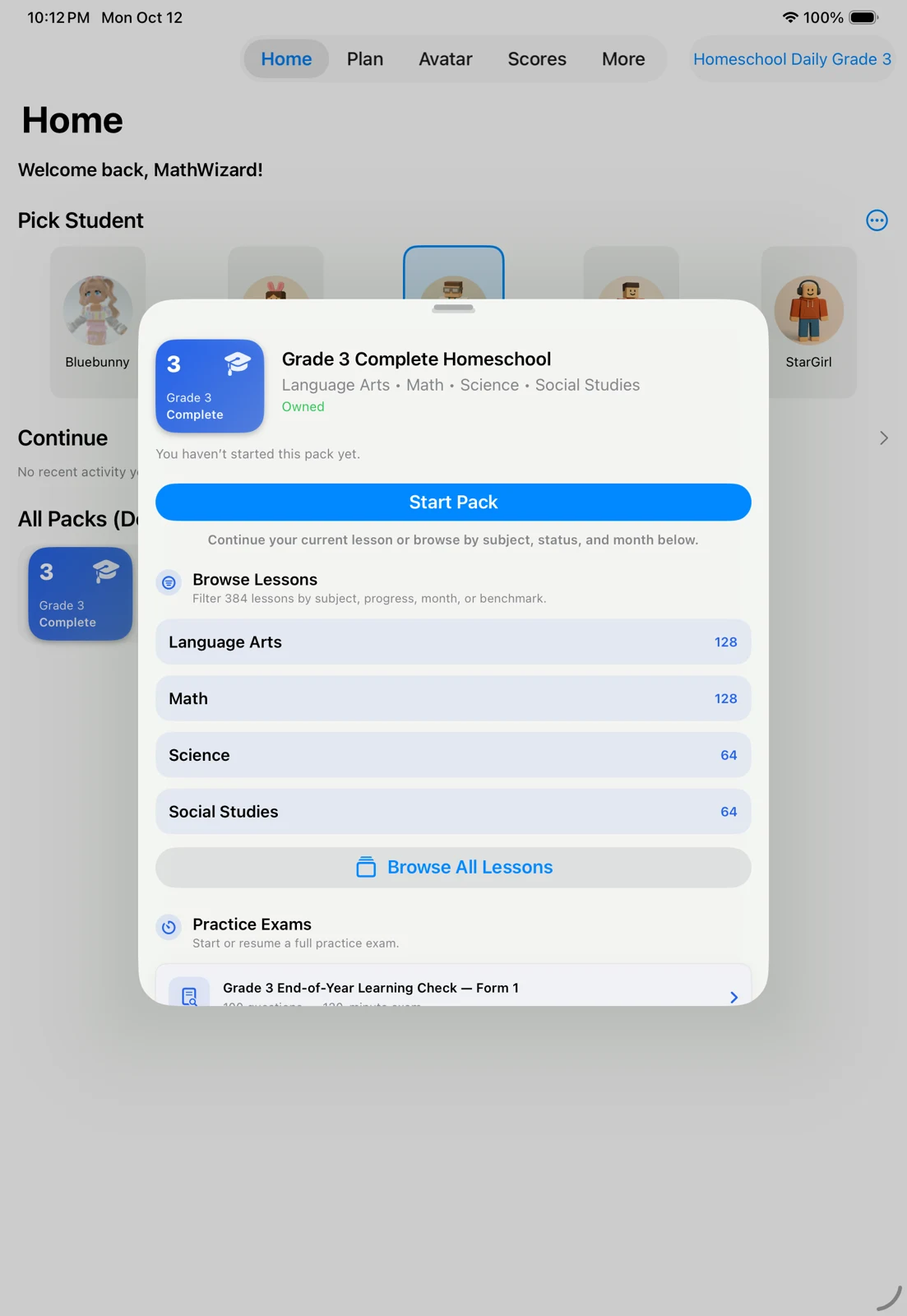
See the learning path
Grade 3 app example: organized subjects and lessons.
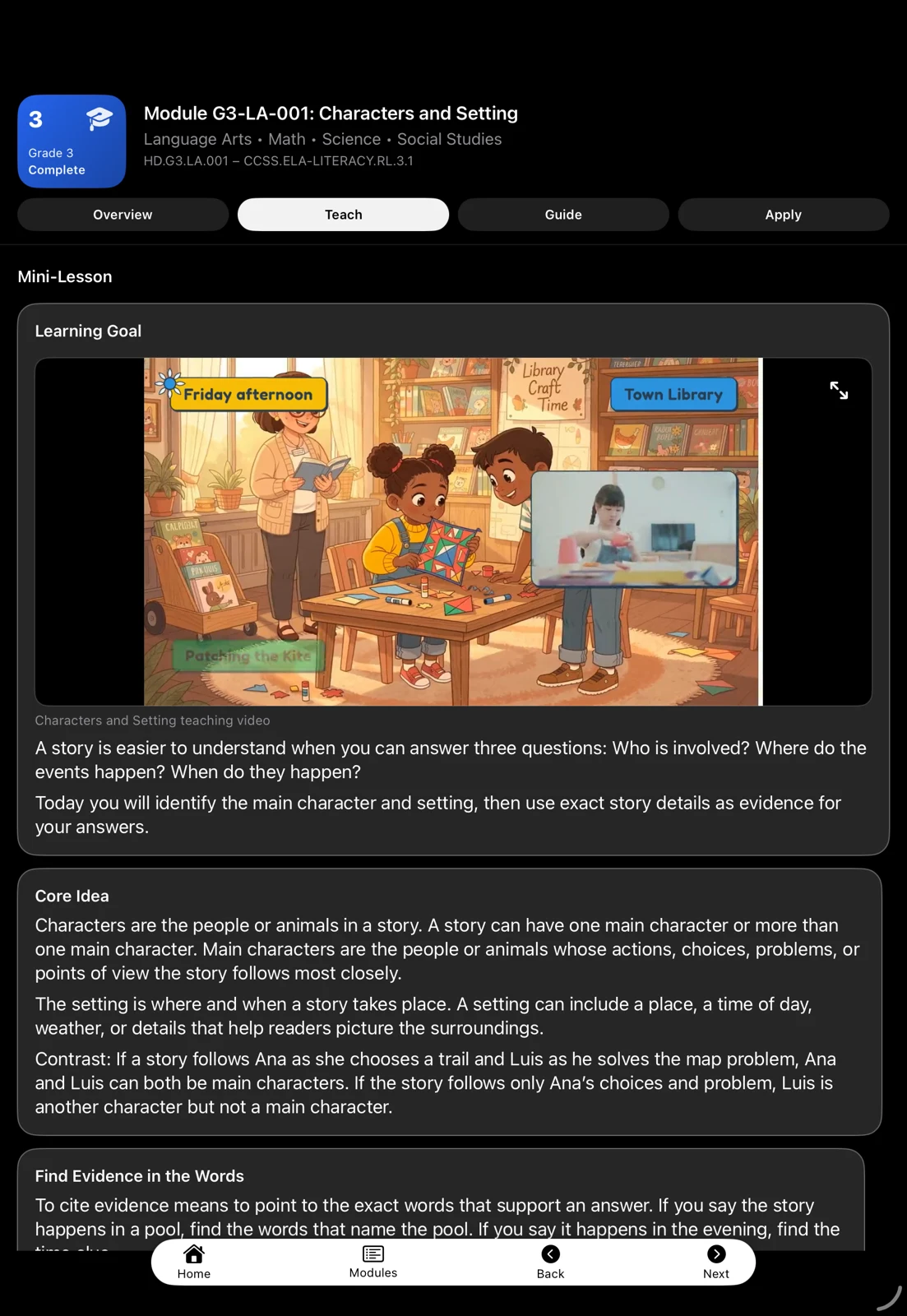
Learn one idea at a time
Grade 3 app example: a lesson on characters and setting.
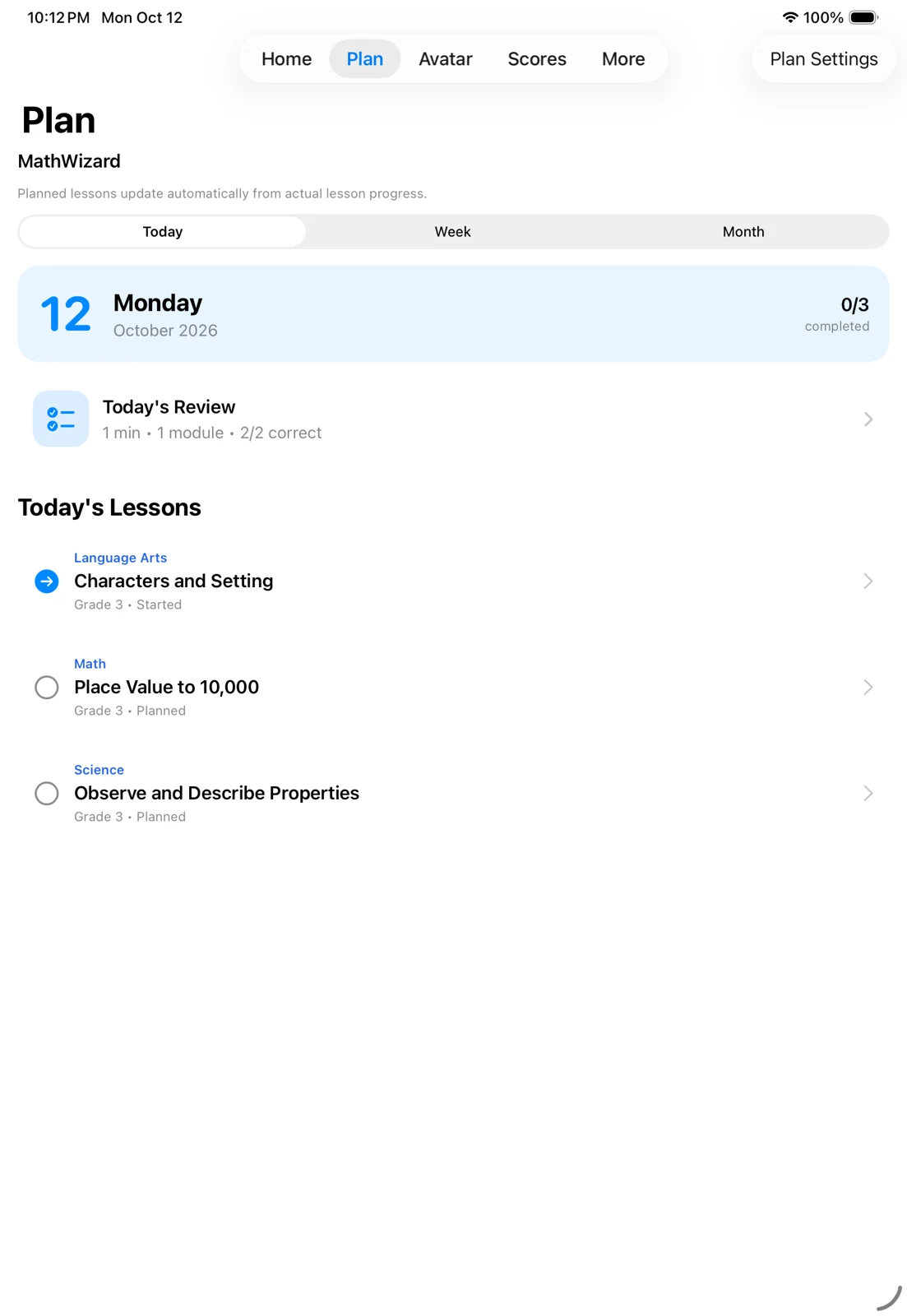
Make room for a daily routine
Grade 3 app example: the daily learning plan.
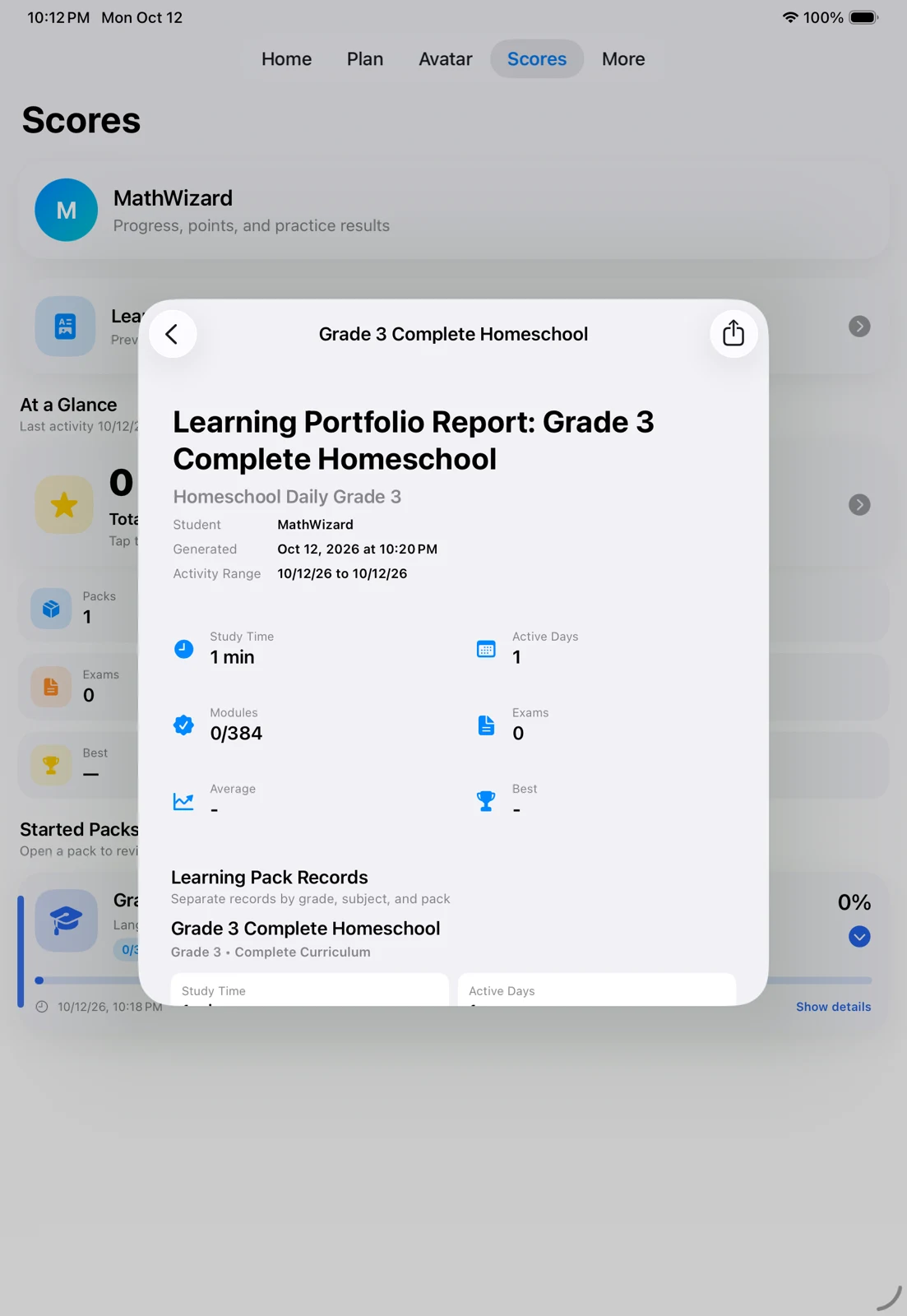
Keep a record of progress
Grade 3 app example: learning portfolio tools.
FROM CART TO CONFIDENCE
Your next steps are simple.
-
01
Get the app
Install the app for your chosen pack. Available store links are on its product page.
-
02
Choose your packs
Mix packs from different apps in one cart and pay once.
-
03
Unlock and learn
We email an itemized receipt and a license key for each pack. Enter each key in its app under More → Activation Keys.
Each license supports up to two devices at once. Website purchases unlock content in the named app; they are not a separate browser-based course.