Homeschool Daily Grade 7 / Grade 7
Grade 7 Complete Homeschool
A complete grade-level pack across four core subjects, with a clear lesson-by-lesson learning path.
WHAT’S INSIDE
Know what you’ll learn.
Explore the lessons in this pack.
Open a topic for a closer look.
01 Language Arts Several Clues, One Inference
Form a literary inference from several details. Cite distinct passages supporting that inference.
Topic reference: HD.G7.LA.001
02 Math Balances on Either Side of Zero
Interpret a signed quantity relative to a reference value. Identify opposite quantities that combine to zero.
Topic reference: HD.G7.MATH.001
03 Science Properties Before and After a Change
Compare measured properties before and after an interaction. Identify evidence relevant to formation of a new substance.
Topic reference: HD.G7.SCI.001
04 Language Arts What the Passage Actually Says
Distinguish explicit information from a literary inference. Explain the evidence connecting an inference to the text.
Topic reference: HD.G7.LA.002
05 Math Joining Signed Changes
Model addition of signed integers on a number line. Explain the direction of movement for a negative addend.
Topic reference: HD.G7.MATH.002
06 Social Studies Questions for a Connected World
Form a supporting question about a world-history inquiry. Explain its connection to the larger inquiry.
Topic reference: HD.G7.SS.001
07 Language Arts Weighing a Conflicting Detail
Identify a detail that challenges an interpretation. Revise the interpretation to account for the detail.
Topic reference: HD.G7.LA.003
08 Math Two Negatives in a Sum
Calculate a sum of two negative integers. Check the sum against the starting location.
Topic reference: HD.G7.MATH.003
09 Science A Change That Is Not Enough Evidence
Distinguish a physical change from evidence of reaction. Explain why one visible sign may be inconclusive.
Topic reference: HD.G7.SCI.002
10 Language Arts Building a Supported Reading
Write a brief interpretation supported by multiple quotations. Explain how each quotation contributes evidence.
Topic reference: HD.G7.LA.004
11 Math Signs With Different Magnitudes
Calculate an integer sum with unlike signs. Explain the result using zero pairs.
Topic reference: HD.G7.MATH.004
12 Social Studies A Source Useful for This Question
Evaluate a historical source's relevance to an inquiry. Explain how its origin affects its usefulness.
Topic reference: HD.G7.SS.002
13 Language Arts A Theme Takes Shape
State a defensible theme in a story. Identify an early detail introducing that theme.
Topic reference: HD.G7.LA.005
14 Math Removing a Negative Change
Rewrite integer subtraction as addition of an opposite. Explain why removing a negative changes the direction.
Topic reference: HD.G7.MATH.005
15 Science Testing a Reaction Claim
Select property measurements that could test a reaction claim. Identify a variable to control in the comparison.
Topic reference: HD.G7.SCI.003
16 Language Arts Following a Theme Through Change
Trace a theme across the middle of a narrative. Explain how a character's response develops it.
Topic reference: HD.G7.LA.006
17 Math Distance Between Signed Locations
Calculate distance between two rational locations. Distinguish distance from signed displacement.
Topic reference: HD.G7.MATH.006
18 Social Studies Reading a Source in Its Own Time
Interpret a source using its historical context. Identify a modern assumption that could distort the reading.
Topic reference: HD.G7.SS.003
19 Language Arts An Ending That Changes Meaning
Explain how an ending develops a theme. Compare the ending's evidence with an earlier moment.
Topic reference: HD.G7.LA.007
20 Math Recovering a Missing Change
Determine a missing addend in a signed-number relationship. Verify the missing value by substitution.
Topic reference: HD.G7.MATH.007
21 Science An Explanation From Several Observations
Construct a reaction explanation using multiple observations. State a limitation of the available evidence.
Topic reference: HD.G7.SCI.004
22 Language Arts An Objective Story Summary
Summarize a story's essential events objectively. Separate summary from personal evaluation.
Topic reference: HD.G7.LA.008
23 Math Several Changes in One Record
Combine a sequence of positive and negative changes. Justify a useful regrouping of the changes.
Topic reference: HD.G7.MATH.008
24 Social Studies Corroboration Before a Conclusion
Compare evidence from two historical sources. Identify agreement and a remaining evidentiary gap.
Topic reference: HD.G7.SS.004
25 Language Arts Context Before a Guess
Infer an unfamiliar word's meaning from its sentence. Identify the contextual clue supporting the inference.
Topic reference: HD.G7.LA.009
26 Math Fraction Steps Across Zero
Add signed fractions with a common denominator. Locate the resulting sum on a number line.
Topic reference: HD.G7.MATH.009
27 Science Atoms Rearranged Into New Groups
Model atom rearrangement in a chemical reaction. Distinguish changing bonds from changing atom identity.
Topic reference: HD.G7.SCI.005
28 Language Arts Word Parts as Evidence
Infer a meaning from a Greek or Latin word part. Check that meaning against the surrounding paragraph.
Topic reference: HD.G7.LA.010
29 Math Unlike Fractional Changes
Add signed fractions with unlike denominators. Explain the equivalent-unit conversion used in the sum.
Topic reference: HD.G7.MATH.010
30 Social Studies Maps With a Time as Well as a Place
Interpret a historical map's date and spatial extent. Distinguish historical regions from modern political boundaries.
Topic reference: HD.G7.SS.005
31 Language Arts Choosing the Right Reference Entry
Select a dictionary meaning suited to a passage. Use the entry to identify the word's part of speech.
Topic reference: HD.G7.LA.011
32 Math Decimal Changes and Differences
Subtract signed decimals in a measurement context. Check the sign of the result by estimation.
Topic reference: HD.G7.MATH.011
33 Science Counting Across a Reaction Model
Count each atom type on both sides of a model. Identify a model that fails to conserve atoms.
Topic reference: HD.G7.SCI.006
34 Language Arts Verifying a Preliminary Meaning
Compare an inferred meaning with a reference source. Revise the inference when the evidence disagrees.
Topic reference: HD.G7.LA.012
35 Math Choosing a Useful Number Form
Convert a rational quantity to a useful equivalent form. Solve an additive problem using that form.
Topic reference: HD.G7.MATH.012
36 Social Studies Barriers and Corridors of Movement
Explain how a physical feature shapes a route. Support the route explanation with physical-map evidence.
Topic reference: HD.G7.SS.006
37 Language Arts Phrases Doing Different Jobs
Identify a phrase's function in a sentence. Explain the word or idea it modifies.
Topic reference: HD.G7.LA.013
38 Math A Negative Quantity Repeated
Calculate a negative number times a positive integer. Explain the product using repeated signed changes.
Topic reference: HD.G7.MATH.013
39 Science Mass in a Closed Reaction System
Explain mass conservation using a particle model. Relate the model to closed-system measurements.
Topic reference: HD.G7.SCI.007
40 Language Arts Independent and Dependent Clauses
Distinguish independent from dependent clauses. Explain how a dependent clause contributes meaning.
Topic reference: HD.G7.LA.014
41 Math Extending the Product Pattern
Predict a negative-times-negative product using a pattern. Justify the sign using the distributive property.
Topic reference: HD.G7.MATH.014
42 Social Studies Building a Map of Connections
Construct a map of a bounded exchange network. Use symbols and a legend to communicate the relationships.
Topic reference: HD.G7.SS.007
43 Language Arts Clauses in a Compound Sentence
Construct a compound sentence expressing related ideas. Explain the relationship signaled by its connector.
Topic reference: HD.G7.LA.015
44 Math Signs in Longer Products
Determine the sign of a product with several factors. Calculate the product after grouping magnitudes.
Topic reference: HD.G7.MATH.015
45 Science When a Gas Leaves the Container
Explain an apparent mass decrease in an open system. Identify the boundary needed for a conservation account.
Topic reference: HD.G7.SCI.008
46 Language Arts Complex Sentences for Precise Relations
Construct a complex sentence with a purposeful dependent clause. Explain how clause order affects emphasis.
Topic reference: HD.G7.LA.016
47 Math Scaling a Signed Fraction
Multiply signed rational numbers. Check whether the product magnitude fits the scale factor.
Topic reference: HD.G7.MATH.016
48 Social Studies Transport Changes the Reach of Exchange
Explain how a transport development changes connections. Cite a geographic constraint that still remains.
Topic reference: HD.G7.SS.008
49 Language Arts Two Ideas in One Article
Identify two central ideas in an informational text. Assign relevant details to each idea.
Topic reference: HD.G7.LA.017
50 Math A Quotient as a Missing Factor
Determine the sign of a rational quotient. Verify the quotient with multiplication.
Topic reference: HD.G7.MATH.017
51 Science From a Resource to a New Material
Trace a synthetic material to its natural-resource inputs. Identify a chemical process in the transformation.
Topic reference: HD.G7.SCI.009
52 Language Arts An Idea Developed Across Sections
Trace one central idea through several sections. Explain how later evidence develops the idea.
Topic reference: HD.G7.LA.018
53 Math Dividing Signed Fractions
Calculate a quotient of signed fractions. Explain the reciprocal step using a missing-factor relationship.
Topic reference: HD.G7.MATH.018
54 Social Studies Roman Institutions After Political Change
Identify continuity after western Roman political fragmentation. Explain a change in regional authority.
Topic reference: HD.G7.SS.009
55 Language Arts Connecting Central Ideas
Explain a relationship between two central ideas. Support the relationship with several textual details.
Topic reference: HD.G7.LA.019
56 Math Quotients Written as Decimals
Convert a rational fraction using long division. Classify its decimal as terminating or repeating.
Topic reference: HD.G7.MATH.019
57 Science Properties That Make a Material Useful
Connect a synthetic material's properties to a use. Cite evidence supporting that connection.
Topic reference: HD.G7.SCI.010
58 Language Arts A Balanced Nonfiction Summary
Summarize multiple central ideas objectively. Remove details that distort the article's emphasis.
Topic reference: HD.G7.LA.020
59 Math Why Zero Cannot Be a Divisor
Explain why a nonzero number divided by zero has no quotient. Distinguish zero as dividend from zero as divisor.
Topic reference: HD.G7.MATH.020
60 Social Studies Constantinople at a Crossroads
Explain the strategic importance of Constantinople's location. Connect geography to trade or governance evidence.
Topic reference: HD.G7.SS.010
61 Language Arts An Idea Influences an Event
Explain how an idea influences an event in a text. Cite evidence for the connection.
Topic reference: HD.G7.LA.021
62 Math A Calculation With Grouping
Evaluate a rational expression with grouping symbols. Identify which operation must occur first.
Topic reference: HD.G7.MATH.021
63 Science Benefits and Costs of a Material
Compare a material's benefits and societal impacts. Distinguish documented evidence from promotional claims.
Topic reference: HD.G7.SCI.011
64 Language Arts People and Ideas Affect Each Other
Analyze how an individual's actions change an idea's influence. Distinguish the author's evidence from an unsupported assumption.
Topic reference: HD.G7.LA.022
65 Math Changes in a Measured Rate
Solve a multistep rational-number context. Interpret the final sign with its units.
Topic reference: HD.G7.MATH.022
66 Social Studies Law and Authority in Byzantium
Explain how legal traditions supported Byzantine rule. Distinguish continuity from later adaptation.
Topic reference: HD.G7.SS.011
67 Language Arts Why This Section Comes Next
Explain a section's contribution to an informational text. Relate its placement to the development of an idea.
Topic reference: HD.G7.LA.023
68 Math Comparing Two Calculation Routes
Compare equivalent operation sequences for one rational calculation. Explain which route reduces arithmetic complexity.
Topic reference: HD.G7.MATH.023
69 Science Explaining a Material Choice
Construct an evidence-based explanation of a material choice. Acknowledge a tradeoff in production or disposal.
Topic reference: HD.G7.SCI.012
70 Language Arts Testing a Structural Revision
Evaluate the effect of moving or removing a section. Support the evaluation with the text's logical relationships.
Topic reference: HD.G7.LA.024
71 Math Repairing a Signed Calculation
Identify the first invalid step in a rational calculation. Correct the step using an operation property.
Topic reference: HD.G7.MATH.024
72 Social Studies Different Paths Around the Mediterranean
Compare post-Roman developments in two regions. Explain a contextual factor contributing to the difference.
Topic reference: HD.G7.SS.012
73 Language Arts A Focus for an Explanation
Narrow an explanatory topic for a defined audience. State the focus in an introductory claim.
Topic reference: HD.G7.LA.025
74 Math One Unit From Fractional Measures
Calculate a unit rate from two fractional quantities. State the compound unit of the rate.
Topic reference: HD.G7.MATH.025
75 Science A Reaction Transfers Thermal Energy
Interpret temperature evidence for an energy-releasing or absorbing process. Describe energy transfer across the device boundary.
Topic reference: HD.G7.SCI.013
76 Language Arts Organizing Related Information
Group explanatory details into meaningful sections. Explain the order chosen for the sections.
Topic reference: HD.G7.LA.026
77 Math Which Rate Answers the Question
Distinguish reciprocal rates in one context. Select the rate suited to a stated comparison.
Topic reference: HD.G7.MATH.026
78 Social Studies An Emerging Community in Arabia
Place early Islam in its Arabian historical context. Distinguish a religious belief from a historian's evidence claim.
Topic reference: HD.G7.SS.013
79 Language Arts Developing With Concrete Evidence
Expand an explanation using relevant facts and examples. Connect the examples to the section's main idea.
Topic reference: HD.G7.LA.027
80 Math Comparing Fractional Rates
Compare two rates expressed with fractional measures. Justify the comparison using a common unit.
Topic reference: HD.G7.MATH.027
81 Science Criteria for a Thermal Device
Define measurable criteria for a reaction-powered thermal device. Identify safety and material constraints.
Topic reference: HD.G7.SCI.014
82 Language Arts A Conclusion That Follows
Draft a conclusion grounded in an explanation. Distinguish a supported implication from a new unsupported claim.
Topic reference: HD.G7.LA.028
83 Math A Rate Across Measurement Units
Convert compatible units before finding a rate. Explain how the conversion changes the numerical rate.
Topic reference: HD.G7.MATH.028
84 Social Studies Cities Linked Across Regions
Explain how urban networks supported exchange in Islamic societies. Cite route or location evidence.
Topic reference: HD.G7.SS.014
85 Language Arts Transitions Between Explanatory Ideas
Use transitions to clarify relationships in an explanation. Explain the relationship expressed by a selected transition.
Topic reference: HD.G7.LA.029
86 Math A Constant Ratio Test
Determine whether a table has a constant ratio. Identify the constant of proportionality when it exists.
Topic reference: HD.G7.MATH.029
87 Science Comparing Two Thermal Designs
Evaluate device designs using common test data. Explain which design better satisfies a stated criterion.
Topic reference: HD.G7.SCI.015
88 Language Arts Precise Terms for an Audience
Replace vague wording with accurate explanatory language. Define a technical term when the audience needs it.
Topic reference: HD.G7.LA.030
89 Math The Starting Fee Matters
Explain why an added fixed fee breaks proportionality. Contrast the relationship with one starting at zero.
Topic reference: HD.G7.MATH.030
90 Social Studies Learning Across Languages
Explain a contribution of translation and scholarship to exchange. Identify evidence of interaction among communities.
Topic reference: HD.G7.SS.015
91 Language Arts Removing Redundant Explanations
Revise redundant explanatory sentences concisely. Preserve the original necessary meaning.
Topic reference: HD.G7.LA.031
92 Math Completing a Proportional Table
Find a missing quantity in a proportional table. Verify the value using a second pair.
Topic reference: HD.G7.MATH.031
93 Science A Revision Based on Thermal Evidence
Propose a device modification from test results. Explain the expected improvement and remaining tradeoff.
Topic reference: HD.G7.SCI.016
94 Language Arts Revising a Complete Explanation
Revise an explanatory draft for coherence. Justify a major change using audience and purpose.
Topic reference: HD.G7.LA.032
95 Math A Counterexample to Proportionality
Identify a pair that disproves a proportional claim. Explain why matching differences alone is insufficient.
Topic reference: HD.G7.MATH.032
96 Social Studies Authority and Diversity Across Empires
Compare forms of authority in two Islamic political settings. Explain why empire and religious community are not identical categories.
Topic reference: HD.G7.SS.016
97 Language Arts A Setting That Restricts Choices
Explain how a setting shapes a character's options. Cite a resulting plot consequence.
Topic reference: HD.G7.LA.033
98 Math Proportional Points on a Plane
Plot a proportional relationship from a table. Explain why its graph passes through the origin.
Topic reference: HD.G7.MATH.033
99 Science Matter Entering a Growing Plant
Identify matter inputs used in photosynthesis. Explain why soil alone cannot account for plant growth.
Topic reference: HD.G7.SCI.017
100 Language Arts One Event, Different Perspectives
Compare two characters' views of one event. Identify details developing the contrast.
Topic reference: HD.G7.LA.034
101 Math Reading the Unit-Rate Point
Interpret the point with first coordinate one. Connect its second coordinate to the constant ratio.
Topic reference: HD.G7.MATH.034
102 Social Studies Trade Across the Sahara
Explain how environments shaped trans-Saharan trade. Identify resources exchanged along a documented route.
Topic reference: HD.G7.SS.017
103 Language Arts What a Narrator Chooses to Reveal
Analyze how narration develops a viewpoint. Explain the effect of withholding a detail.
Topic reference: HD.G7.LA.035
104 Math An Equation for a Proportional Model
Write an equation of the form y equals k times x. Interpret the coefficient in the modeled context.
Topic reference: HD.G7.MATH.035
105 Science Light Energy and Chemical Storage
Explain light's role in photosynthesis. Distinguish an energy input from a matter input.
Topic reference: HD.G7.SCI.018
106 Language Arts Interactions That Move the Plot
Explain how character and setting interact to move a plot. Support the explanation with linked events.
Topic reference: HD.G7.LA.036
107 Math Matching Table, Graph, and Equation
Match three representations of one proportional relationship. Reject a representation with an inconsistent rate.
Topic reference: HD.G7.MATH.036
108 Social Studies Mali and the Movement of Wealth
Explain a connection between trade and authority in Mali. Support the explanation with bounded historical evidence.
Topic reference: HD.G7.SS.018
109 Language Arts An Image Beyond Literal Meaning
Interpret a figure of speech in a literary passage. Explain its effect on the passage's meaning.
Topic reference: HD.G7.LA.037
110 Math Scaling a Mixture Consistently
Determine an equivalent mixture using proportional reasoning. Explain why changing only one ingredient changes the ratio.
Topic reference: HD.G7.MATH.037
111 Science Tracing Carbon Into Plant Material
Model carbon moving from air into plant sugars. Explain how the model accounts for added plant matter.
Topic reference: HD.G7.SCI.019
112 Language Arts Allusions With Supplied Context
Interpret an allusion using a supplied source account. Explain the association it brings to the passage.
Topic reference: HD.G7.LA.038
113 Math A Missing Measure in a Proportion
Solve for an unknown proportional quantity. Check the solution with its units and context.
Topic reference: HD.G7.MATH.038
114 Social Studies Cities on the Swahili Coast
Compare Indian Ocean connections of Swahili city-states. Explain a geographic factor supporting maritime exchange.
Topic reference: HD.G7.SS.019
115 Language Arts Similar Definitions, Different Associations
Compare connotations of words with similar definitions. Explain how a word choice shapes tone.
Topic reference: HD.G7.LA.039
116 Math Two Competing Proportional Plans
Compare costs under two proportional pricing models. Explain the constant-rate reason for the comparison.
Topic reference: HD.G7.MATH.039
117 Science Evidence for a Photosynthesis Explanation
Construct a photosynthesis explanation from investigation evidence. Identify a condition limiting the explanation.
Topic reference: HD.G7.SCI.020
118 Language Arts Sound Repeated for an Effect
Analyze the effect of repeated sounds in a literary passage. Cite the words producing that effect.
Topic reference: HD.G7.LA.040
119 Math When a Proportion Is Not Appropriate
Decide whether a situation supports proportional modeling. Identify an assumption needed for the model.
Topic reference: HD.G7.MATH.040
120 Social Studies Sources for Several African Histories
Compare oral, material, and written historical evidence. Identify what each source type can and cannot establish.
Topic reference: HD.G7.SS.020
121 Language Arts A Stanza as a Meaningful Unit
Explain how a stanza contributes to a poem's meaning. Relate its idea to a neighboring stanza.
Topic reference: HD.G7.LA.041
122 Math Locating the Percent Base
Identify the whole in a percent situation. Calculate a part from the stated whole and rate.
Topic reference: HD.G7.MATH.041
123 Science Food Molecules Can Be Rearranged
Model food reacting with oxygen in cellular respiration. Trace matter into resulting products.
Topic reference: HD.G7.SCI.021
124 Language Arts Pauses Across Poetic Lines
Analyze how a line break directs a reader's attention. Support the analysis with specific wording.
Topic reference: HD.G7.LA.042
125 Math Recovering the Whole
Determine a whole from a known percent and part. Check the reconstructed whole by multiplication.
Topic reference: HD.G7.MATH.042
126 Social Studies Institutions in Tang and Song China
Explain continuity and change in Chinese government. Cite a development supporting the comparison.
Topic reference: HD.G7.SS.021
127 Language Arts A Refrain That Develops Meaning
Trace the changing effect of a repeated poetic phrase. Explain how context alters its significance.
Topic reference: HD.G7.LA.043
128 Math Finding an Unstated Percent
Calculate the percent represented by a part. Explain the relationship between ratio and percent.
Topic reference: HD.G7.MATH.043
129 Science Energy for Cellular Work
Explain how food processing supports organism activities. Distinguish transferred energy from recycled matter.
Topic reference: HD.G7.SCI.022
130 Language Arts Form and the Speaker's Message
Explain how a poem's structure supports its message. Cite both structural and verbal evidence.
Topic reference: HD.G7.LA.044
131 Math Comparisons With Different Wholes
Compare percent claims based on different totals. Explain why larger percent need not mean larger quantity.
Topic reference: HD.G7.MATH.044
132 Social Studies Technology Travels Through Networks
Trace a documented technological transmission. Explain an adaptation associated with its use elsewhere.
Topic reference: HD.G7.SS.022
133 Language Arts Stage Directions Shape a Scene
Explain how a stage direction affects a dramatic interaction. Connect the direction to character or conflict.
Topic reference: HD.G7.LA.045
134 Math A Change Relative to the Start
Calculate percent increase from an initial amount. Identify the initial amount as the comparison base.
Topic reference: HD.G7.MATH.045
135 Science Growth Uses Matter From Food
Explain how food matter contributes to growth or repair. Trace a plausible matter pathway into body structures.
Topic reference: HD.G7.SCI.023
136 Language Arts Dialogue With Unequal Knowledge
Analyze an interaction between differently informed characters. Cite dialogue revealing the difference.
Topic reference: HD.G7.LA.046
137 Math A Decrease Relative to the Start
Calculate percent decrease in a quantity. Check that the rate matches the stated change.
Topic reference: HD.G7.MATH.046
138 Social Studies Connections Under Mongol Rule
Explain how Mongol rule affected Eurasian connections. Distinguish expanded exchange from its human costs.
Topic reference: HD.G7.SS.023
139 Language Arts A Character Speaks Alone
Explain the contribution of a soliloquy to a drama. Distinguish private reflection from dialogue with another character.
Topic reference: HD.G7.LA.047
140 Math Multipliers for Percent Changes
Represent a percent change with a multiplier. Use the multiplier to find the final amount.
Topic reference: HD.G7.MATH.047
141 Science Connecting Photosynthesis and Respiration
Compare matter pathways in photosynthesis and respiration. Explain why their energy relationships are not a closed energy cycle.
Topic reference: HD.G7.SCI.024
142 Language Arts The Structure of a Turning Point
Analyze how a scene's structure develops a turning point. Support the analysis with a change in dramatic action.
Topic reference: HD.G7.LA.048
143 Math Undoing a Percent Change
Recover an original amount from a changed value. Explain why an opposite percent does not generally undo the change.
Topic reference: HD.G7.MATH.048
144 Social Studies Japan's Regional Adaptations
Compare a Japanese institution with an external influence. Explain how local circumstances shaped its adaptation.
Topic reference: HD.G7.SS.024
145 Language Arts A Narrative Situation With Stakes
Plan a narrative situation with a clear conflict. Establish a narrator suited to the situation.
Topic reference: HD.G7.LA.049
146 Math A Total With Tax
Calculate a purchase total from a stated tax rate. Identify which charges belong in the stated tax base.
Topic reference: HD.G7.MATH.049
147 Science Structures That Support Pollination
Explain how a plant structure supports reproductive success. Cite evidence connecting structure and pollinator behavior.
Topic reference: HD.G7.SCI.025
148 Language Arts Events That Grow From Choices
Outline events linked by character decisions. Explain the causal connection between two events.
Topic reference: HD.G7.LA.050
149 Math A Discount Followed by Tax
Calculate successive percent changes in order. Explain why the second base differs from the first.
Topic reference: HD.G7.MATH.050
150 Social Studies Seasonal Winds and Maritime Routes
Explain how monsoon patterns affected travel timing. Support the explanation using a route map.
Topic reference: HD.G7.SS.025
151 Language Arts Dialogue That Changes the Scene
Draft dialogue that advances a narrative. Explain what the exchange reveals about a character.
Topic reference: HD.G7.LA.051
152 Math Earnings With a Commission
Calculate a commission from a stated sales amount. Combine commission and fixed pay in a total.
Topic reference: HD.G7.MATH.051
153 Science Different Routes for Pollen
Compare pollination mechanisms using observations. Explain why a feature is useful in one mechanism.
Topic reference: HD.G7.SCI.026
154 Language Arts Pacing an Important Moment
Expand a significant narrative moment with detail. Condense less important time without losing coherence.
Topic reference: HD.G7.LA.052
155 Math Interest for a Stated Time
Calculate simple interest with compatible time units. Distinguish interest from the final account balance.
Topic reference: HD.G7.MATH.052
156 Social Studies Political Power in South Asian Settings
Compare authority in two bounded South Asian settings. Identify a contextual factor shaping each arrangement.
Topic reference: HD.G7.SS.026
157 Language Arts Details That Place the Reader
Add precise sensory details to a narrative scene. Explain how the details serve the scene's purpose.
Topic reference: HD.G7.LA.053
158 Math Measurement Error as a Percent
Calculate percent error relative to an accepted value. Explain the role of absolute difference.
Topic reference: HD.G7.MATH.053
159 Science Animal Behavior and Reproductive Success
Construct an argument linking behavior to reproduction. Distinguish correlation from sufficient causal evidence.
Topic reference: HD.G7.SCI.027
160 Language Arts Signals Through Shifts in Time
Use transitions to signal a narrative time shift. Preserve clarity about event order.
Topic reference: HD.G7.LA.054
161 Math A Budget With Several Rates
Solve a budget problem involving different percent bases. Check that the parts reconcile with the total.
Topic reference: HD.G7.MATH.054
162 Social Studies Port Cities and Cultural Exchange
Explain how a port city supported cultural interaction. Distinguish evidence of exchange from cultural uniformity.
Topic reference: HD.G7.SS.027
163 Language Arts An Ending Earned by the Story
Draft an ending reflecting the narrative's events. Explain its connection to the character's experience.
Topic reference: HD.G7.LA.055
164 Math Testing a Sale Claim
Evaluate a claimed equivalent discount. Support the decision with a countercalculation.
Topic reference: HD.G7.MATH.055
165 Science A Changed Pollination Relationship
Predict how a changed interaction could affect reproduction. Qualify the prediction using limitations of the evidence.
Topic reference: HD.G7.SCI.028
166 Language Arts Revising a Narrative Arc
Revise a narrative for coherent development. Justify a change to pacing or event placement.
Topic reference: HD.G7.LA.056
167 Math Choosing Between Percent Strategies
Select a suitable route for a multistep percent problem. Explain why its intermediate quantities are meaningful.
Topic reference: HD.G7.MATH.056
168 Social Studies Beliefs in Historical Context
Compare documented religious practices in two historical communities. Acknowledge diversity within the traditions being compared.
Topic reference: HD.G7.SS.028
169 Language Arts Compound-Complex Relationships
Construct a compound-complex sentence expressing linked ideas. Explain the function of each clause.
Topic reference: HD.G7.LA.057
170 Math Terms With Rational Coefficients
Identify like terms in a rational expression. Combine their coefficients without changing the variable part.
Topic reference: HD.G7.MATH.057
171 Science Environmental Conditions and Growth
Analyze growth data under different environmental conditions. Identify a condition associated with a growth difference.
Topic reference: HD.G7.SCI.029
172 Language Arts Moving a Misplaced Modifier
Revise a sentence with a misplaced modifier. Explain which meaning the revision clarifies.
Topic reference: HD.G7.LA.058
173 Math Distributing a Negative Factor
Expand an expression with a negative rational factor. Explain the sign of each resulting term.
Topic reference: HD.G7.MATH.058
174 Social Studies Land, Labor, and Obligations
Explain relationships in a bounded medieval rural setting. Identify whose perspective a source represents.
Topic reference: HD.G7.SS.029
175 Language Arts Giving a Dangling Phrase a Subject
Correct a dangling modifier in a sentence. Identify the actor required by the modifying phrase.
Topic reference: HD.G7.LA.059
176 Math Adding Algebraic Expressions
Add two linear expressions with rational coefficients. Check the sum at a chosen input.
Topic reference: HD.G7.MATH.059
177 Science Inherited Factors and Growth Patterns
Compare growth patterns of organisms under common conditions. Explain evidence consistent with a genetic contribution.
Topic reference: HD.G7.SCI.030
178 Language Arts Commas Between Coordinate Adjectives
Determine whether adjectives are coordinate. Punctuate the adjective sequence appropriately.
Topic reference: HD.G7.LA.060
179 Math Subtracting Algebraic Expressions
Simplify a difference of linear expressions. Explain why all terms in the subtracted group change sign.
Topic reference: HD.G7.MATH.060
180 Social Studies Towns and New Opportunities
Explain how town growth changed economic opportunities. Identify a group for whom opportunities remained limited.
Topic reference: HD.G7.SS.030
181 Language Arts Checking Spelling in Context
Correct a misspelled word using an appropriate reference. Verify that the corrected word fits the sentence.
Topic reference: HD.G7.LA.061
182 Math Factoring a Shared Rational Factor
Factor a linear expression using a common factor. Verify the result by expansion.
Topic reference: HD.G7.MATH.061
183 Science Separating Two Possible Influences
Plan a comparison of environmental and genetic growth factors. Identify variables needed to avoid confounding.
Topic reference: HD.G7.SCI.031
184 Language Arts Editing Mechanics Without Changing Meaning
Edit capitalization and punctuation in a paragraph. Explain how a selected correction clarifies meaning.
Topic reference: HD.G7.LA.062
185 Math An Expression That Reveals a Change
Rewrite an expression to show an increase or decrease. Interpret the rewritten factor in context.
Topic reference: HD.G7.MATH.062
186 Social Studies Religious Institutions and Public Life
Analyze a religious institution's historical social role. Distinguish institutional influence from uniform personal belief.
Topic reference: HD.G7.SS.031
187 Language Arts Precise and Concise Sentences
Revise wordy sentences without losing necessary detail. Explain why the revision is more precise.
Topic reference: HD.G7.LA.063
188 Math Equivalent Forms With Different Uses
Select an equivalent expression suited to a question. Explain the information that its form makes visible.
Topic reference: HD.G7.MATH.063
189 Science An Explanation With Multiple Factors
Construct a growth explanation using genetic and environmental evidence. Explain why the evidence does not determine every individual's outcome.
Topic reference: HD.G7.SCI.032
190 Language Arts Using Academic Vocabulary Accurately
Use a newly studied academic word in original writing. Verify its meaning and grammatical use.
Topic reference: HD.G7.LA.064
191 Math Disproving an Equivalence Claim
Find a value that disproves a proposed identity. Locate the algebraic error behind the claim.
Topic reference: HD.G7.MATH.064
192 Social Studies Disease and Social Change
Explain multiple consequences of a medieval epidemic. Separate supported causal links from coincidence.
Topic reference: HD.G7.SS.032
193 Language Arts Following an Argument's Reasoning
Trace the reasoning connecting evidence to a claim. Identify an unstated assumption in that connection.
Topic reference: HD.G7.LA.065
194 Math Translating a Multistep Situation
Write an expression for a multistep quantity. Explain what each operation represents.
Topic reference: HD.G7.MATH.065
195 Science One Parent and Similar Offspring
Model inheritance in asexual reproduction. Explain why offspring are typically genetically similar.
Topic reference: HD.G7.SCI.033
196 Language Arts Relevant Evidence for a Specific Claim
Evaluate evidence for relevance to a claim. Explain why an appealing detail may be irrelevant.
Topic reference: HD.G7.LA.066
197 Math Estimating Before Calculating
Estimate a multistep rational result. Use the estimate to judge a computed answer.
Topic reference: HD.G7.MATH.066
198 Social Studies Cities and Environments in Mesoamerica
Explain an adaptation linking a Mesoamerican city to its environment. Cite evidence specific to that Mesoamerican community.
Topic reference: HD.G7.SS.033
199 Language Arts Enough Evidence to Support the Reach
Judge whether evidence supports a claim's scope. Identify what additional evidence is needed.
Topic reference: HD.G7.LA.067
200 Math Choosing Exact or Approximate Values
Select an appropriate form for a rational quantity. Explain when rounding should occur in a context.
Topic reference: HD.G7.MATH.067
201 Science Genetic Contributions From Two Parents
Model genetic contributions in sexual reproduction. Explain a source of variation among offspring.
Topic reference: HD.G7.SCI.034
202 Language Arts When Reasoning Breaks Down
Identify an invalid inference in an argument. Explain why the cited evidence does not justify it.
Topic reference: HD.G7.LA.068
203 Math Checking a Practical Constraint
Solve a multistep quantity problem with a limit. Decide whether the computed result meets that limit.
Topic reference: HD.G7.MATH.068
204 Social Studies Andean Networks Across Elevation
Explain how Andean geography shaped political or economic connections. Interpret a dated route or settlement map.
Topic reference: HD.G7.SS.034
205 Language Arts An Author Distinguishes a Position
Explain how an author separates a position from another view. Cite language signaling that distinction.
Topic reference: HD.G7.LA.069
206 Math Building a Two-Step Equation
Model a context with an equation of the form px plus q equals r. Interpret the variable and coefficients.
Topic reference: HD.G7.MATH.069
207 Science Comparing Reproductive Outcomes
Compare variation in sexual and asexual offspring datasets. State a limitation of the small sample.
Topic reference: HD.G7.SCI.035
208 Language Arts Different Evidence, Same Topic
Compare evidence emphasized by two authors. Explain its effect on their presentations.
Topic reference: HD.G7.LA.070
209 Math Solving With Inverse Operations
Solve a two-step equation with rational coefficients. Verify the solution in the original equation.
Topic reference: HD.G7.MATH.070
210 Social Studies North American Societies in Their Regions
Compare two Indigenous societies in distinct North American regions. Explain how local environments shaped a documented practice.
Topic reference: HD.G7.SS.035
211 Language Arts One Fact, Different Interpretations
Compare authors' interpretations of a shared fact. Identify the reasoning leading to each interpretation.
Topic reference: HD.G7.LA.071
212 Math A Group Multiplied Together
Solve an equation of the form p times x plus q in parentheses equals r. Explain the role of grouping in the solution.
Topic reference: HD.G7.MATH.071
213 Science Probabilities Are Not Promises
Interpret a simple inheritance probability model. Explain why a predicted ratio need not appear in a small family.
Topic reference: HD.G7.SCI.036
214 Language Arts Writing a Fair Source Comparison
Write an evidence-based comparison of two authors. Distinguish disagreement about facts from disagreement about meaning.
Topic reference: HD.G7.LA.072
215 Math Arithmetic and Algebra Agree
Compare arithmetic and algebraic routes to a two-step problem. Explain why both routes produce the same unknown.
Topic reference: HD.G7.MATH.072
216 Social Studies Interpreting Indigenous Histories Carefully
Evaluate evidence for a claim about an Indigenous society. Identify a limitation caused by the source's origin or survival.
Topic reference: HD.G7.SS.036
217 Language Arts A Claim Worth Defending
Form a focused claim for an intended audience. Identify evidence needed to support it.
Topic reference: HD.G7.LA.073
218 Math A Perimeter With an Unknown Length
Form a two-step equation from a perimeter relationship. Solve for a contextually valid length.
Topic reference: HD.G7.MATH.073
219 Science From a Gene to a Protein's Role
Describe how a gene contributes to protein structure. Explain how protein function can affect a trait.
Topic reference: HD.G7.SCI.037
220 Language Arts Reasons in a Useful Order
Organize reasons supporting an argument. Explain the connection between a reason and the claim.
Topic reference: HD.G7.LA.074
221 Math A Rational Coefficient in Context
Solve a two-step equation involving a fractional rate. Interpret the solution with the appropriate unit.
Topic reference: HD.G7.MATH.074
222 Social Studies Patronage and New Forms of Expression
Explain how patronage shaped a Renaissance work or practice. Support the explanation using historical context.
Topic reference: HD.G7.SS.037
223 Language Arts Acknowledging an Alternative Claim
State an opposing claim fairly. Distinguish it from the writer's own position.
Topic reference: HD.G7.LA.075
224 Math Finding the Broken Equality Step
Identify a non-equivalent step in an equation solution. Repair it while preserving equality.
Topic reference: HD.G7.MATH.075
225 Science A Change in Genetic Information
Model a mutation as a change in genetic information. Distinguish that change from a temporary environmental effect.
Topic reference: HD.G7.SCI.038
226 Language Arts Answering With Relevant Evidence
Draft a response to a counterclaim. Support the response with relevant evidence.
Topic reference: HD.G7.LA.076
227 Math A Solution and Its Meaning
Evaluate whether an equation solution fits stated restrictions. Explain why a mathematical solution may be impractical.
Topic reference: HD.G7.MATH.076
228 Social Studies Printing Expands an Audience
Explain how printing altered circulation of ideas. Identify a limitation on access to printed material.
Topic reference: HD.G7.SS.038
229 Language Arts Transitions Through an Argument
Use transitions connecting claims and reasons. Explain the logical relation a transition expresses.
Topic reference: HD.G7.LA.077
230 Math From a Limit to an Inequality
Model a practical limit using a two-step inequality. Explain whether the boundary is included.
Topic reference: HD.G7.MATH.077
231 Science Different Consequences of Mutation
Compare beneficial, harmful, and neutral mutation outcomes. Explain why context affects an outcome's significance.
Topic reference: HD.G7.SCI.039
232 Language Arts A Formal Voice With Clear Meaning
Revise argument wording for an appropriate formal style. Remove language that distracts from the reasoning.
Topic reference: HD.G7.LA.078
233 Math Solving a Positive-Factor Inequality
Solve a two-step inequality with a positive coefficient. Graph the solution set on a number line.
Topic reference: HD.G7.MATH.078
234 Social Studies Religious Reform and Political Authority
Explain an interaction between reform and political power. Distinguish the perspectives of two affected groups.
Topic reference: HD.G7.SS.039
235 Language Arts A Conclusion Grounded in Reasons
Draft an argument conclusion following from the evidence. Avoid extending the claim beyond its support.
Topic reference: HD.G7.LA.079
236 Math A Negative Factor Reverses Order
Solve an inequality requiring division by a negative. Justify the reversal with a numerical comparison.
Topic reference: HD.G7.MATH.079
237 Science Evaluating a Gene-to-Trait Model
Identify a limitation in a simplified gene-to-trait model. Revise a claim that treats all traits as single-gene outcomes.
Topic reference: HD.G7.SCI.040
238 Language Arts Revising an Argument's Weakest Link
Identify a weak connection in an argument draft. Revise the connection using stronger reasoning or evidence.
Topic reference: HD.G7.LA.080
239 Math Testing a Boundary and Beyond
Check a boundary and a nonboundary value in an inequality. Interpret the solution set in its original context.
Topic reference: HD.G7.MATH.080
240 Social Studies Evidence and Changing Explanations
Compare approaches to explanation in a bounded scientific development. Identify both change and continuity in the historical evidence.
Topic reference: HD.G7.SS.040
241 Language Arts A Research Question That Can Grow
Form a focused research question. Generate a related question for further inquiry.
Topic reference: HD.G7.LA.081
242 Math Reading a Drawing Scale
Interpret a drawing-to-actual length ratio. Convert a drawn distance to an actual distance.
Topic reference: HD.G7.MATH.081
243 Science A Receptor Detects a Stimulus
Identify the stimulus detected by a sensory receptor. Explain the receptor's role in information transfer.
Topic reference: HD.G7.SCI.041
244 Language Arts Search Terms With a Purpose
Design search terms for a research need. Revise terms after examining their relevance.
Topic reference: HD.G7.LA.082
245 Math Planning a Scaled Length
Calculate a drawing length from an actual dimension. Check whether it fits a specified page.
Topic reference: HD.G7.MATH.082
246 Social Studies Several Motives for Ocean Voyages
Explain multiple motives for a documented overseas voyage. Distinguish stated motives from a historian's inference.
Topic reference: HD.G7.SS.041
247 Language Arts Choosing Credible Sources
Evaluate a source's credibility for a particular inquiry. Explain the significance of its author and publication context.
Topic reference: HD.G7.LA.083
248 Math Redrawing With a New Scale
Reproduce a figure using a different scale. Explain how corresponding lengths change.
Topic reference: HD.G7.MATH.083
249 Science Signals Through an Interacting System
Trace a sensory signal toward processing in the brain. Distinguish signal transmission from movement of the stimulus itself.
Topic reference: HD.G7.SCI.042
250 Language Arts Several Sources, One Investigation
Select multiple relevant sources for a research question. Identify a gap that the sources leave unanswered.
Topic reference: HD.G7.LA.084
251 Math Area in a Scaled Plan
Determine actual area from a scaled drawing. Explain why area does not use the length factor alone.
Topic reference: HD.G7.MATH.084
252 Social Studies Navigation With Geographic Constraints
Explain how navigation methods supported an ocean route. Identify an environmental constraint on the voyage.
Topic reference: HD.G7.SS.042
253 Language Arts Notes That Preserve Attribution
Record a source-based note with attribution. Separate source information from a personal inference.
Topic reference: HD.G7.LA.085
254 Math Three Lengths That Can Meet
Determine whether three lengths form a triangle. Explain failure using the triangle inequality.
Topic reference: HD.G7.MATH.085
255 Science Responding to Sensory Information
Explain a response using a sensory-processing pathway. Support the explanation with observational evidence.
Topic reference: HD.G7.SCI.043
256 Language Arts Paraphrasing Without Distorting
Paraphrase a source idea accurately. Check the paraphrase against the original meaning.
Topic reference: HD.G7.LA.086
257 Math A Triangle Fixed by Its Sides
Construct a triangle from three feasible side lengths. Explain why its size and shape are determined.
Topic reference: HD.G7.MATH.086
258 Social Studies Encounters Seen From Different Positions
Compare perspectives on an early colonial encounter. Explain how power differences shaped the available accounts.
Topic reference: HD.G7.SS.043
259 Language Arts Quoting for a Clear Reason
Integrate a brief quotation into original writing. Explain why the exact wording is useful evidence.
Topic reference: HD.G7.LA.087
260 Math Angles Without a Fixed Size
Construct triangles from stated angles. Explain why the angles can allow different sizes.
Topic reference: HD.G7.MATH.087
261 Science Stored Information Shapes a Response
Explain how prior information can influence a response. Distinguish an evidence-based inference from an unsupported claim about memory.
Topic reference: HD.G7.SCI.044
262 Language Arts Citations That Let Readers Check
Create a citation in a specified standard format. Connect an in-text reference to its source entry.
Topic reference: HD.G7.LA.088
263 Math Sorting Construction Conditions
Classify triangle conditions as unique, multiple, or impossible. Support a classification with a construction or contradiction.
Topic reference: HD.G7.MATH.088
264 Social Studies Coercion in Expanding Networks
Explain how coercion affected an early colonial network. Support the explanation with age-appropriate historical evidence.
Topic reference: HD.G7.SS.044
265 Language Arts Grouping Research by Ideas
Organize research notes by explanatory idea. Distinguish idea-based organization from source-by-source listing.
Topic reference: HD.G7.LA.089
266 Math A Slice Parallel to a Prism Base
Identify a cross-section parallel to a right-prism base. Relate its boundary to the intersected solid.
Topic reference: HD.G7.MATH.089
267 Science Biodiversity and a System's Benefits
Explain a connection between biodiversity and an ecosystem service. Cite ecological evidence for the biodiversity-service connection.
Topic reference: HD.G7.SCI.045
268 Language Arts Combining Evidence Responsibly
Synthesize complementary information from multiple sources. Preserve distinctions in what each source establishes.
Topic reference: HD.G7.LA.090
269 Math A Vertical Slice Through a Box
Draw a planar section through a rectangular prism. Distinguish the section from the visible outer faces.
Topic reference: HD.G7.MATH.090
270 Social Studies Organisms Across Ocean Networks
Trace a documented transfer of crops or animals. Explain an environmental consequence in a receiving region.
Topic reference: HD.G7.SS.045
271 Language Arts Explaining a Research Finding
Draft a research explanation with cited evidence. Clarify how the evidence answers the inquiry.
Topic reference: HD.G7.LA.091
272 Math Slicing a Rectangular Pyramid
Describe sections of a rectangular pyramid at different heights. Explain why the section size changes.
Topic reference: HD.G7.MATH.091
273 Science Comparing Restoration Proposals
Evaluate two biodiversity-supporting solutions against criteria. Identify a tradeoff affecting the comparison.
Topic reference: HD.G7.SCI.046
274 Language Arts A New Question From the Findings
Identify a question raised by completed research. Explain which unresolved evidence makes it worth investigating.
Topic reference: HD.G7.LA.092
275 Math Predicting an Oblique Section
Predict a feasible oblique prism cross-section. Justify its edges using the faces the plane crosses.
Topic reference: HD.G7.MATH.092
276 Social Studies Disease and Demographic Disruption
Explain a disease-related population impact after contact. Identify a limitation in historical population estimates.
Topic reference: HD.G7.SS.046
277 Language Arts Links That Support a Reader
Add a purposeful link or citation to digital writing. Explain how it helps a reader inspect evidence.
Topic reference: HD.G7.LA.093
278 Math One Circle, Two Key Lengths
Distinguish radius from diameter in a circle. Calculate either from the other.
Topic reference: HD.G7.MATH.093
279 Science A Change With Unintended Effects
Predict an unintended ecosystem effect of a proposed solution. Support the prediction using interaction evidence.
Topic reference: HD.G7.SCI.047
280 Language Arts Collaborating on a Revision
Respond to a peer's substantive writing feedback. Record the reason for accepting or declining a suggestion.
Topic reference: HD.G7.LA.094
281 Math Circumference Relative to Diameter
Estimate the constant ratio of circumference to diameter. Explain why measurement results only approximate pi.
Topic reference: HD.G7.MATH.094
282 Social Studies Forced Migration and Human Consequences
Explain the coercive character of the Atlantic slave trade. Distinguish forced migration from voluntary movement.
Topic reference: HD.G7.SS.047
283 Language Arts Publishing for a Defined Audience
Format original writing for a chosen audience. Check that presentation supports the intended purpose.
Topic reference: HD.G7.LA.095
284 Math Calculating a Circular Boundary
Calculate circumference from radius or diameter. Report a suitable exact or approximate value.
Topic reference: HD.G7.MATH.095
285 Science Choosing With Ecological Evidence
Construct an argument for a restoration approach. Explain uncertainty that requires further monitoring.
Topic reference: HD.G7.SCI.048
286 Language Arts Writing Across Different Timeframes
Complete a short writing task for a defined purpose. Plan revisions appropriate to a longer writing timeframe.
Topic reference: HD.G7.LA.096
287 Math Recovering a Circle's Size
Determine radius from a stated circumference. Check the result using the circumference relationship.
Topic reference: HD.G7.MATH.096
288 Social Studies Weighing Unequal Consequences
Compare consequences of early global exchange for different groups. Support a judgment about relative causes with evidence.
Topic reference: HD.G7.SS.048
289 Language Arts Preparing Evidence for Discussion
Prepare textual evidence for a discussion question. Explain how a selected detail supports a contribution.
Topic reference: HD.G7.LA.097
290 Math Rearranging a Circle's Area
Explain an informal derivation of circle area using rearranged sectors. Identify the corresponding approximate rectangle dimensions.
Topic reference: HD.G7.MATH.097
291 Science A Moon Lit From One Direction
Model the illuminated half of the Moon. Distinguish illumination from the portion visible on Earth.
Topic reference: HD.G7.SCI.049
292 Language Arts Questions That Advance a Conversation
Pose an elaborating question during discussion. Connect the question to another participant's idea.
Topic reference: HD.G7.LA.098
293 Math Calculating a Circular Region
Calculate circle area from a given radius. Label the result with square units.
Topic reference: HD.G7.MATH.098
294 Social Studies Authority Needs Rules and Institutions
Compare purposes of two historical governing institutions. Identify who could participate in each setting.
Topic reference: HD.G7.SS.049
295 Language Arts Building on a Different View
Respond to a peer's view using relevant evidence. Distinguish disagreement with an idea from a personal criticism.
Topic reference: HD.G7.LA.099
296 Math A Circular Part of a Larger Region
Find an area involving a semicircle or quarter circle. Explain the fractional relationship to a whole circle.
Topic reference: HD.G7.MATH.099
297 Science Phases Across an Orbit
Use a Sun-Earth-Moon model to explain lunar phases. Predict the next phase from orbital position.
Topic reference: HD.G7.SCI.050
298 Language Arts Revising a View After Discussion
Summarize key ideas from a discussion. Explain a warranted change in personal understanding.
Topic reference: HD.G7.LA.100
299 Math An Area With a Circular Cutout
Calculate the area of a region with a circular hole. Identify the boundary measurements needed for the calculation.
Topic reference: HD.G7.MATH.100
300 Social Studies A Law and Its Intended Purpose
Explain the purpose of a law or agreement in context. Distinguish its stated purpose from an observed consequence.
Topic reference: HD.G7.SS.050
301 Language Arts Ideas Presented in Different Forms
Identify main ideas in an oral and visual presentation. Explain how a visual contributes to a spoken point.
Topic reference: HD.G7.LA.101
302 Math Angles Along a Straight Line
Find an unknown supplementary angle. Cite the straight-angle relationship supporting the calculation.
Topic reference: HD.G7.MATH.101
303 Science Alignments That Produce Eclipses
Model the alignment required for a solar or lunar eclipse. Explain why eclipses do not occur every month.
Topic reference: HD.G7.SCI.051
304 Language Arts Checking a Speaker's Evidence
Evaluate evidence supporting a speaker's claim. Distinguish relevant support from an unrelated detail.
Topic reference: HD.G7.LA.102
305 Math Two Parts of a Right Angle
Solve for a complementary angle. Distinguish complementary from supplementary relationships.
Topic reference: HD.G7.MATH.102
306 Social Studies Comparing Ways to Deliberate
Compare two procedures for collective decision making. Explain how each procedure affects participation.
Topic reference: HD.G7.SS.051
307 Language Arts Reasoning Heard Aloud
Evaluate the reasoning in a spoken argument. Identify a gap between evidence and conclusion.
Topic reference: HD.G7.LA.103
308 Math Opposite Angles at an Intersection
Use vertical-angle equality to find an angle. Explain which angles are adjacent instead.
Topic reference: HD.G7.MATH.103
309 Science Tilt and the Pattern of Seasons
Use an axial-tilt model to explain seasons. Relate hemispheric differences to sunlight angle and day length.
Topic reference: HD.G7.SCI.052
310 Language Arts A Question for the Presenter
Form a question about an unsupported spoken claim. Explain what evidence would resolve the uncertainty.
Topic reference: HD.G7.LA.104
311 Math An Equation From Angle Relationships
Form and solve an equation from an angle diagram. Check that the angle measures fit the stated relationship.
Topic reference: HD.G7.MATH.104
312 Social Studies Evaluating a Rule With Evidence
Evaluate a proposed community rule against stated goals. Identify a likely benefit and a limitation.
Topic reference: HD.G7.SS.052
313 Language Arts An Oral Explanation With a Clear Path
Organize a presentation around a focused finding. Support its key points with pertinent details.
Topic reference: HD.G7.LA.105
314 Math Choosing a Useful Decomposition
Divide a composite polygon into known shapes. Explain why the pieces cover the region without overlap.
Topic reference: HD.G7.MATH.105
315 Science Objects at Different Space Scales
Compare sizes and distances using solar-system data. Explain a limitation of a compressed scale illustration.
Topic reference: HD.G7.SCI.053
316 Language Arts A Visual That Earns Its Place
Select a visual that clarifies a presentation point. Explain what the audience should learn from it.
Topic reference: HD.G7.LA.106
317 Math Area With a Missing Dimension
Determine a needed length in a composite figure. Calculate the total area using that length.
Topic reference: HD.G7.MATH.106
318 Social Studies A Choice With Costs for Others
Explain effects of an economic decision on different groups. Identify an opportunity cost in the decision.
Topic reference: HD.G7.SS.053
319 Language Arts Delivery That Supports Meaning
Deliver a short presentation with clear volume and pacing. Use audience feedback to identify a delivery improvement.
Topic reference: HD.G7.LA.107
320 Math Two Area Methods for One Region
Compute area by addition and subtraction. Explain why the methods agree.
Topic reference: HD.G7.MATH.107
321 Science Gravity Organizes Orbital Systems
Model gravity's role in orbital motion. Explain why a curved path indicates changing motion.
Topic reference: HD.G7.SCI.054
322 Language Arts Adapting Speech to the Setting
Adapt spoken language to audience and purpose. Demonstrate formal English when the context requires it.
Topic reference: HD.G7.LA.108
323 Math An Area Estimate With a Purpose
Estimate a practical polygonal area. Evaluate whether a precise calculation is needed for the decision.
Topic reference: HD.G7.MATH.108
324 Social Studies Buyers and Sellers With Different Roles
Explain buyer and seller roles in a product or labor market. Distinguish a payment from the resource exchanged.
Topic reference: HD.G7.SS.054
325 Language Arts A Story on the Page and Stage
Compare a written scene with its performance. Explain how a staging choice affects its meaning.
Topic reference: HD.G7.LA.109
326 Math Surface Area From a Prism Net
Calculate the surface area of a right prism. Identify every face included in the total.
Topic reference: HD.G7.MATH.109
327 Science A Solar System Within a Galaxy
Locate a solar system within a galaxy model. Explain gravity's organizing role at the larger scale.
Topic reference: HD.G7.SCI.055
328 Language Arts Sound Changes a Poem's Effect
Compare a written poem with an audio reading. Analyze the effect of a vocal technique.
Topic reference: HD.G7.LA.110
329 Math Faces of a Right Pyramid
Calculate area from a right-pyramid net with supplied face heights. Distinguish slant height from vertical height.
Topic reference: HD.G7.MATH.110
330 Social Studies Competition and Market Choices
Explain how competition can affect prices or wages. Identify an assumption needed for that explanation.
Topic reference: HD.G7.SS.055
331 Language Arts A Speech Read and Heard
Compare a speech's transcript with its delivery. Explain how vocal emphasis shapes its impact.
Topic reference: HD.G7.LA.111
332 Math Volume Beyond a Rectangular Base
Calculate volume of a right prism with a polygonal base. Explain the role of base area and perpendicular height.
Topic reference: HD.G7.MATH.111
333 Science Choosing a Useful Space Representation
Analyze data to choose a size or distance representation. Explain which relationships cannot be shown accurately at that scale.
Topic reference: HD.G7.SCI.056
334 Language Arts Images Shape a Nonfiction Portrayal
Compare written and visual portrayals of a nonfiction subject. Explain the effect of a medium-specific choice.
Topic reference: HD.G7.LA.112
335 Math Matching a Measure to a Need
Choose surface area or volume for a practical problem. Solve using consistent units and the selected measure.
Topic reference: HD.G7.MATH.112
336 Social Studies Supply and Demand Both Matter
Explain a price change using a supply or demand shift. Distinguish a shift from movement caused by the price itself.
Topic reference: HD.G7.SS.056
337 Language Arts A Fictional Scene in a Documented Time
Compare a fictional setting with a historical account. Identify a detail supported by the historical evidence.
Topic reference: HD.G7.LA.113
338 Math Who the Sample Represents
Identify a population and its sampling frame. Explain a source of undercoverage.
Topic reference: HD.G7.MATH.113
339 Science Geological Processes Leave Resources
Explain how a geological process forms a mineral or energy resource. Cite formation evidence supporting the explanation.
Topic reference: HD.G7.SCI.057
340 Language Arts A Character Shaped by an Author
Distinguish invented characterization from documented information. Explain the invention's effect on a reader's understanding.
Topic reference: HD.G7.LA.114
341 Math A Fair Method for Selecting Members
Design a random sampling procedure. Distinguish randomness from convenience selection.
Topic reference: HD.G7.MATH.114
342 Social Studies Money Reduces a Trading Obstacle
Explain how money facilitates exchange. Compare monetary exchange with a barter constraint.
Topic reference: HD.G7.SS.057
343 Language Arts History Altered for a Story
Identify a fictional alteration of a historical event. Explain how the alteration serves the story.
Topic reference: HD.G7.LA.115
344 Math Estimating From a Random Sample
Use sample data to estimate a population characteristic. State a limitation of the estimate.
Topic reference: HD.G7.MATH.115
345 Science Fresh Water in Unequal Places
Explain a freshwater-resource distribution using Earth processes. Interpret a relevant geological or watershed map.
Topic reference: HD.G7.SCI.058
346 Language Arts Comparing Without Confusing Genres
Write a comparison of fictional and historical portrayals. Support the comparison with evidence from both texts.
Topic reference: HD.G7.LA.116
347 Math Different Samples, Different Estimates
Compare estimates from repeated equal-size samples. Describe the observed sampling variation.
Topic reference: HD.G7.MATH.116
348 Social Studies A Geographic Barrier to Trade
Explain how geography affects trade costs. Support the explanation with map evidence.
Topic reference: HD.G7.SS.058
349 Language Arts Words Related by Analogy
Explain the relationship in a word analogy. Use that relationship to clarify an unfamiliar word.
Topic reference: HD.G7.LA.117
350 Math Seeing Overlap in Two Distributions
Describe overlap between two numerical distributions. Compare their centers on a common scale.
Topic reference: HD.G7.MATH.117
351 Science Past Processes and Present Access
Connect past geological processes to present resource availability. Distinguish occurrence of a resource from practical access.
Topic reference: HD.G7.SCI.059
352 Language Arts A Technical Meaning in Context
Determine a domain-specific meaning from a nonfiction passage. Verify the meaning with a specialized reference.
Topic reference: HD.G7.LA.118
353 Math A Difference Measured in Variability
Express a difference in means as a multiple of mean absolute deviation. Interpret that comparison informally.
Topic reference: HD.G7.MATH.118
354 Social Studies A Policy Barrier Changes Incentives
Explain how a tariff or quota affects trade incentives. Identify a group likely to face a cost.
Topic reference: HD.G7.SS.059
355 Language Arts Word Choices Shape Nonfiction Tone
Analyze how a nonfiction word choice shapes tone. Explain how a near synonym would change the passage's implication.
Topic reference: HD.G7.LA.119
356 Math Comparing Populations From Samples
Draw a qualified comparison using random samples. Support the inference with center and spread.
Topic reference: HD.G7.MATH.119
357 Science A Resource Explanation Across Scales
Construct an explanation for an uneven resource distribution. State a limitation of the regional evidence.
Topic reference: HD.G7.SCI.060
358 Language Arts A Vocabulary Strategy Chosen Deliberately
Choose a strategy for resolving an unfamiliar expression. Justify the strategy using the available context.
Topic reference: HD.G7.LA.120
359 Math Checking an Overstated Data Claim
Evaluate a population claim based on two samples. Identify uncertainty that limits the conclusion.
Topic reference: HD.G7.MATH.120
360 Social Studies Comparing Benefits and Costs of Trade Policy
Evaluate a trade-policy choice for different stakeholders. Support the evaluation with a stated economic mechanism.
Topic reference: HD.G7.SS.060
361 Language Arts Planning a Sustained Literary Reading
Set a reading plan for a substantial literary text. Select a strategy for a challenging section.
Topic reference: HD.G7.LA.121
362 Math Locating Chance on a Scale
Place an event's probability between zero and one. Compare the likelihood of two events.
Topic reference: HD.G7.MATH.121
363 Science Population and Use Per Person
Analyze how population and per-person use affect total consumption. Explain why both factors matter for impact.
Topic reference: HD.G7.SCI.061
364 Language Arts Tracking Meaning Across a Longer Work
Trace a theme across widely separated parts of a work. Cite evidence from each part of the reading.
Topic reference: HD.G7.LA.122
365 Math Equally Likely Outcomes
Construct a uniform probability model. Calculate the probability of an event from that model.
Topic reference: HD.G7.MATH.122
366 Social Studies A Claim Across Connected Regions
Construct a world-history claim using multiple sources. Identify a limitation in the supporting evidence.
Topic reference: HD.G7.SS.061
367 Language Arts Resolving a Difficult Literary Passage
Analyze a challenging passage using rereading and context. Explain how the analysis changes an initial interpretation.
Topic reference: HD.G7.LA.123
368 Math Learning From Repeated Trials
Estimate a probability using observed frequencies. Predict an approximate frequency for more trials.
Topic reference: HD.G7.MATH.123
369 Science Evidence for a Resource-Use Argument
Construct an argument about resource consumption and Earth systems. Support it with more than one evidence source.
Topic reference: HD.G7.SCI.062
370 Language Arts A Supported Response to a Whole Work
Write an interpretation of a completed literary work. Support the interpretation with distributed textual evidence.
Topic reference: HD.G7.LA.124
371 Math When the Model and Data Differ
Compare predicted and observed event frequencies. Explain a plausible source of disagreement.
Topic reference: HD.G7.MATH.124
372 Social Studies A Counterclaim Worth Considering
Develop a plausible counterclaim to a historical argument. Compare the strengths of the competing evidence.
Topic reference: HD.G7.SS.062
373 Language Arts Navigating a Demanding Nonfiction Text
Apply a comprehension strategy to complex nonfiction. Explain how text structure supports understanding.
Topic reference: HD.G7.LA.125
374 Math Listing a Compound Sample Space
Represent a two-stage sample space systematically. Identify outcomes belonging to a stated event.
Topic reference: HD.G7.MATH.125
375 Science Combining Tested Design Features
Analyze tests to identify useful features of environmental solutions. Model a combined design satisfying stated criteria.
Topic reference: HD.G7.SCI.063
376 Language Arts Reconsidering an Initial Explanation
Revise a nonfiction interpretation using later evidence. Identify the detail requiring the revision.
Topic reference: HD.G7.LA.126
377 Math Probability From a Complete Tree
Calculate a compound probability from an appropriate model. Check whether the elementary outcomes are equally likely.
Topic reference: HD.G7.MATH.126
378 Social Studies Presenting an Inquiry for an Audience
Adapt an evidence-based inquiry presentation for an audience. Explain how the presentation preserves source attribution.
Topic reference: HD.G7.SS.063
379 Language Arts Comparing Findings Across a Reading Set
Compare interpretations across related nonfiction sources. Support a synthesis with attributed evidence.
Topic reference: HD.G7.LA.127
380 Math Designing a Chance Simulation
Specify a simulation for a compound event. Explain how the random mechanism matches the situation.
Topic reference: HD.G7.MATH.127
381 Science An Iteration With Measurable Evidence
Use a model to test a revised environmental design. Specify a further revision supported by test evidence.
Topic reference: HD.G7.SCI.064
382 Language Arts Reflecting With Evidence From Writing
Evaluate growth using an original writing portfolio. Identify a specific reading or writing goal supported by that evidence.
Topic reference: HD.G7.LA.128
383 Math Evaluating Simulation Evidence
Estimate a compound probability from simulation results. Explain why repeated runs can produce different estimates.
Topic reference: HD.G7.MATH.128
384 Social Studies An Informed Community Decision
Use a deliberative procedure to choose a bounded civic action. Assess what participants can realistically contribute to the action.
Topic reference: HD.G7.SS.064
No lessons match that search.
A LOOK INSIDE
See learning in action.
Real app screens. Explore a preview, then find the pack that fits.
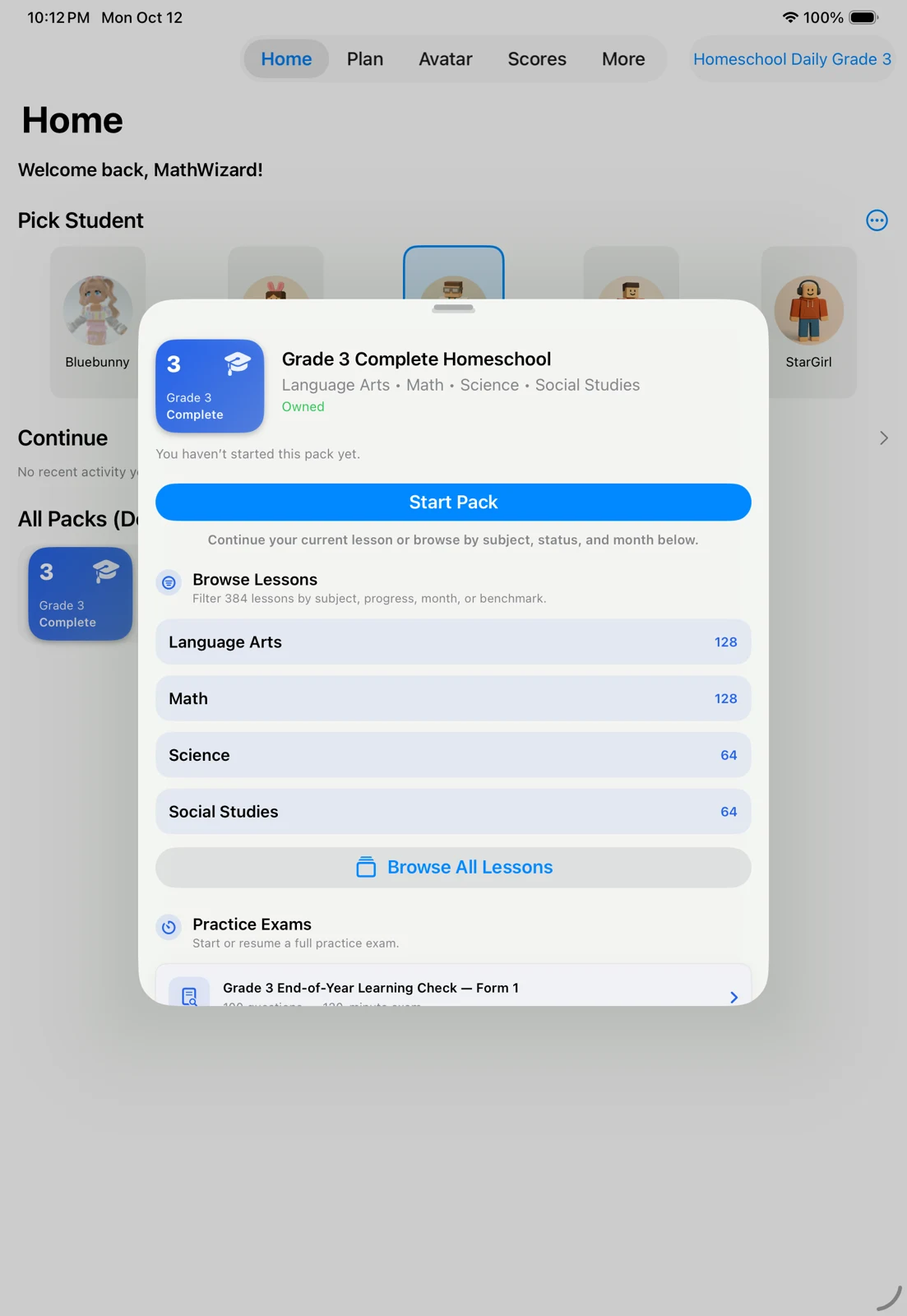
See the learning path
Grade 3 app example: organized subjects and lessons.
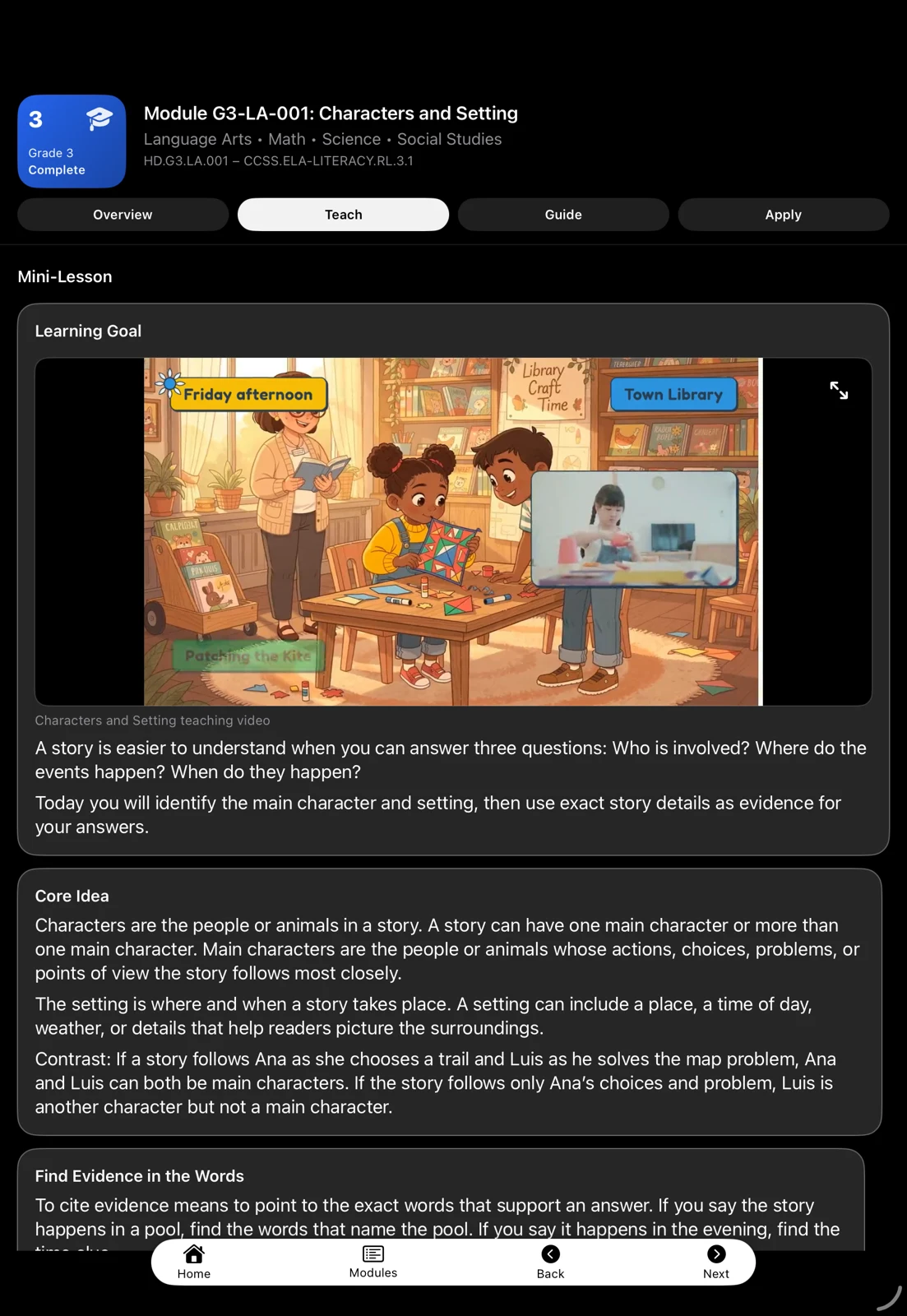
Learn one idea at a time
Grade 3 app example: a lesson on characters and setting.
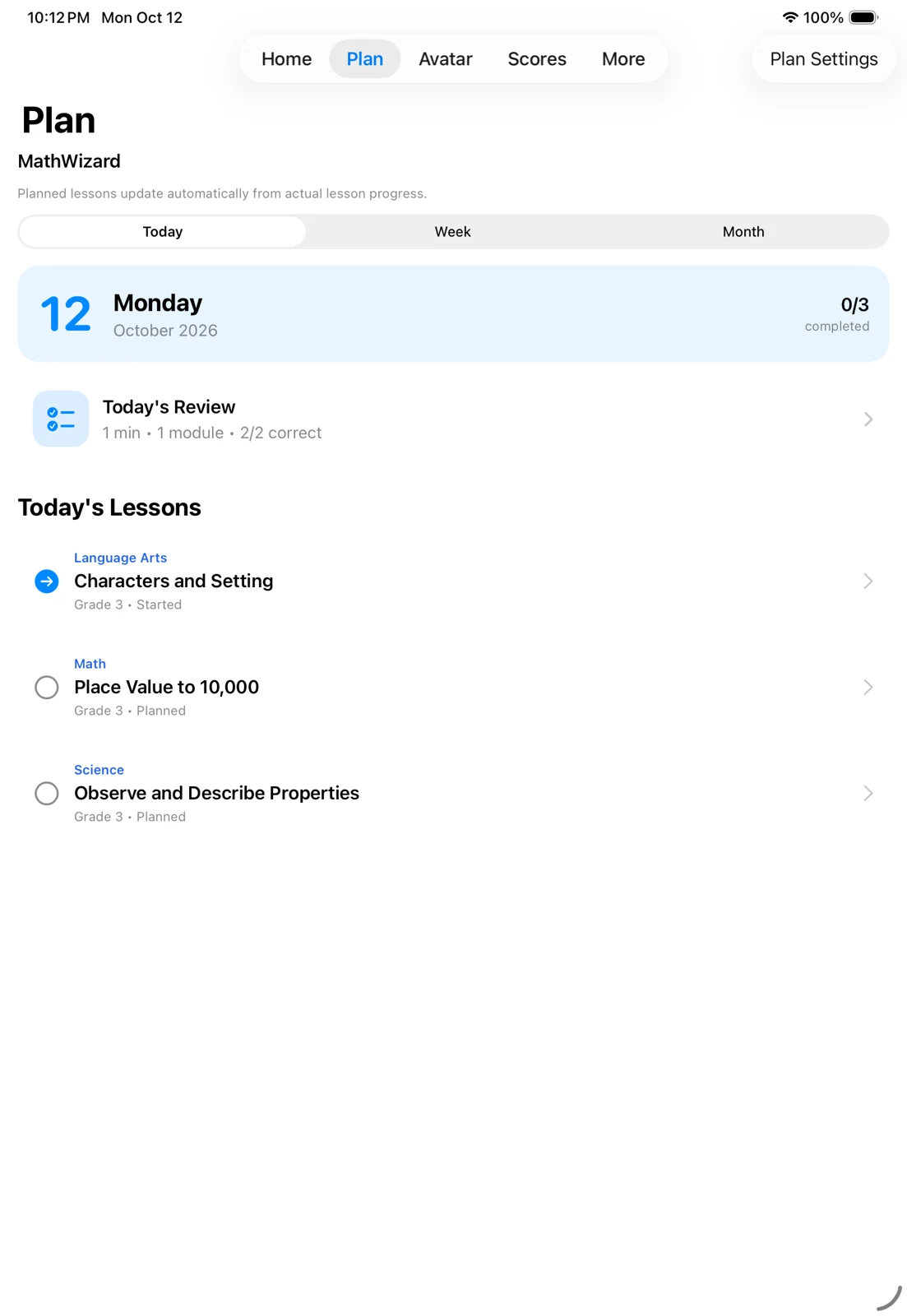
Make room for a daily routine
Grade 3 app example: the daily learning plan.

Keep a record of progress
Grade 3 app example: learning portfolio tools.
FROM CART TO CONFIDENCE
Your next steps are simple.
-
01
Get the app
Install the app for your chosen pack. Available store links are on its product page.
-
02
Choose your packs
Mix packs from different apps in one cart and pay once.
-
03
Unlock and learn
We email an itemized receipt and a license key for each pack. Enter each key in its app under More → Activation Keys.
Each license supports up to two devices at once. Website purchases unlock content in the named app; they are not a separate browser-based course.