Homeschool Daily Grade 8 / Grade 8
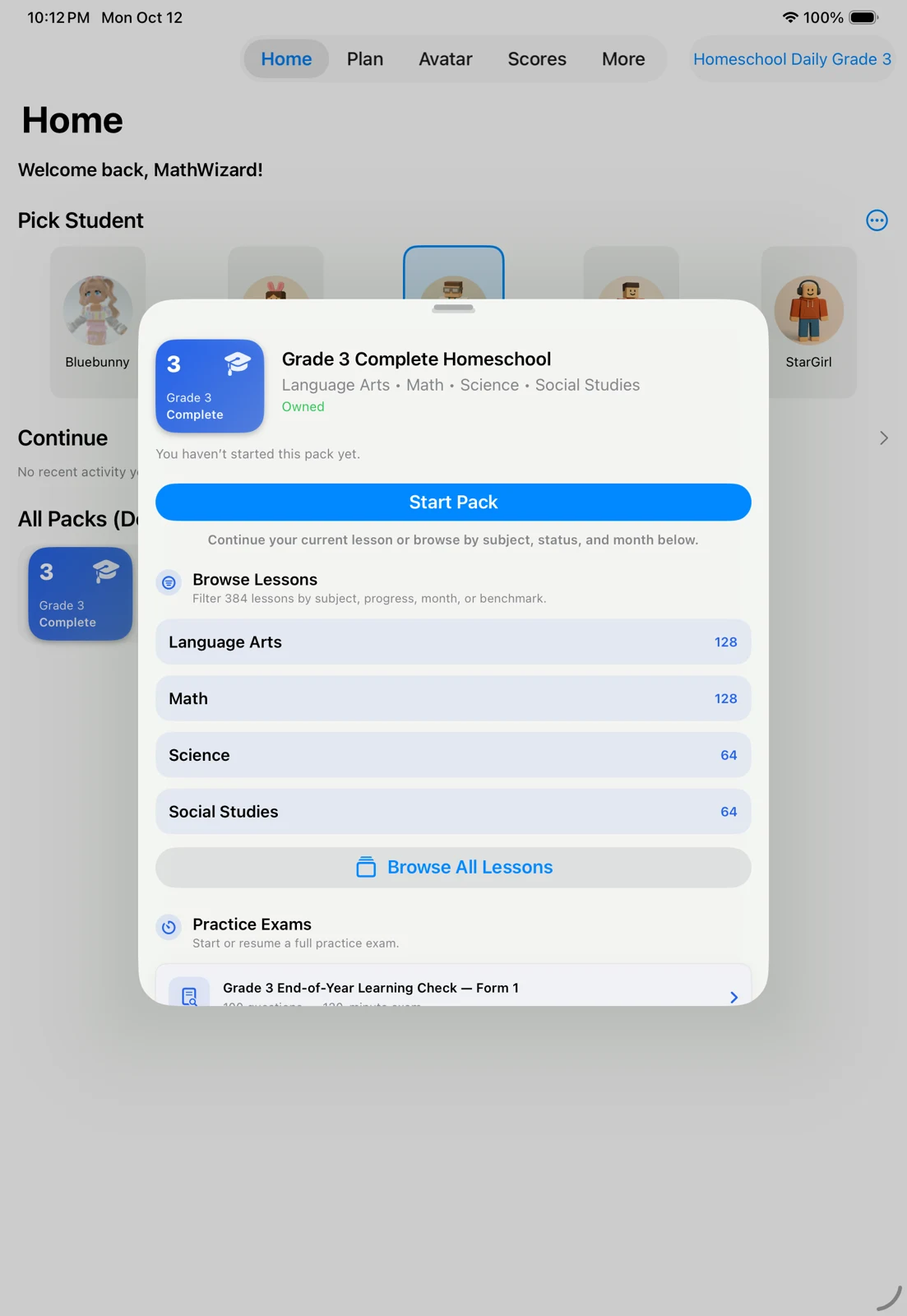
Grade 8 Complete Homeschool
A complete grade-level pack across four core subjects, with a clear lesson-by-lesson learning path.
WHAT’S INSIDE
Know what you’ll learn.
Explore the lessons in this pack.
Open a topic for a closer look.
01 Language Arts The Detail That Carries the Claim
Select the strongest textual evidence for a literary inference. Explain why a competing detail is less probative.
Topic reference: HD.G8.LA.001
02 Math Beyond Terminating Decimals
Classify a repeating decimal as rational. Express a terminating decimal as a fraction in simplest form.
Topic reference: HD.G8.MATH.001
03 Science A Question With Measurable Evidence
Define measurable variables for a physical-science investigation. Identify a condition that must remain controlled.
Topic reference: HD.G8.SCI.001
04 Language Arts Reading Beneath a Response
Infer a character's motive from dialogue and action. Support the inference with two complementary details.
Topic reference: HD.G8.LA.002
05 Math A Repeating Pattern as a Fraction
Convert a single repeating decimal block into a fraction using an equation. Verify the fraction by division.
Topic reference: HD.G8.MATH.002
06 Social Studies A Question About the Nation's Past
Formulate a historical inquiry with supporting questions. Identify evidence needed to investigate it. Explain how an inquiry question expresses a central historical concept.
Topic reference: HD.G8.SS.001
07 Language Arts A Choice Changes the Plot
Trace how a character's decision advances an event. Explain a consequence that would change without that decision.
Topic reference: HD.G8.LA.003
08 Math Two Number Families
Distinguish an irrational decimal expansion from a repeating expansion. Classify numbers within nested real-number subsets.
Topic reference: HD.G8.MATH.003
09 Science Measurements With Limits
Distinguish measurement variation from a systematic error. Report a measurement with appropriate units and precision.
Topic reference: HD.G8.SCI.002
10 Language Arts Dialogue Reveals a Difference
Analyze what an exchange reveals about two characters. Connect a line of dialogue to a later decision.
Topic reference: HD.G8.LA.004
11 Math An Exact Value or an Approximation
Distinguish an exact radical value from its decimal approximation. Explain why finite calculator output does not establish rationality.
Topic reference: HD.G8.MATH.004
12 Social Studies A Timeline With an Argument
Order related events using appropriate chronological intervals. Distinguish sequence from a claim of causation.
Topic reference: HD.G8.SS.002
13 Language Arts From Topic to Theme
Formulate a thematic statement supported by a story. Distinguish that statement from a summary of events.
Topic reference: HD.G8.LA.005
14 Math Between Two Squares
Bound a nonperfect square root between consecutive integers. Justify the bounds using integer squares.
Topic reference: HD.G8.MATH.005
15 Science Comparing Competing Explanations
Evaluate which of two explanations better fits supplied data. Identify additional evidence needed to distinguish them.
Topic reference: HD.G8.SCI.003
16 Language Arts A Theme Takes Shape
Trace a theme through an early and a late scene. Explain how a character's change develops that theme.
Topic reference: HD.G8.LA.006
17 Math Narrowing a Root
Refine a square-root estimate to tenths. Check the estimate by squaring nearby decimals.
Topic reference: HD.G8.MATH.006
18 Social Studies Reading a Historical Map
Use a map's date legend and scale to support a spatial claim. Identify information the map cannot establish.
Topic reference: HD.G8.SS.003
19 Language Arts A Summary Without Judgment
Compose an objective summary of a literary passage. Exclude personal evaluation while retaining essential events.
Topic reference: HD.G8.LA.007
20 Math Ordering Mixed Forms
Compare a fraction with an estimated irrational value. Place mixed real-number forms in increasing order.
Topic reference: HD.G8.MATH.007
21 Science An Investigation Worth Revising
Identify a flaw in an experimental comparison. Revise the plan to produce more useful evidence.
Topic reference: HD.G8.SCI.004
22 Language Arts Two Plausible Readings
Compare the evidence for two interpretations of a character. Defend the more strongly supported interpretation.
Topic reference: HD.G8.LA.008
23 Math Distance With an Irrational Measure
Locate an irrational distance approximately on a number line. Report a context-appropriate approximation with an explicit precision.
Topic reference: HD.G8.MATH.008
24 Social Studies More Than One Cause
Distinguish contributing causes from an immediate trigger. Explain a relationship among causes of a historical change. Construct a sequenced causal explanation that acknowledges its evidentiary limits.
Topic reference: HD.G8.SS.004
25 Language Arts Finding the Strongest Support
Select evidence that most directly supports an informational inference. Explain the evidentiary weakness of an unrelated fact.
Topic reference: HD.G8.LA.009
26 Math Multiplying Powers
Derive the product rule for equal bases from factors. Simplify a product using integer exponents.
Topic reference: HD.G8.MATH.009
27 Science Describing Motion Precisely
Determine average speed from measured distance and time. Distinguish speed from a change in direction.
Topic reference: HD.G8.SCI.005
28 Language Arts A Central Idea in Motion
State an informational text's central idea precisely. Trace its development through supporting sections.
Topic reference: HD.G8.LA.010
29 Math Dividing Powers
Derive the quotient rule for equal nonzero bases. Simplify a quotient without changing its base.
Topic reference: HD.G8.MATH.010
30 Social Studies Native Nations and Homelands
Compare relationships between two Native nations and their environments. Explain why regional diversity rules out a single Native experience.
Topic reference: HD.G8.SS.005
31 Language Arts Details With Different Jobs
Distinguish illustration from explanation in supporting details. Explain how each develops the central idea.
Topic reference: HD.G8.LA.011
32 Math Zero and Negative Powers
Explain why a nonzero base to power zero equals one. Rewrite a negative integer power as a reciprocal.
Topic reference: HD.G8.MATH.011
33 Science Balanced Does Not Mean Still
Use a net-force model to distinguish balanced from unbalanced forces. Explain constant motion under balanced forces.
Topic reference: HD.G8.SCI.006
34 Language Arts An Objective Informational Summary
Summarize a complex informational passage without opinion. Preserve the relative importance of its ideas.
Topic reference: HD.G8.LA.012
35 Math Power of a Power
Apply the power-of-a-power rule. Distinguish a power of a product from a sum raised to a power.
Topic reference: HD.G8.MATH.012
36 Social Studies Encounters With Unequal Consequences
Compare perspectives on early colonial encounters. Explain how access to power shaped recorded accounts. Explain how a source creator's perspective shaped the information recorded.
Topic reference: HD.G8.SS.006
37 Language Arts People, Ideas, and Events
Trace how an idea influences a documented event. Explain how that event changes a person's later response.
Topic reference: HD.G8.LA.013
38 Math Undoing a Square
Solve x squared equals a positive rational number. Verify both signed solutions by substitution.
Topic reference: HD.G8.MATH.013
39 Science Changing Motion, Changing Evidence
Use data to relate net force to change in motion at fixed mass. Use data to relate mass to motion change at fixed net force.
Topic reference: HD.G8.SCI.007
40 Language Arts An Analogy That Clarifies
Explain how an analogy distinguishes unfamiliar ideas. Identify a limit of the comparison.
Topic reference: HD.G8.LA.014
41 Math Undoing a Cube
Solve x cubed equals a rational number. Explain the sign of a real cube root.
Topic reference: HD.G8.MATH.014
42 Social Studies Labor and Colonial Economies
Explain differences among colonial labor systems including enslavement. Connect a regional economic pattern to geography.
Topic reference: HD.G8.SS.007
43 Language Arts A Chain of Connections
Analyze a relationship among individuals and events in a text. Support the relationship with explicit details.
Topic reference: HD.G8.LA.015
44 Math Roots in Measurement
Find a side from a square's area. Find a cube edge from its volume.
Topic reference: HD.G8.MATH.015
45 Science Two Objects in a Collision
Represent equal opposite interaction forces on two different objects. Apply the interaction principle to a collision-safety design.
Topic reference: HD.G8.SCI.008
46 Language Arts Checking a Broad Conclusion
Evaluate whether selected details support a summary claim. Revise the claim to fit the text's actual scope.
Topic reference: HD.G8.LA.016
47 Math When a Root Is Not Rational
Identify a square equation with irrational real solutions. Represent its solutions exactly and approximately.
Topic reference: HD.G8.MATH.016
48 Social Studies An Atlantic World of Exchange
Trace a movement of people goods or ideas across the Atlantic. Explain a consequence for more than one affected community.
Topic reference: HD.G8.SS.008
49 Language Arts Meaning From the Surroundings
Infer a word's meaning from surrounding syntax and context. Verify the inference with an appropriate reference entry.
Topic reference: HD.G8.LA.017
50 Math Writing Very Large Quantities
Express a large measured quantity in scientific notation. Interpret the coefficient and exponent in its magnitude.
Topic reference: HD.G8.MATH.017
51 Science A Force Across a Gap
Use evidence to support the existence of noncontact forces. Describe how a field model represents interaction across space.
Topic reference: HD.G8.SCI.009
52 Language Arts A Root With Several Relatives
Use a Greek or Latin root to infer an unfamiliar word. Explain a meaning difference between related words.
Topic reference: HD.G8.LA.018
53 Math Writing Tiny Quantities
Express a small positive quantity in scientific notation. Convert a negative-exponent scientific value to ordinary notation.
Topic reference: HD.G8.MATH.018
54 Social Studies Rights and Imperial Authority
Explain a colonial dispute over political authority. Connect a grievance to a claim about rights.
Topic reference: HD.G8.SS.009
55 Language Arts When a Word Has Two Roles
Determine which sense of a multiple-meaning word fits a passage. Use part of speech to reject an unsuitable definition.
Topic reference: HD.G8.LA.019
56 Math Comparing Orders of Magnitude
Estimate how many times larger one scientific quantity is than another. Identify the dominant power of ten in a comparison.
Topic reference: HD.G8.MATH.019
57 Science Changing Distance in an Electric Interaction
Ask an investigable question about distance and electric force. Identify controls needed for a fair comparison.
Topic reference: HD.G8.SCI.010
58 Language Arts A Figure Beyond the Literal
Interpret a figure of speech in context. Explain the effect of its nonliteral meaning.
Topic reference: HD.G8.LA.020
59 Math Choosing a Sensible Unit
Select a unit that produces a readable scientific measurement. Explain how unit choice changes the written coefficient.
Topic reference: HD.G8.MATH.020
60 Social Studies From Protest to Independence
Trace how selected events escalated imperial conflict. Distinguish a cause of independence from a later justification.
Topic reference: HD.G8.SS.010
61 Language Arts The Weight of a Connotation
Compare connotations of words with similar denotations. Choose a word whose connotation matches an intended tone.
Topic reference: HD.G8.LA.021
62 Math Products at Different Scales
Multiply quantities written in scientific notation. Normalize a product whose coefficient exceeds ten.
Topic reference: HD.G8.MATH.021
63 Science Strength of a Magnetic Interaction
Analyze evidence relating magnetic interaction strength to a changed factor. Distinguish a measured effect from a model of its cause.
Topic reference: HD.G8.SCI.011
64 Language Arts An Allusion's Contribution
Explain the meaning of an allusion using a supplied original context note. Analyze its effect on a passage's meaning.
Topic reference: HD.G8.LA.022
65 Math Ratios Across Scales
Divide quantities expressed in scientific notation. Interpret the quotient with its resulting unit.
Topic reference: HD.G8.MATH.022
66 Social Studies A Declaration and Its Limits
Analyze a founding statement's argument about government. Compare its principles with unequal rights at the time.
Topic reference: HD.G8.SS.011
67 Language Arts Technical Words in Context
Determine a domain-specific term from an explanation. Use that term accurately in an original explanatory sentence.
Topic reference: HD.G8.LA.023
68 Math Adding Small Measurements
Rewrite scientific quantities with a shared exponent. Add their coefficients and renormalize the result.
Topic reference: HD.G8.MATH.023
69 Science Mapping an Invisible Interaction
Plan an investigation that detects a magnetic field. Use observations to support a field-based explanation.
Topic reference: HD.G8.SCI.012
70 Language Arts Verifying a Vocabulary Choice
Consult a reference for pronunciation or usage information. Revise a word choice that misrepresents the intended meaning.
Topic reference: HD.G8.LA.024
71 Math Reading a Calculator's Exponent
Interpret E notation on a calculator display. Check whether a computed scientific result has a plausible magnitude.
Topic reference: HD.G8.MATH.024
72 Social Studies War From Several Positions
Compare perspectives of Patriots Loyalists and affected Native communities. Explain how the conflict's outcome altered political authority.
Topic reference: HD.G8.SS.012
73 Language Arts A Verb Form Acting as a Noun
Identify a gerund's function in a sentence. Distinguish a gerund from a finite verb.
Topic reference: HD.G8.LA.025
74 Math An Equation With Groups
Expand a rational-coefficient linear expression correctly. Combine like terms while preserving equivalence.
Topic reference: HD.G8.MATH.025
75 Science Attraction Between Masses
Construct an argument that gravity is attractive. Relate the strength of attraction qualitatively to interacting masses.
Topic reference: HD.G8.SCI.013
76 Language Arts Participles That Describe
Identify a participial phrase's modifying role. Place that phrase beside its intended referent.
Topic reference: HD.G8.LA.026
77 Math Unknowns on Both Sides
Solve a linear equation with variables on both sides. Verify the solution in the original equation.
Topic reference: HD.G8.MATH.026
78 Social Studies The Confederation's Dilemma
Explain a governance problem under the Articles of Confederation. Connect the problem to debate over federal power.
Topic reference: HD.G8.SS.013
79 Language Arts Infinitives With Different Jobs
Explain an infinitive's function as noun adjective or adverb. Revise a sentence to make that function clear.
Topic reference: HD.G8.LA.027
80 Math Clearing Fraction Coefficients
Multiply every equation term by a common denominator. Solve the resulting equivalent linear equation.
Topic reference: HD.G8.MATH.027
81 Science Distance in a Gravitational System
Compare gravitational interactions at different separations. Identify the controlled variables needed for the comparison.
Topic reference: HD.G8.SCI.014
82 Language Arts Choosing Active or Passive
Distinguish active from passive voice. Choose a voice that emphasizes the intended participant.
Topic reference: HD.G8.LA.028
83 Math Finding a Broken Step
Identify the first nonequivalent step in a linear solution. Repair that step with a valid inverse operation.
Topic reference: HD.G8.MATH.028
84 Social Studies Designing Divided Power
Distinguish legislative executive and judicial powers. Explain an interaction that checks another branch. Compare decision procedures in a civic association and representative government.
Topic reference: HD.G8.SS.014
85 Language Arts Mood and the Speaker's Purpose
Distinguish indicative imperative and interrogative moods. Construct a sentence whose mood fits its purpose.
Topic reference: HD.G8.LA.029
86 Math One Value Works
Recognize a linear equation with exactly one solution. Explain how the simplified equation identifies that value.
Topic reference: HD.G8.MATH.029
87 Science Energy in a Changed Position
Model how relative position changes a system's potential energy. Define the system boundary for that model.
Topic reference: HD.G8.SCI.015
88 Language Arts Conditions and Hypotheticals
Distinguish conditional from subjunctive constructions. Use an appropriate form for a hypothetical situation.
Topic reference: HD.G8.LA.030
89 Math No Value Works
Recognize a contradiction after valid simplification. Explain why a contradictory equation has no solution.
Topic reference: HD.G8.MATH.030
90 Social Studies Federal and State Authority
Distinguish delegated reserved and shared governmental responsibilities. Apply federalism to a state-neutral institutional example.
Topic reference: HD.G8.SS.015
91 Language Arts Repairing a Shift
Identify an inappropriate shift in voice or mood. Revise the shift while preserving intended meaning.
Topic reference: HD.G8.LA.031
92 Math Every Value Works
Recognize an identity after valid simplification. Explain why an identity has infinitely many solutions.
Topic reference: HD.G8.MATH.031
93 Science Fields and Stored Energy
Compare energy changes in gravitational and magnetic arrangements. Explain why potential energy belongs to a system of interacting objects.
Topic reference: HD.G8.SCI.016
94 Language Arts A Pause or an Omission
Use a comma dash or ellipsis for an intended pause or omission. Explain how the chosen punctuation affects reading.
Topic reference: HD.G8.LA.032
95 Math A Constraint From a Situation
Translate a contextual equality into a linear equation. Interpret the solution or lack of solution in that situation.
Topic reference: HD.G8.MATH.032
96 Social Studies Debating Ratification
Compare Federalist and Anti-Federalist concerns. Use evidence to explain the role of a bill of rights in ratification.
Topic reference: HD.G8.SS.016
97 Language Arts A Narrator's Limited View
Identify information unavailable to a narrator. Explain how the limitation affects reader interpretation.
Topic reference: HD.G8.LA.033
98 Math Proportional or Merely Increasing
Test a table for a constant output-to-input ratio. Distinguish proportional growth from a constant added amount.
Topic reference: HD.G8.MATH.033
99 Science Mass and Motion Energy
Use data to relate kinetic energy to mass at fixed speed. Explain why the speed condition matters.
Topic reference: HD.G8.SCI.017
100 Language Arts What the Reader Knows First
Analyze a knowledge difference between reader and character. Explain how that difference creates suspense or humor.
Topic reference: HD.G8.LA.034
101 Math A Unit Rate on a Graph
Identify a unit rate as slope on a proportional graph. Interpret the graph's origin in context.
Topic reference: HD.G8.MATH.034
102 Social Studies Rights in a Constitutional System
Explain the role of constitutional protections in limiting government. Distinguish a protected liberty from a policy preference.
Topic reference: HD.G8.SS.017
103 Language Arts An Ironic Turn
Explain a discrepancy between expectation and outcome. Connect the discrepancy to a story's point of view.
Topic reference: HD.G8.LA.035
104 Math Comparing Two Rates
Compare rates represented in different forms. Justify which proportional relationship grows faster.
Topic reference: HD.G8.MATH.035
105 Science Speed Has a Stronger Effect
Use a graph to describe the speed-kinetic-energy relationship. Distinguish the speed relationship from direct proportionality.
Topic reference: HD.G8.SCI.018
106 Language Arts Words That Shift the Mood
Analyze how a word pattern shapes literary tone. Support the analysis with precise language evidence.
Topic reference: HD.G8.LA.036
107 Math Choosing Between Rate Models
Construct a proportional equation from context. Explain the units of its constant of proportionality.
Topic reference: HD.G8.MATH.036
108 Social Studies Due Process and Equal Protection
Distinguish fair legal procedures from equal treatment requirements. Apply the distinction to a historical civic scenario.
Topic reference: HD.G8.SS.018
109 Language Arts How a Poem Is Built
Analyze how stanza arrangement develops an idea. Explain the effect of a structural turn.
Topic reference: HD.G8.LA.037
110 Math Rise and Run
Compute slope from two points on a nonvertical line. Preserve the sign when subtracting coordinates consistently.
Topic reference: HD.G8.MATH.037
111 Science Tracking an Energy Transfer
Use evidence to argue that a kinetic-energy change involves transfer. Identify the interacting objects in the transfer.
Topic reference: HD.G8.SCI.019
112 Language Arts Two Forms, One Concern
Compare the structures of a poem and a story. Explain how each structure supports meaning.
Topic reference: HD.G8.LA.038
113 Math Why the Slope Stays Fixed
Use similar right triangles to justify constant slope. Explain why different runs give equal rise-to-run ratios.
Topic reference: HD.G8.MATH.038
114 Social Studies How a Legal Dispute Moves
Describe the roles of trial and appellate review. Distinguish a factual finding from review of a legal question.
Topic reference: HD.G8.SS.019
115 Language Arts A Scene Placed Earlier
Analyze the effect of a flashback on understanding. Explain what would change under chronological ordering.
Topic reference: HD.G8.LA.039
116 Math A Line Through the Origin
Derive y equals mx from a slope triangle. Connect the equation to proportional change.
Topic reference: HD.G8.MATH.039
117 Science An Energy Account for a Motion System
Represent energy before and after a motion event. Explain an apparent energy loss using transfer beyond the chosen boundary.
Topic reference: HD.G8.SCI.020
118 Language Arts Form and Meaning Together
Support a claim about the relationship between literary structure and theme. Compare a plausible alternative arrangement with the original.
Topic reference: HD.G8.LA.040
119 Math Moving the Line Up
Derive y equals mx plus b using a vertical intercept. Distinguish the roles of m and b on a graph.
Topic reference: HD.G8.MATH.040
120 Social Studies Changing the Constitutional Rules
Explain the constitutional amendment process at a structural level. Compare amendment with ordinary legislation.
Topic reference: HD.G8.SS.020
121 Language Arts A Situation Worth Entering
Establish a narrative situation and point of view. Introduce a character through a purposeful detail.
Topic reference: HD.G8.LA.041
122 Math One Output per Input
Determine whether a mapping defines a function. Explain why repeated outputs can still be allowed.
Topic reference: HD.G8.MATH.041
123 Science Temperature and Amount of Matter
Compare temperature changes for different masses of the same material. Explain why temperature alone does not measure total thermal energy.
Topic reference: HD.G8.SCI.021
124 Language Arts An Event Sequence With Purpose
Plan a logical narrative sequence. Identify a turning point that changes the character's choices.
Topic reference: HD.G8.LA.042
125 Math A Table That Breaks the Rule
Identify an input assigned conflicting outputs. Repair a relation to satisfy the function condition.
Topic reference: HD.G8.MATH.042
126 Social Studies A Republic Faces Foreign Pressure
Explain a foreign-policy challenge in the early republic. Connect a government response to its stated purpose.
Topic reference: HD.G8.SS.021
127 Language Arts Dialogue That Does Work
Write dialogue that advances action or develops character. Revise dialogue that merely repeats narration.
Topic reference: HD.G8.LA.043
128 Math Reading a Function Graph
Determine whether a graph assigns one output to each input. Interpret an ordered pair as an input-output statement.
Topic reference: HD.G8.MATH.043
129 Science Material Matters in Heating
Plan a heating comparison that controls mass and energy input. Use data to compare temperature response across materials.
Topic reference: HD.G8.SCI.022
130 Language Arts Pacing a Crucial Moment
Expand a key moment with selective detail. Compress less important time without losing coherence.
Topic reference: HD.G8.LA.044
131 Math Functions Without a Formula
Describe a function given by a verbal rule. Generate a table that follows the rule consistently.
Topic reference: HD.G8.MATH.044
132 Social Studies Expansion and Sovereignty
Analyze a territorial expansion from multiple affected perspectives. Use a historical map to establish the spatial change.
Topic reference: HD.G8.SS.022
133 Language Arts Description With Precision
Use sensory language to convey a setting. Replace a vague description with a specific image.
Topic reference: HD.G8.LA.045
134 Math Two Tables, Two Rates
Determine rates of change from two function tables. Compare the rates with consistent input units.
Topic reference: HD.G8.MATH.045
135 Science Slowing a Thermal Transfer
Apply thermal-transfer principles to specify an insulation design. Identify measurable criteria for comparing designs.
Topic reference: HD.G8.SCI.023
136 Language Arts Moving Across Time
Use transitions to signal changes in time or setting. Repair an unclear shift in an event sequence.
Topic reference: HD.G8.LA.046
137 Math An Equation Meets a Graph
Compare a function's initial value across algebraic and graphical forms. Compare its rate with another representation.
Topic reference: HD.G8.MATH.046
138 Social Studies Who Could Participate
Explain changes and exclusions in early nineteenth-century political participation. Distinguish expanded voting access from universal suffrage.
Topic reference: HD.G8.SS.023
139 Language Arts An Ending That Follows
Write a conclusion that follows from the narrative experience. Connect the ending to an established character change.
Topic reference: HD.G8.LA.047
140 Math A Story Meets a Table
Translate a verbal linear rule into a table. Compare that rule with a second tabulated function.
Topic reference: HD.G8.MATH.047
141 Science Testing an Insulation Improvement
Evaluate insulation test results against a shared criterion. Revise a design using evidence from the comparison.
Topic reference: HD.G8.SCI.024
142 Language Arts Revising a Complete Narrative
Revise a narrative for coherent development and appropriate style. Explain a revision's effect on its intended audience.
Topic reference: HD.G8.LA.048
143 Math Choosing at a Specified Input
Evaluate two differently represented functions at the same input. Explain why the larger initial value need not determine the choice.
Topic reference: HD.G8.MATH.048
144 Social Studies Removal and Resistance
Analyze the causes and consequences of Native removal policy. Use evidence to explain Native resistance and sovereignty claims.
Topic reference: HD.G8.SS.024
145 Language Arts The Job of a Paragraph
Analyze how a paragraph's sentences develop a key idea. Identify a sentence whose role changes the argument's direction.
Topic reference: HD.G8.LA.049
146 Math Constant Differences
Identify a linear function by constant rate of change. Distinguish constant rate from a constant output ratio.
Topic reference: HD.G8.MATH.049
147 Science Describing a Repeating Wave
Measure wavelength on a periodic wave representation. Identify amplitude relative to the rest position.
Topic reference: HD.G8.SCI.025
148 Language Arts Purpose Behind the Arrangement
Explain how an author orders information for a purpose. Support the explanation with structural evidence.
Topic reference: HD.G8.LA.050
149 Math A Curve From Squaring
Construct a small table for a square-area relationship. Explain why that relationship is not linear.
Topic reference: HD.G8.MATH.050
150 Social Studies Transportation Changes a Market
Explain how transportation improvements altered trade connections. Use geographic evidence to identify uneven benefits.
Topic reference: HD.G8.SS.025
151 Language Arts A Position With an Acknowledgment
Identify an author's point of view. Analyze how the author responds to a conflicting viewpoint.
Topic reference: HD.G8.LA.051
152 Math Straight-Line Equations
Recognize y equals mx plus b as a linear function. Explain why a horizontal line is also a function.
Topic reference: HD.G8.MATH.051
153 Science Amplitude and Transported Energy
Use a mathematical representation to relate amplitude and energy. Compare waves while holding the medium and other conditions fixed.
Topic reference: HD.G8.SCI.026
154 Language Arts Tracing the Reasoning
Trace an argument from claim through reasons to evidence. Identify a missing connection in that chain.
Topic reference: HD.G8.LA.052
155 Math A Counterexample to Linearity
Provide inputs that disprove a claimed constant rate. Classify a function from graphical and tabular evidence.
Topic reference: HD.G8.MATH.052
156 Social Studies Work Moves Into Factories
Compare labor arrangements before and during industrialization. Explain a consequence for workers or households. Explain how increased productivity can raise average living standards without guaranteeing equal gains.
Topic reference: HD.G8.SS.026
157 Language Arts Relevant Is Not Sufficient
Distinguish relevant evidence from sufficient evidence. Explain what additional support a claim requires.
Topic reference: HD.G8.LA.053
158 Math Build a Rule From Two Values
Determine a linear rate from two input-output pairs. Determine the initial value using that rate.
Topic reference: HD.G8.MATH.053
159 Science Frequency in a Wave Record
Determine frequency from cycles during a measured interval. Distinguish frequency from wavelength in a representation.
Topic reference: HD.G8.SCI.027
160 Language Arts A Reason That Does Not Follow
Identify unsound reasoning in an argument. Explain the mismatch between the reason and conclusion.
Topic reference: HD.G8.LA.054
161 Math A Starting Amount and a Change
Construct a linear model from a context. Interpret each parameter using the context's units.
Topic reference: HD.G8.MATH.054
162 Social Studies Regional Economies and Enslavement
Explain how slavery supported an interconnected regional economy. Distinguish economic explanation from moral justification.
Topic reference: HD.G8.SS.027
163 Language Arts Language That Tilts a Claim
Analyze how word choices shape an informational text's tone. Distinguish evaluative language from neutral description.
Topic reference: HD.G8.LA.055
164 Math A Decreasing Quantity
Model a constant decrease with negative slope. Identify where the model ceases to make contextual sense.
Topic reference: HD.G8.MATH.055
165 Science Reading Two Wave Models
Compare wave properties using consistent axes. Explain which claims cannot be supported by a static profile alone.
Topic reference: HD.G8.SCI.028
166 Language Arts Judging the Whole Argument
Evaluate an argument's reasoning and evidentiary support. Qualify the evaluation when only part of the claim is established.
Topic reference: HD.G8.LA.056
167 Math Check a Proposed Model
Test a linear model against supplied observations. Explain the meaning of a mismatch between model and data.
Topic reference: HD.G8.MATH.056
168 Social Studies Reformers and Their Strategies
Compare strategies used by two antebellum reform movements. Evaluate how institutions constrained their efforts. Analyze a reform policy's purpose implementation and consequences in two settings.
Topic reference: HD.G8.SS.028
169 Language Arts A Claim You Can Defend
Formulate a focused arguable claim. Distinguish the claim from an uncontested fact.
Topic reference: HD.G8.LA.057
170 Math Describing a Changing Rate
Describe intervals where a quantity increases or decreases. Distinguish steep change from a large quantity.
Topic reference: HD.G8.MATH.057
171 Science A Wave Meets a Boundary
Model reflection absorption and transmission at a boundary. Relate a material's response to the observed wave behavior.
Topic reference: HD.G8.SCI.029
172 Language Arts Reasons in a Logical Order
Organize reasons into a coherent argument. Explain the ordering's effect on a reader.
Topic reference: HD.G8.LA.058
173 Math A Pause in a Journey
Interpret a horizontal interval on a contextual graph. Distinguish constant position from constant nonzero speed.
Topic reference: HD.G8.MATH.058
174 Social Studies The Expansion of Slavery
Explain how territorial expansion intensified conflict over slavery. Connect a political compromise to the conflict it attempted to manage.
Topic reference: HD.G8.SS.029
175 Language Arts Evidence With an Explanation
Integrate relevant evidence into an argument paragraph. Explain how that evidence supports its reason.
Topic reference: HD.G8.LA.059
176 Math Sketching a Story's Graph
Sketch a qualitative graph from a verbal description. Label transitions where the behavior changes.
Topic reference: HD.G8.MATH.059
177 Science Sound and Light Travel Differently
Compare medium requirements for sound and light. Use the comparison to explain a transmission limit.
Topic reference: HD.G8.SCI.030
178 Language Arts Giving a Counterclaim a Fair Hearing
State a counterclaim accurately. Distinguish acknowledgment from agreement.
Topic reference: HD.G8.LA.060
179 Math Comparing Parts of a Curve
Identify intervals of linear and nonlinear change. Support an interval description with visible graph features.
Topic reference: HD.G8.MATH.060
180 Social Studies Arguments Before Secession
Compare competing constitutional claims in the sectional crisis. Identify whose rights each argument included or excluded.
Topic reference: HD.G8.SS.030
181 Language Arts Responding With Evidence
Respond to a counterclaim using reasoned evidence. Avoid misrepresenting the opposing position.
Topic reference: HD.G8.LA.061
182 Math Where Two Conditions Meet
Interpret an intersection as a solution to both equations. Verify its ordered pair in each equation.
Topic reference: HD.G8.MATH.061
183 Science Encoding a Message
Represent information as a simple digital signal. Distinguish discrete encoding from continuous variation.
Topic reference: HD.G8.SCI.031
184 Language Arts Connections Between Ideas
Use transitions to clarify relationships among claims and reasons. Revise a misleading logical transition.
Topic reference: HD.G8.LA.062
185 Math A Graph With No Meeting Point
Identify parallel distinct lines as a system with no solution. Relate their slopes and intercepts to that conclusion.
Topic reference: HD.G8.MATH.062
186 Social Studies From Secession to War
Explain slavery's central role in secession using historical evidence. Distinguish an immediate military trigger from underlying causes.
Topic reference: HD.G8.SS.031
187 Language Arts A Formal Voice and a Conclusion
Maintain an appropriate formal style in an argument. Write a conclusion that follows from the argument.
Topic reference: HD.G8.LA.063
188 Math Two Rules for One Line
Identify coincident lines as infinitely many common solutions. Explain why two equation forms can represent one constraint.
Topic reference: HD.G8.MATH.063
189 Science Why Digital Signals Can Be More Reliable
Integrate technical information about signal transmission. Support a claim about the reliability of digitized information.
Topic reference: HD.G8.SCI.032
190 Language Arts Revising an Argument's Weak Point
Identify the weakest support in an argument draft. Revise that support using better reasoning or evidence.
Topic reference: HD.G8.LA.064
191 Math Estimating an Intersection
Estimate a system's solution from a scaled graph. State the limits of graphical precision.
Topic reference: HD.G8.MATH.064
192 Social Studies War Aims and Emancipation
Trace changes in Union war aims and emancipation policy. Explain the role of enslaved people's actions in the struggle for freedom.
Topic reference: HD.G8.SS.032
193 Language Arts An Older Pattern in a New Story
Compare an original modern narrative with a supplied traditional-story summary. Analyze how the modern version transforms a theme or character pattern.
Topic reference: HD.G8.LA.065
194 Math Substituting an Expression
Substitute one equation's expression into the other equation. Solve the resulting equation for one coordinate.
Topic reference: HD.G8.MATH.065
195 Science Patterns in the Fossil Record
Analyze fossil data for changes in organism diversity over time. Identify a limitation caused by an incomplete fossil record.
Topic reference: HD.G8.SCI.033
196 Language Arts An Adaptation's Choice
Compare a written scene with an original storyboard adaptation. Evaluate the effect of a deliberate change in presentation.
Topic reference: HD.G8.LA.066
197 Math Recovering the Other Coordinate
Determine the second coordinate from a solved first coordinate. Verify the ordered pair in both original equations.
Topic reference: HD.G8.MATH.066
198 Social Studies Geography and Wartime Strategy
Use geographic evidence to explain a strategic decision. Distinguish a map-supported claim from speculation.
Topic reference: HD.G8.SS.033
199 Language Arts Words Become Sound
Analyze how an original audio performance changes emphasis. Compare the performance's interpretation with textual evidence.
Topic reference: HD.G8.LA.067
200 Math Eliminating a Variable
Add equivalent equations to eliminate one variable. Recover and check the system's solution.
Topic reference: HD.G8.MATH.067
201 Science Structures That Suggest Relationships
Compare anatomical similarities across modern and fossil organisms. Use shared structures as evidence for evolutionary relationships.
Topic reference: HD.G8.SCI.034
202 Language Arts An Illustration's Interpretation
Compare an original illustration's choices with a literary description. Explain which textual features the illustration emphasizes.
Topic reference: HD.G8.LA.068
203 Math Choosing a System Strategy
Select graphing substitution or elimination for a system. Justify the selection from the equations' structure.
Topic reference: HD.G8.MATH.068
204 Social Studies Resources and the War Effort
Compare material advantages and constraints of the opposing war efforts. Explain why an advantage did not guarantee an immediate outcome.
Topic reference: HD.G8.SS.034
205 Language Arts Two Accounts Disagree
Identify conflicting facts in two informational accounts. Distinguish factual disagreement from different emphasis.
Topic reference: HD.G8.LA.069
206 Math When Two Plans Cost the Same
Write two linear cost rules from a situation. Find and interpret their break-even point.
Topic reference: HD.G8.MATH.069
207 Science Developmental Evidence
Interpret patterns in supplied embryological-development diagrams. Explain how those patterns contribute to common-ancestry evidence.
Topic reference: HD.G8.SCI.035
208 Language Arts Tracing an Interpretation Gap
Analyze why two accounts interpret shared evidence differently. Support the analysis with each account's reasoning.
Topic reference: HD.G8.LA.070
209 Math Two Totals, Two Unknowns
Represent two contextual totals as simultaneous equations. Interpret each variable with its unit.
Topic reference: HD.G8.MATH.070
210 Social Studies Civilian Lives During War
Compare wartime experiences across two civilian groups. Support the comparison with contextualized sources. Infer an uncertain source's likely audience using corroborating historical evidence.
Topic reference: HD.G8.SS.035
211 Language Arts A Medium's Strength and Limit
Evaluate advantages of text and visual media for a particular topic. Identify information obscured by one medium.
Topic reference: HD.G8.LA.071
212 Math An Intersection Outside the Context
Solve a contextual system. Reject a solution that violates a stated domain constraint.
Topic reference: HD.G8.MATH.071
213 Science Combining Lines of Evolutionary Evidence
Compare conclusions supported by fossil and anatomical data. Distinguish a supported relationship from a claim beyond the evidence.
Topic reference: HD.G8.SCI.036
214 Language Arts A Comparative Claim With Support
Write a comparison grounded in evidence from both sources. Avoid attributing a difference unsupported by the supplied materials.
Topic reference: HD.G8.LA.072
215 Math Defending a System Model
Explain why two equations encode distinct conditions. Check whether the solution satisfies the original story.
Topic reference: HD.G8.MATH.072
216 Social Studies Victory and Unfinished Questions
Explain a major consequence of the war's outcome. Identify a political or social question left unresolved in 1865.
Topic reference: HD.G8.SS.036
217 Language Arts Defining an Explanatory Focus
Introduce a focused explanatory topic. Select concepts needed for its intended audience.
Topic reference: HD.G8.LA.073
218 Math Sliding a Figure
Describe a translation using direction and distance. Verify preservation of segment lengths after translation.
Topic reference: HD.G8.MATH.073
219 Science Variation Before a Change
Identify heritable variation within a population. Distinguish an existing trait difference from an acquired response.
Topic reference: HD.G8.SCI.037
220 Language Arts Grouping Related Ideas
Organize explanatory information into meaningful categories. Use headings when they improve navigation.
Topic reference: HD.G8.LA.074
221 Math Turning Around a Point
Describe a rotation by center angle and direction. Identify corresponding angles before and after rotation.
Topic reference: HD.G8.MATH.074
222 Social Studies Freedom Written Into Law
Explain the distinct purposes of the Reconstruction amendments. Connect each purpose to a postwar problem.
Topic reference: HD.G8.SS.037
223 Language Arts Facts That Develop an Explanation
Develop an idea with relevant facts and concrete details. Explain why a chosen example clarifies the idea.
Topic reference: HD.G8.LA.075
224 Math Reflecting Across a Line
Construct reflected points at equal perpendicular distances. Verify angle measures in the reflected figure.
Topic reference: HD.G8.MATH.075
225 Science A Trait in a Particular Environment
Explain how a trait can affect survival and reproduction. Qualify the advantage by the environmental conditions.
Topic reference: HD.G8.SCI.038
226 Language Arts Defining Without Going in Circles
Write a useful definition of a technical concept. Add an example that distinguishes it from a related concept.
Topic reference: HD.G8.LA.076
227 Math What Rigid Moves Preserve
Compare parallel lines before and after a rigid motion. Explain preservation of shape under a sequence of rigid moves.
Topic reference: HD.G8.MATH.076
228 Social Studies Rebuilding Political Participation
Analyze an example of Black political participation during Reconstruction. Explain an institutional condition that enabled it.
Topic reference: HD.G8.SS.038
229 Language Arts Linking an Explanation
Use transitions to clarify relationships among explanatory ideas. Repair a missing causal or comparative connection.
Topic reference: HD.G8.LA.077
230 Math Coordinates After a Slide
Apply a translation to polygon coordinates. Describe the inverse translation.
Topic reference: HD.G8.MATH.077
231 Science Populations Change Over Generations
Use mathematical data to explain changing trait proportions. Distinguish population change from change within one individual.
Topic reference: HD.G8.SCI.039
232 Language Arts Precise Language, Clear Meaning
Use domain vocabulary accurately in explanatory writing. Replace imprecise language without making the prose inaccessible.
Topic reference: HD.G8.LA.078
233 Math Coordinates in a Mirror
Determine coordinates reflected across a coordinate axis. Distinguish horizontal from vertical coordinate changes.
Topic reference: HD.G8.MATH.078
234 Social Studies Resistance to Reconstruction
Explain how violence and policy undermined Reconstruction rights. Distinguish formal rights from their enforcement.
Topic reference: HD.G8.SS.039
235 Language Arts An Ending That Synthesizes
Write a conclusion that follows from an explanation. Connect the conclusion to the significance of the topic.
Topic reference: HD.G8.LA.079
236 Math A Quarter Turn
Determine coordinates after a quarter-turn about the origin. Check rotation direction using a plotted vertex.
Topic reference: HD.G8.MATH.079
237 Science Selection Without Intention
Construct an evidence-based natural-selection explanation. Reject an explanation that assigns purposeful choice to evolution.
Topic reference: HD.G8.SCI.040
238 Language Arts Revising for a Reader
Revise an explanatory draft for development and clarity. Explain how the revision addresses an audience need.
Topic reference: HD.G8.LA.080
239 Math Proving Congruence by Motion
Describe a rigid-motion sequence mapping one figure to another. Use corresponding vertices to justify congruence.
Topic reference: HD.G8.MATH.080
240 Social Studies Jim Crow and the Struggle for Rights
Trace how segregation and disfranchisement developed after Reconstruction. Use evidence to identify resistance to those systems. Identify a limitation in the historical record by comparing different source types.
Topic reference: HD.G8.SS.040
241 Language Arts A Question Small Enough to Research
Formulate a focused research question. Generate a related question that deepens the inquiry.
Topic reference: HD.G8.LA.081
242 Math A Dilation From the Origin
Scale coordinates by a positive dilation factor. Identify whether the dilation enlarges or reduces.
Topic reference: HD.G8.MATH.081
243 Science Genes, Proteins, and Trait Changes
Use a model linking a gene change to a possible protein change. Explain why a mutation may have harmful beneficial or neutral effects.
Topic reference: HD.G8.SCI.041
244 Language Arts Searching With Precision
Choose search terms suited to an information need. Revise a search strategy after irrelevant results.
Topic reference: HD.G8.LA.082
245 Math Lengths Change, Angles Stay
Compare corresponding side ratios in similar figures. Verify that corresponding angle measures agree.
Topic reference: HD.G8.MATH.082
246 Social Studies Choices Have Opportunity Costs
Identify the opportunity cost of an economic decision. Explain a tradeoff under a stated resource constraint.
Topic reference: HD.G8.SS.041
247 Language Arts A Source's Credibility
Evaluate a source's authority and evidence. Identify a limitation relevant to the research question.
Topic reference: HD.G8.LA.083
248 Math Similarity Through a Sequence
Describe a dilation followed by rigid motions. Use that sequence to establish similarity.
Topic reference: HD.G8.MATH.083
249 Science Two Routes to Offspring
Model inheritance in sexual and asexual reproduction. Compare expected genetic variation in the offspring.
Topic reference: HD.G8.SCI.042
250 Language Arts Notes in Your Own Words
Paraphrase a source idea accurately without copying its phrasing. Separate a personal inference from a source statement.
Topic reference: HD.G8.LA.084
251 Math Finding a Missing Similar Length
Determine an unknown corresponding length using scale factor. Check that all corresponding ratios agree.
Topic reference: HD.G8.MATH.084
252 Social Studies Prices and Market Responses
Explain how a change in supply or demand can affect price. Distinguish movement along a relationship from a changed condition. Explain how a cost imposed on outsiders can affect a market outcome.
Topic reference: HD.G8.SS.042
253 Language Arts Quoting for a Reason
Select a brief quotation that serves an analytical purpose. Integrate the quotation with a clear attribution.
Topic reference: HD.G8.LA.085
254 Math Angles Made by a Transversal
Identify corresponding and alternate interior angles. Use parallelism to justify an unknown angle measure.
Topic reference: HD.G8.MATH.085
255 Science People Influence Inherited Traits
Gather information on a technology that changes desired traits. Distinguish selective breeding from environmental training.
Topic reference: HD.G8.SCI.043
256 Language Arts Following a Citation Trail
Create a citation using a consistent standard format. Connect an in-text reference to its source record.
Topic reference: HD.G8.LA.086
257 Math A Triangle's Three Corners
Give an informal parallel-line argument for the triangle angle sum. Determine a missing interior angle from that sum.
Topic reference: HD.G8.MATH.086
258 Social Studies Saving, Borrowing, and Risk
Compare borrowing and saving choices using costs and risks. Explain why a higher promised return need not be a better choice. Explain how an interest-rate change can influence borrowing and investment decisions.
Topic reference: HD.G8.SS.043
259 Language Arts Conflicting Evidence in Research
Compare conflicting source findings. Adjust a research claim to reflect unresolved evidence.
Topic reference: HD.G8.LA.087
260 Math An Exterior Angle's Partners
Explain the relationship between an exterior angle and remote interior angles. Use the relationship to determine an unknown measure.
Topic reference: HD.G8.MATH.087
261 Science Evaluating a Trait Technology
Assess evidence for a claimed outcome of a genetic technology. Identify a scientific limitation or tradeoff in the claim.
Topic reference: HD.G8.SCI.044
262 Language Arts A Short Evidence-Based Inquiry
Synthesize findings from multiple sources to answer a question. Identify a follow-up question raised by the research.
Topic reference: HD.G8.LA.088
263 Math Why Two Angles Establish Similarity
Use the triangle angle sum to identify a third matching angle. Give an informal argument for angle-angle similarity.
Topic reference: HD.G8.MATH.088
264 Social Studies Economic Policy and Public Goals
Compare economic-policy options using benefits and costs. Explain how a policy can affect groups differently.
Topic reference: HD.G8.SS.044
265 Language Arts A Sentence Worth Keeping
Revise a fragment or run-on within a draft. Explain how the repair clarifies the intended relationship.
Topic reference: HD.G8.LA.089
266 Math Squares Along a Right Triangle
Identify the hypotenuse relative to a right angle. Explain the Pythagorean relationship with areas.
Topic reference: HD.G8.MATH.089
267 Science Reading Relative Geologic Time
Order events from a geologic cross-section. Explain how a cross-cutting feature constrains relative age.
Topic reference: HD.G8.SCI.045
268 Language Arts A Clear Referent
Resolve an ambiguous pronoun reference. Preserve agreement while revising a complex sentence.
Topic reference: HD.G8.LA.090
269 Math An Area-Based Argument
Describe how rearranged areas support the Pythagorean theorem. Identify what remains equal in the rearrangement.
Topic reference: HD.G8.MATH.090
270 Social Studies Industry, Migration, and Cities
Explain how industrial opportunities influenced migration and urbanization. Identify a consequence for receiving communities.
Topic reference: HD.G8.SS.045
271 Language Arts Modifiers Beside Their Meaning
Identify a misplaced or dangling modifier. Revise its placement to remove unintended meaning.
Topic reference: HD.G8.LA.091
272 Math Testing the Converse
Use side squares to test whether a triangle is right. Distinguish the theorem from its converse.
Topic reference: HD.G8.MATH.091
273 Science Fossils Connect Separated Layers
Use fossil evidence to correlate rock layers. Distinguish relative ordering from numerical age.
Topic reference: HD.G8.SCI.046
274 Language Arts A Deliberate Voice Shift
Evaluate whether a voice shift serves a stated purpose. Repair an unintentional shift without changing the facts.
Topic reference: HD.G8.LA.092
275 Math A Triangle That Fails the Test
Show that a proposed right triangle violates the square relationship. Explain why a sketch alone cannot establish a right angle.
Topic reference: HD.G8.MATH.092
276 Social Studies Workers Organize
Analyze a labor dispute from worker and employer perspectives. Explain how power affected the available strategies. Compare the economic roles of corporations nonprofit organizations and labor unions.
Topic reference: HD.G8.SS.046
277 Language Arts Mood Across a Paragraph
Maintain a consistent grammatical mood when purpose is unchanged. Explain an intentional mood change in a request or hypothesis.
Topic reference: HD.G8.LA.093
278 Math Finding a Diagonal
Calculate a rectangle's diagonal with the Pythagorean theorem. State an exact and a rounded length.
Topic reference: HD.G8.MATH.093
279 Science A Planet Changed Over Vast Time
Explain how geoscience processes reshape Earth at different scales. Use evidence to connect a landform to its formation process.
Topic reference: HD.G8.SCI.047
280 Language Arts Punctuation for Emphasis
Choose punctuation that conveys an intended emphasis. Distinguish an omission mark from a hesitation mark.
Topic reference: HD.G8.LA.094
281 Math Finding a Missing Leg
Rearrange the Pythagorean equation for a leg. Check that the leg is shorter than the hypotenuse.
Topic reference: HD.G8.MATH.094
282 Social Studies Reform and Government Responsibility
Compare Progressive reform approaches to a social problem. Evaluate the limits of a reform's reach.
Topic reference: HD.G8.SS.047
283 Language Arts An Accurate Final Copy
Correct spelling and capitalization using reference tools. Apply consistent quotation formatting in a draft.
Topic reference: HD.G8.LA.095
284 Math A Right Triangle in Space
Identify a useful right triangle in a three-dimensional object. Calculate a missing distance using successive right triangles.
Topic reference: HD.G8.MATH.095
285 Science Continents and Ocean-Floor Evidence
Analyze fossil rock and seafloor data for past plate motion. Explain why converging evidence strengthens a reconstruction.
Topic reference: HD.G8.SCI.048
286 Language Arts Editing With an Explanation
Prioritize revisions that most improve clarity. Explain a grammatical revision using appropriate terminology.
Topic reference: HD.G8.LA.096
287 Math Choosing the Relevant Triangle
Extract a right triangle from a contextual diagram. Justify which labeled measurements belong in the equation.
Topic reference: HD.G8.MATH.096
288 Social Studies Changing the Electorate
Trace an expansion of voting rights in the early twentieth century. Distinguish legal change from equal access in practice.
Topic reference: HD.G8.SS.048
289 Language Arts Preparing to Contribute
Prepare a discussion claim with relevant textual evidence. Identify an issue needing clarification before discussion.
Topic reference: HD.G8.LA.097
290 Math Distance Between Two Points
Construct perpendicular legs between two coordinate points. Compute the straight-line distance from those legs.
Topic reference: HD.G8.MATH.097
291 Science Weather Records and Climate Evidence
Distinguish short-term variability from a long-term climate trend. Select a time scale appropriate to a climate claim.
Topic reference: HD.G8.SCI.049
292 Language Arts Rules That Support Inquiry
Establish discussion roles and decision rules. Explain how a rule supports equitable participation.
Topic reference: HD.G8.LA.098
293 Math Distance Across Quadrants
Calculate coordinate differences across signed axes. Use their squares to determine distance.
Topic reference: HD.G8.MATH.098
294 Social Studies A World War and an American Decision
Explain factors influencing U.S. entry into World War I. Connect a domestic consequence to wartime mobilization.
Topic reference: HD.G8.SS.049
295 Language Arts A Question That Moves Thinking
Pose a question connecting multiple speakers' ideas. Distinguish a probing question from a repetition request.
Topic reference: HD.G8.LA.099
296 Math Comparing Two Routes
Compare a grid route with a direct distance. Explain why the direct path is no longer than the grid route.
Topic reference: HD.G8.MATH.099
297 Science Explaining Rising Global Temperature
Ask a question connecting observed temperature change to causal evidence. Evaluate evidence for factors in recent global warming.
Topic reference: HD.G8.SCI.050
298 Language Arts Responding to a New Idea
Respond to another speaker with relevant evidence. Acknowledge information that changes an earlier view.
Topic reference: HD.G8.LA.100
299 Math Checking a Coordinate Shape
Calculate side lengths of a coordinate polygon. Use those lengths to evaluate a geometric claim.
Topic reference: HD.G8.MATH.100
300 Social Studies Prosperity With Uneven Foundations
Analyze uneven economic conditions during the 1920s. Distinguish broad growth from prosperity for every group. Use employment price production and income data to evaluate a historical economy.
Topic reference: HD.G8.SS.050
301 Language Arts Listening for Sound Support
Identify a speaker's claim and supporting reasons. Evaluate the relevance of the speaker's evidence.
Topic reference: HD.G8.LA.101
302 Math Stacking Circular Layers
Explain cylinder volume as base area times height. Calculate volume from radius and perpendicular height.
Topic reference: HD.G8.MATH.101
303 Science Unequal Heating Moves Air and Water
Model how unequal heating and rotation drive circulation. Explain how circulation redistributes thermal energy.
Topic reference: HD.G8.SCI.051
304 Language Arts Noticing Irrelevant Evidence
Identify evidence that does not support a spoken claim. Explain the logical gap without attacking the speaker.
Topic reference: HD.G8.LA.102
305 Math Diameter in a Volume Problem
Convert a stated diameter to radius before calculating volume. Express the result in cubic units.
Topic reference: HD.G8.MATH.102
306 Social Studies Depression and Government Response
Explain interacting causes of the Great Depression at an introductory level. Compare New Deal responses by their intended purposes. Explain how unemployment and falling prices affect different household groups.
Topic reference: HD.G8.SS.051
307 Language Arts Synthesizing a Discussion
Summarize points of agreement and disagreement. Qualify a conclusion in light of new discussion evidence.
Topic reference: HD.G8.LA.103
308 Math Recovering a Cylinder Height
Solve a cylinder-volume equation for height. Check the result by recomputing volume.
Topic reference: HD.G8.MATH.103
309 Science Testing a Climate Explanation
Compare a proposed climate explanation with multiple datasets. Identify uncertainty without treating all explanations as equally supported.
Topic reference: HD.G8.SCI.052
310 Language Arts Adapting Spoken Language
Adapt speech to a formal or informal context. Use standard English when the speaking task calls for it.
Topic reference: HD.G8.LA.104
311 Math A Capacity Model
Model a cylindrical container's capacity. Choose an appropriate precision for a practical measurement.
Topic reference: HD.G8.MATH.104
312 Social Studies World War II and Civic Contradictions
Explain U.S. mobilization and participation in World War II. Analyze a wartime rights restriction against constitutional principles.
Topic reference: HD.G8.SS.052
313 Language Arts A Message for a Particular Audience
Plan a presentation with a focused claim or finding. Select details suited to the audience's knowledge.
Topic reference: HD.G8.LA.105
314 Math A Cone and Its Cylinder
Calculate cone volume using one third of a matching cylinder. Distinguish slant height from perpendicular height.
Topic reference: HD.G8.MATH.105
315 Science Resources Have Geologic Histories
Explain uneven resource distribution using geologic processes. Use a map as evidence for a resource-location claim.
Topic reference: HD.G8.SCI.053
316 Language Arts Evidence in a Clear Order
Organize spoken reasoning in a coherent sequence. Connect a supporting detail explicitly to the main finding.
Topic reference: HD.G8.LA.106
317 Math Space Inside a Sphere
Calculate sphere volume from its radius. Convert diameter information before substitution.
Topic reference: HD.G8.MATH.106
318 Social Studies A Divided Postwar World
Explain a major source of U.S.-Soviet conflict. Use a map to describe the geographic reach of the rivalry.
Topic reference: HD.G8.SS.053
319 Language Arts Reading a Message's Purpose
Analyze a media presentation's informational or persuasive purpose. Identify a social or commercial motive supported by evidence.
Topic reference: HD.G8.LA.107
320 Math Comparing Curved Solids
Compare volumes of solids with shared dimensions. Explain why equal heights do not imply equal volumes.
Topic reference: HD.G8.MATH.107
321 Science Patterns in Natural Hazards
Analyze historical hazard data to identify risk patterns. Explain the limits of using past data for a forecast.
Topic reference: HD.G8.SCI.054
322 Language Arts A Visual That Adds Meaning
Select a visual that clarifies a presentation's evidence. Explain why decorative media would not serve that purpose.
Topic reference: HD.G8.LA.108
323 Math A Composite Container
Decompose a container into supported curved solids. Combine component volumes without double counting overlap.
Topic reference: HD.G8.MATH.108
324 Social Studies Security and Civil Liberties
Analyze a Cold War debate over security and rights. Distinguish an evidence-based concern from an unsupported accusation.
Topic reference: HD.G8.SS.054
325 Language Arts Delivering With Precision
Use appropriate volume pronunciation and pacing in a presentation. Revise delivery after audience feedback.
Topic reference: HD.G8.LA.109
326 Math Plotting Paired Observations
Construct a scatterplot from paired numerical data. Label axes with variables and units.
Topic reference: HD.G8.MATH.109
327 Science Monitoring an Environmental Impact
Design a method to monitor a specified human environmental impact. Define a measurable criterion for evaluating a mitigation strategy.
Topic reference: HD.G8.SCI.055
328 Language Arts Publishing With Technology
Use a digital tool to present writing and connect relevant information. Attribute linked sources accurately.
Topic reference: HD.G8.LA.110
329 Math Describing a Data Cloud
Describe positive negative or absent association. Identify a cluster in a scatterplot.
Topic reference: HD.G8.MATH.110
330 Social Studies Civil Rights Through Collective Action
Compare legal and direct-action strategies in the civil rights movement. Explain how collective action influenced institutions.
Topic reference: HD.G8.SS.055
331 Language Arts Collaborating on a Revision
Use shared feedback to revise a digital composition. Distinguish accepted revisions from unresolved suggestions.
Topic reference: HD.G8.LA.111
332 Math An Unusual Observation
Identify an outlier relative to the overall data pattern. Explain how it may affect a pattern description.
Topic reference: HD.G8.MATH.111
333 Science Population, Consumption, and Earth Systems
Construct an argument linking consumption to environmental effects. Distinguish population size from per-person resource use.
Topic reference: HD.G8.SCI.056
334 Language Arts Evaluating a Finished Presentation
Evaluate the sufficiency of a presentation's reasoning and evidence. Recommend a specific improvement to its media support.
Topic reference: HD.G8.LA.112
335 Math A Pattern With Limits
Distinguish linear from nonlinear association. Explain why association alone cannot establish causation.
Topic reference: HD.G8.MATH.112
336 Social Studies Change and Continuity in Equal Rights
Compare a civil rights achievement with an unresolved barrier. Support a continuity-and-change claim across Reconstruction and the twentieth century.
Topic reference: HD.G8.SS.056
337 Language Arts Planning Independent Reading
Set a purpose for reading a challenging literary text. Choose a monitoring strategy for comprehension breakdowns.
Topic reference: HD.G8.LA.113
338 Math A Line Through the Cloud
Draw an informal line fitting a linear data pattern. Balance deviations on either side of the line visually.
Topic reference: HD.G8.MATH.113
339 Science Defining a Design Challenge
Specify measurable criteria for an engineering problem. Identify constraints including relevant environmental impacts.
Topic reference: HD.G8.SCI.057
340 Language Arts Tracking a Long Text
Trace an idea across separated sections of a longer text. Support the connection with accurately located evidence.
Topic reference: HD.G8.LA.114
341 Math Comparing Candidate Fits
Evaluate two proposed fit lines by closeness to data. Reject a fit driven only by one outlier.
Topic reference: HD.G8.MATH.114
342 Social Studies The United States in Global Networks
Use a trade-flow map to explain an economic connection. Identify a benefit and a vulnerability in interdependence.
Topic reference: HD.G8.SS.057
343 Language Arts Reading an Unfamiliar Informational Form
Interpret the organization of a complex informational text. Use its structure to locate relevant evidence independently.
Topic reference: HD.G8.LA.115
344 Math Reading Model Deviations
Compare observed outputs with values predicted by a fit line. Describe the size and direction of deviations.
Topic reference: HD.G8.MATH.115
345 Science Comparing Feasible Designs
Evaluate competing solutions using a systematic criteria matrix. Explain a tradeoff between two feasible designs.
Topic reference: HD.G8.SCI.058
346 Language Arts Resolving a Comprehension Problem
Identify a specific obstacle in a challenging passage. Apply rereading or reference checking to resolve it.
Topic reference: HD.G8.LA.116
347 Math When a Line Is a Poor Choice
Identify a scatterplot poorly described by a straight line. Explain the visible pattern that undermines a linear fit.
Topic reference: HD.G8.MATH.116
348 Social Studies Migration Across Different Scales
Explain a migration pattern using human and environmental factors. Distinguish a regional pattern from every migrant's experience. Compare cultural and environmental characteristics across two world regions.
Topic reference: HD.G8.SS.058
349 Language Arts A Brief Analytical Response
Write a concise response grounded in reading evidence. Distinguish analysis from unsupported personal reaction.
Topic reference: HD.G8.LA.117
350 Math Predicting From a Data Model
Use a fitted linear equation to predict an output. Distinguish a prediction from an observed value.
Topic reference: HD.G8.MATH.117
351 Science Evidence Before a Design Decision
Identify test evidence needed to compare proposed solutions. Distinguish performance evidence from a designer's assertion.
Topic reference: HD.G8.SCI.059
352 Language Arts Writing Over Time
Plan an extended writing task with checkpoints. Use a revision checkpoint to improve evidentiary support.
Topic reference: HD.G8.LA.118
353 Math Slope With Data Units
Interpret fitted slope as expected change per input unit. Explain its sign in the data context.
Topic reference: HD.G8.MATH.118
354 Social Studies Environment and Settlement Choices
Analyze how environment and technology influence settlement. Explain a human modification that changes the relationship. Evaluate how long-term human environmental change influences spatial patterns of cooperation or conflict.
Topic reference: HD.G8.SS.059
355 Language Arts Writing Under a Short Time Limit
Produce a focused evidence-based response within a short session. Check that its reasoning answers the stated task.
Topic reference: HD.G8.LA.119
356 Math An Intercept With a Caveat
Interpret a model's intercept when zero is meaningful. Explain when the intercept lies outside a useful context.
Topic reference: HD.G8.MATH.119
357 Science A Justified Design Selection
Select a solution using the stated criteria and evidence. Explain why another solution was not selected under those constraints.
Topic reference: HD.G8.SCI.060
358 Language Arts Reflecting on Reading Growth
Evaluate a reading strategy using evidence from completed work. Set a specific goal for independent high-school reading.
Topic reference: HD.G8.LA.120
359 Math Predicting Beyond the Observations
Distinguish interpolation from extrapolation. Explain why a far extrapolation needs caution.
Topic reference: HD.G8.MATH.120
360 Social Studies A Map Can Shape a Story
Compare two geographic representations of the same issue. Explain how scale or selected data changes the apparent pattern.
Topic reference: HD.G8.SS.060
361 Language Arts Choosing a Capstone Inquiry
Frame a manageable question requiring more than one source. Explain the question's significance to an intended audience.
Topic reference: HD.G8.LA.121
362 Math Organizing Two Categories
Construct a two-way table from categorical observations. Compute row and column totals consistently.
Topic reference: HD.G8.MATH.121
363 Science Learning From Test Differences
Analyze tests to identify effective features of competing designs. Identify a feature combination worth retesting.
Topic reference: HD.G8.SCI.061
364 Language Arts Planning the Evidence
Identify the types of evidence needed to answer an inquiry. Plan a source search that can reveal competing perspectives.
Topic reference: HD.G8.LA.122
365 Math Comparing Within Groups
Calculate a relative frequency within a specified group. Choose the denominator matching the stated condition.
Topic reference: HD.G8.MATH.122
366 Social Studies Investigating a Public Issue
Gather relevant information from multiple sources about a civic issue. Evaluate each source's origin authority and context. Explain an expert point of agreement relevant to a compelling civic question. Explain an expert point of agreement relevant to a supporting inquiry question.
Topic reference: HD.G8.SS.061
367 Language Arts Building a Source Conversation
Group source findings by agreement and conflict. Distinguish corroboration from repetition of one source.
Topic reference: HD.G8.LA.123
368 Math Evidence of Association
Compare conditional relative frequencies across groups. Use the comparison to describe possible association.
Topic reference: HD.G8.MATH.123
369 Science Modeling Before Building
Develop a model that generates useful performance data. State what the model cannot represent reliably.
Topic reference: HD.G8.SCI.062
370 Language Arts Drafting a Qualified Claim
Develop a claim proportionate to available evidence. Acknowledge a meaningful limitation in its support.
Topic reference: HD.G8.LA.124
371 Math When Counts Mislead
Explain how unequal group sizes distort raw-count comparisons. Reevaluate a claim using appropriate relative frequencies.
Topic reference: HD.G8.MATH.124
372 Social Studies A Claim With Corroboration
Develop a claim using evidence from multiple sources. Identify a limitation in the available evidence. Classify the historical source types used in a secondary interpretation. Use questions about multiple sources to identify a needed follow-up source.
Topic reference: HD.G8.SS.062
373 Language Arts Explaining Before Arguing
Write explanatory context needed to understand a capstone claim. Distinguish that context from the argument itself.
Topic reference: HD.G8.LA.125
374 Math Designing a Measurement Model
Select variables for an original linear investigation. State a reasonable domain for the model.
Topic reference: HD.G8.MATH.125
375 Science An Iteration With a Reason
Use model data to revise a design feature. Predict a measurable consequence of the revision.
Topic reference: HD.G8.SCI.063
376 Language Arts Revising With a Skeptical Reader
Revise a draft in response to a substantive counterargument. Check that every source attribution remains accurate.
Topic reference: HD.G8.LA.126
377 Math Connecting the Representations
Produce a table and graph consistent with a contextual equation. Explain how rate and initial value appear in both.
Topic reference: HD.G8.MATH.126
378 Social Studies Comparing Civic Responses
Assess individual and collective options for addressing a problem. Evaluate tradeoffs using evidence and democratic principles. Critique a civic argument's credibility using its source evidence. Critique whether an explanation's sequence and supporting details establish its conclusion.
Topic reference: HD.G8.SS.063
379 Language Arts Sharing the Inquiry
Present a capstone finding with coherent reasoning and relevant visuals. Answer an audience question using source evidence.
Topic reference: HD.G8.LA.127
380 Math Testing a Prediction Against Evidence
Compare a model prediction with a new observation. Explain a plausible limit revealed by the difference.
Topic reference: HD.G8.MATH.127
381 Science Presenting a Tested Solution
Support a final design recommendation with comparative evidence. Identify the next test needed before broader use.
Topic reference: HD.G8.SCI.064
382 Language Arts A Portfolio With Evidence of Growth
Select writing that demonstrates a specific improvement. Explain the revision decisions that produced that improvement.
Topic reference: HD.G8.LA.128
383 Math Presenting a Mathematical Case
Support a contextual conclusion with a linear model and data. Identify a limitation that constrains the conclusion.
Topic reference: HD.G8.MATH.128
384 Social Studies An Informed Action Proposal
Propose a feasible evidence-based civic action. Specify how its effects and unintended consequences could be evaluated. Apply respectful deliberation and democratic decision rules in a household or community inquiry.
Topic reference: HD.G8.SS.064
No lessons match that search.
A LOOK INSIDE
See learning in action.
Real app screens. Explore a preview, then find the pack that fits.
See the learning path
Grade 3 app example: organized subjects and lessons.

Learn one idea at a time
Grade 3 app example: a lesson on characters and setting.
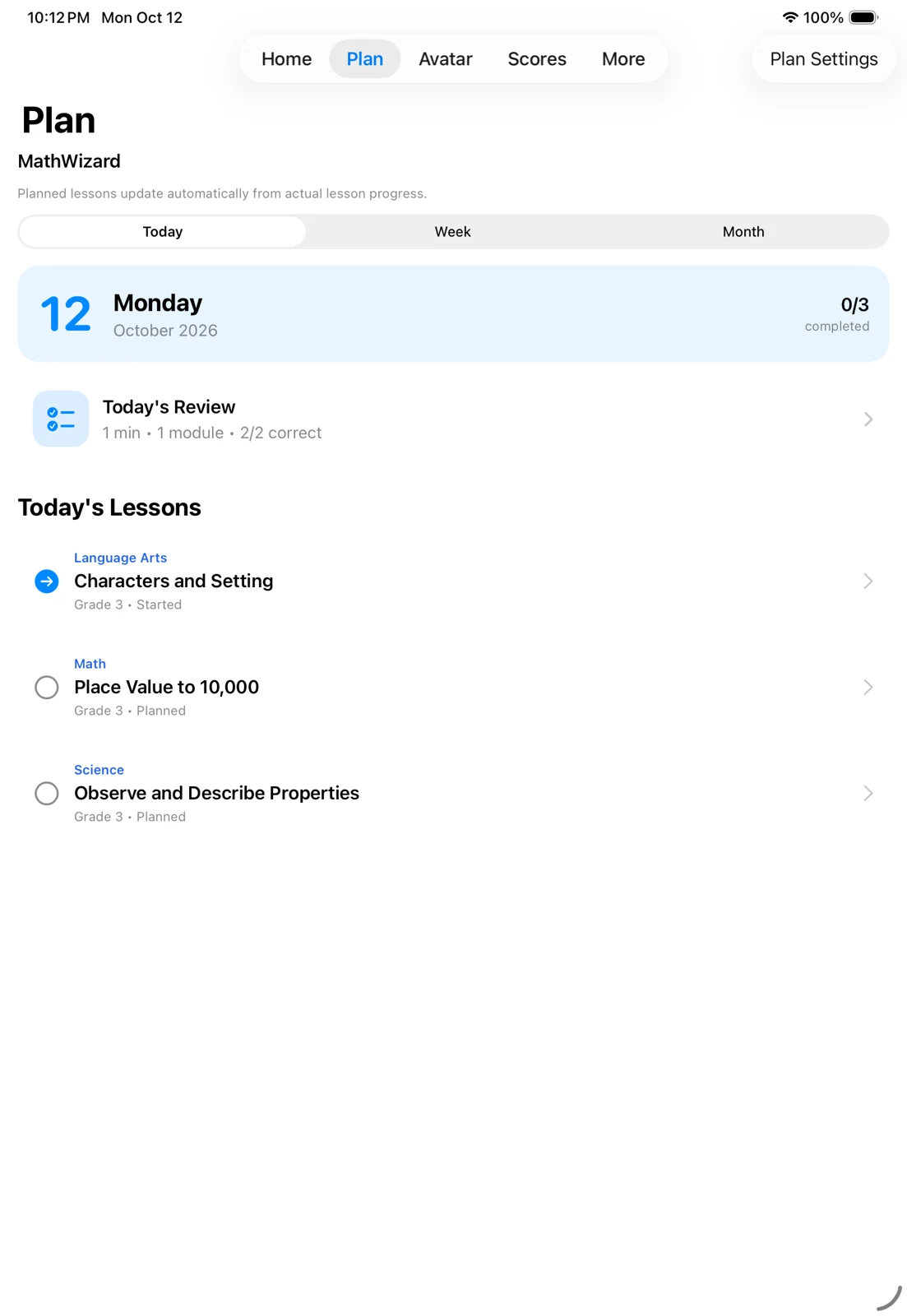
Make room for a daily routine
Grade 3 app example: the daily learning plan.

Keep a record of progress
Grade 3 app example: learning portfolio tools.
FROM CART TO CONFIDENCE
Your next steps are simple.
-
01
Get the app
Install the app for your chosen pack. Available store links are on its product page.
-
02
Choose your packs
Mix packs from different apps in one cart and pay once.
-
03
Unlock and learn
We email an itemized receipt and a license key for each pack. Enter each key in its app under More → Activation Keys.
Each license supports up to two devices at once. Website purchases unlock content in the named app; they are not a separate browser-based course.